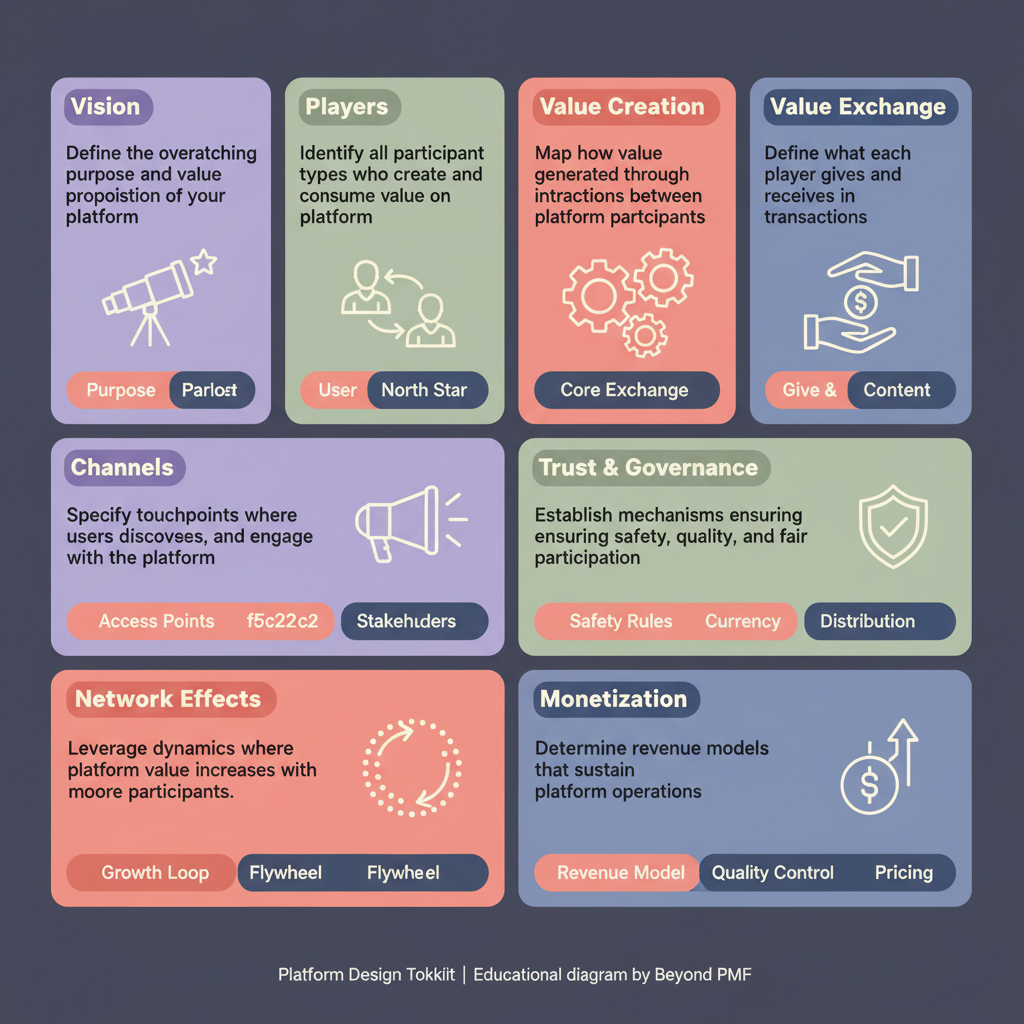
Platform Design Toolkit

The Platform Design Toolkit focuses on designing and implementing platform business models. This inherently involves establishing a clear strategic direction, defining the business model, and ensuring market alignment to create a successful platform.

The Platform Design Toolkit is a strategic tool used to create and develop platforms that facilitate exchanges between producers and consumers. It helps organizations transition from traditional, linear business models to platform-based ecosystems. The framework provides methodologies for mapping out potential interactions, defining value propositions, and designing scalable platform architectures. It is particularly beneficial for enhancing user engagement, leveraging network effects, and creating value through interconnected services.

Steps / Detailed Description

Define your core interaction: Identify the fundamental exchange or interaction that your platform will facilitate. | Map the ecosystem: Analyze and outline all stakeholders involved and their potential interactions within the platform. | Design value propositions: Create compelling value propositions for all participants in the ecosystem. | Establish governance rules: Set rules and standards that govern interactions and transactions on the platform. | Prototype and test: Develop a prototype of the platform and test it with real users to gather feedback and iterate.

Best Practices

Continuously engage with and gather feedback from platform users | Focus on achieving a critical mass of users to leverage network effects | Iterate the platform design based on user data and market trends

Pros

Facilitates scalable business models | Enhances user engagement through network effects | Provides a structured approach to ecosystem design

Cons

Complexity in managing multi-sided markets | High dependency on achieving critical mass of users | Potential for platform lock-in and reduced flexibility

When to Use

When designing a new platform-based business | When transforming a traditional business into a platform model

When Not to Use

For simple, linear business models without network effects | When rapid, short-term monetization is the primary goal

Related Frameworks

Lifecycle

Scope

Scope not defined

Maturity Level

Maturity level not specified

Time to Implement

2–4 Weeks
3–6 Months
1–2 Weeks
3–6 Months
1–2 Months
3–6 Months
1–2 Weeks
Less Than 1 Day
1–2 Weeks
Longer Than 6 Months
1–2 Weeks
Longer Than 6 Months
1–2 Weeks
3–6 Months
1–2 Weeks
1–2 Weeks
1–2 Weeks
1–2 Weeks
1–2 Days
1–2 Weeks
1–2 Weeks
1–2 Weeks
1–2 Weeks
1–2 Weeks
1–2 Weeks
3–6 Months
1–2 Weeks
1–2 Weeks
1–2 Weeks
3–6 Months
1–2 Weeks
1–2 Weeks
2–4 Weeks
1–2 Weeks
1–2 Days
1–2 Weeks
Longer Than 6 Months
3–6 Months
Longer Than 6 Months
1–2 Weeks
Longer Than 6 Months
3–6 Months
Less Than 1 Day
3–6 Months
1–2 Months
3–6 Months
Longer Than 6 Months
3–6 Months
Less Than 1 Day
1–2 Weeks
3–6 Months
3–6 Months
1–2 Weeks
3–6 Months
1–2 Weeks
1–2 Weeks
1–2 Days
1–2 Weeks
1–2 Months
Longer Than 6 Months
1–2 Weeks
Longer Than 6 Months
1–2 Weeks
3–6 Months
1–2 Weeks
Less Than 1 Day
1–2 Weeks
3–6 Months
1–2 Weeks
3–6 Months
1–2 Weeks
1–2 Weeks
Longer Than 6 Months
Less Than 1 Day
3–6 Months
Longer Than 6 Months
1–2 Months
1–2 Weeks
Longer Than 6 Months
1–2 Weeks
3–6 Months
1–2 Weeks
1–2 Weeks
3–6 Months
Less Than 1 Day
1–2 Weeks
1–2 Weeks
3–6 Months
3–6 Months
Less Than 1 Day
1–2 Weeks
Longer Than 6 Months
1–2 Months
1–2 Weeks
1–2 Weeks
1–2 Weeks
Longer Than 6 Months

Copyright Information

Autor:
Boundaryless
2016
Publication:
Boundaryless