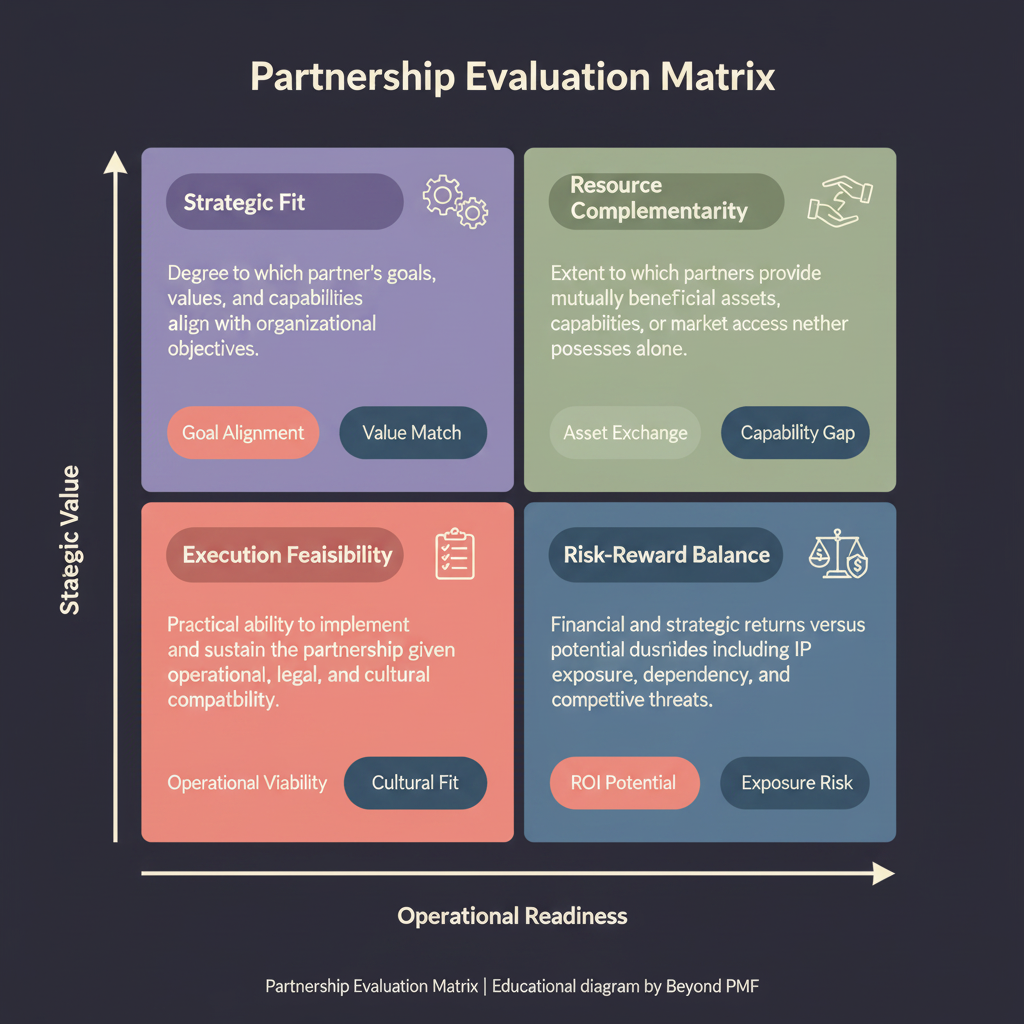
Partnership Evaluation Matrix

https://ik.imagekit.io/beyondpmf/frameworks/partnership-evaluation-matrix.png
The Partnership Evaluation Matrix primarily addresses the strategic alignment of partnerships. It helps evaluate the potential of a partnership in relation to the overall business direction, goals, and market positioning, mitigating risks associated with misaligned strategic objectives.

The Partnership Evaluation Matrix is a strategic framework designed to evaluate and measure the effectiveness and potential of business partnerships. It helps organizations identify the strengths and weaknesses of a partnership, align strategic objectives, and optimize collaborative efforts. The matrix typically considers various factors such as strategic alignment, resource sharing, and market impact, making it an essential tool for decision-makers aiming to maximize partnership value.

Steps / Detailed Description

Identify key performance indicators (KPIs) relevant to the partnership. | Rate each partnership based on predefined criteria such as financial performance, strategic alignment, and operational compatibility. | Analyze the results to identify areas of strength and improvement. | Develop action plans based on the evaluation to enhance partnership outcomes.

Best Practices

Regularly update the criteria to reflect changing business environments | Ensure transparency and communication with partners during the evaluation process | Use a combination of quantitative and qualitative data for a balanced assessment

Pros

Provides a structured approach to evaluate partnerships | Helps in identifying potential risks and opportunities within a partnership | Facilitates better strategic decision-making based on quantitative and qualitative data

Cons

Can be time-consuming to gather all necessary data | May require subjective judgments that could bias the results | Potentially overlooks non-measurable elements of partnership value

When to Use

When considering entering a new partnership | When reviewing the performance of existing partnerships

When Not to Use

When insufficient data is available to perform a thorough analysis | In highly dynamic situations where immediate decisions are necessary

Related Frameworks

Lifecycle

Not tied to a specific lifecycle stage

Scope

Scope not defined

Maturity Level

Maturity level not specified

Time to Implement

2–4 Weeks
3–6 Months
1–2 Weeks
3–6 Months
1–2 Months
3–6 Months
1–2 Weeks
Less Than 1 Day
1–2 Weeks
Longer Than 6 Months
1–2 Weeks
Longer Than 6 Months
1–2 Weeks
3–6 Months
1–2 Weeks
1–2 Weeks
1–2 Weeks
1–2 Weeks
1–2 Days
1–2 Weeks
1–2 Weeks
1–2 Weeks
1–2 Weeks
1–2 Weeks
1–2 Weeks
3–6 Months
1–2 Weeks
1–2 Weeks
1–2 Weeks
3–6 Months
1–2 Weeks
1–2 Weeks
2–4 Weeks
1–2 Weeks
1–2 Days
1–2 Weeks
Longer Than 6 Months
3–6 Months
Longer Than 6 Months
1–2 Weeks
Longer Than 6 Months
3–6 Months
Less Than 1 Day
3–6 Months
1–2 Months
3–6 Months
Longer Than 6 Months
3–6 Months
Less Than 1 Day
1–2 Weeks
3–6 Months
3–6 Months
1–2 Weeks
3–6 Months
1–2 Weeks
1–2 Weeks
1–2 Days
1–2 Weeks
1–2 Months
Longer Than 6 Months
1–2 Weeks
Longer Than 6 Months
1–2 Weeks
3–6 Months
1–2 Weeks
Less Than 1 Day
1–2 Weeks
3–6 Months
1–2 Weeks
3–6 Months
1–2 Weeks
1–2 Weeks
Longer Than 6 Months
Less Than 1 Day
3–6 Months
Longer Than 6 Months
1–2 Months
1–2 Weeks
Longer Than 6 Months
1–2 Weeks
3–6 Months
1–2 Weeks
1–2 Weeks
3–6 Months
Less Than 1 Day
1–2 Weeks
1–2 Weeks
3–6 Months
3–6 Months
Less Than 1 Day
1–2 Weeks
Longer Than 6 Months
1–2 Months
1–2 Weeks
1–2 Weeks
1–2 Weeks
Longer Than 6 Months

Copyright Information

Autor:
Public Domain
N/A
Publication:
Generic Business Tool