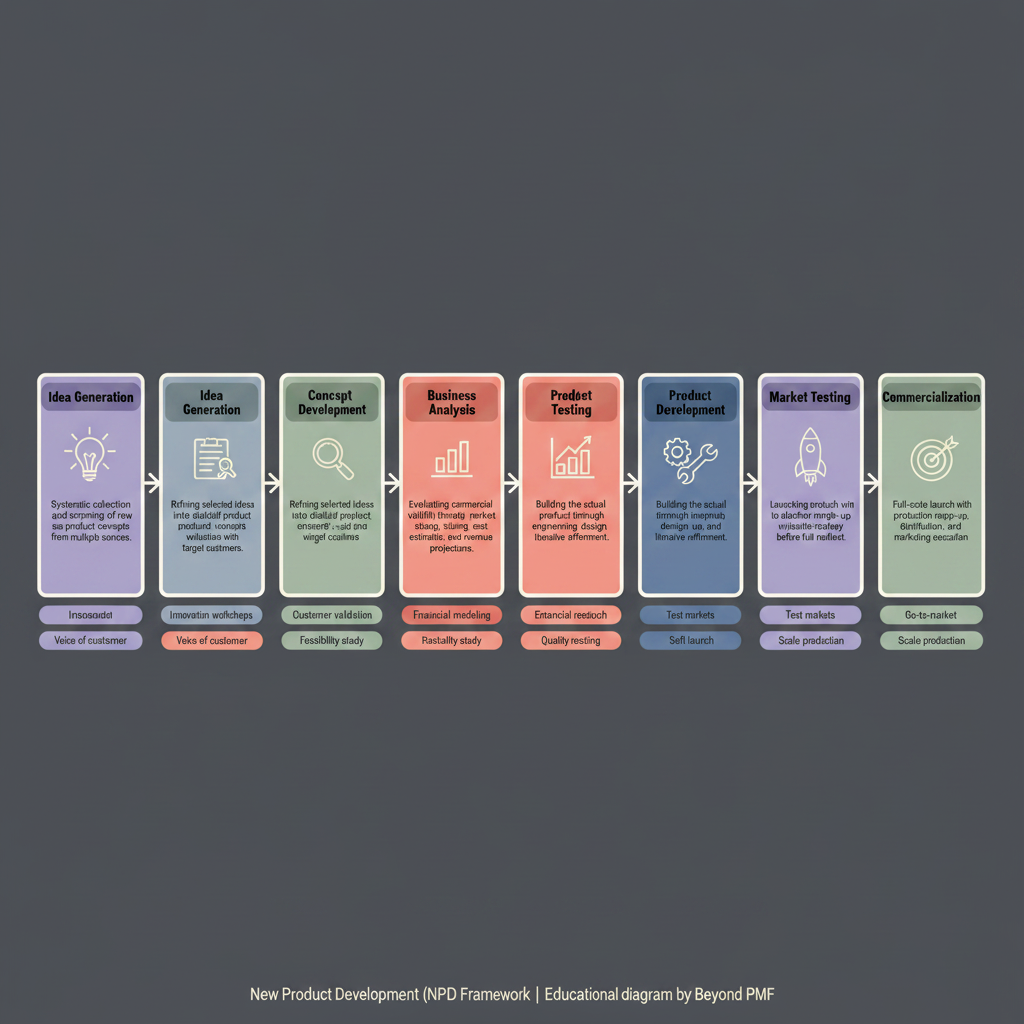
New Product Development (NPD) Framework

https://ik.imagekit.io/beyondpmf/frameworks/new-product-development-npd-framework.png
The New Product Development (NPD) Framework primarily addresses the operational friction related to the systematic processes required to move ideas through development, testing, and launch. It focuses on the workflows, handovers, and coordination needed to efficiently transform an innovative idea into a tangible product.

The New Product Development (NPD) Framework is a structured approach that guides organizations through the complex process of bringing a new product to market. It involves a series of steps that help in ideating, designing, developing, and launching new products effectively. The framework is used to align cross-functional teams, manage risks, and ensure that the product meets market needs and company goals. Its benefits include improved product success rates, better alignment with customer expectations, and optimized resource allocation.

Steps / Detailed Description

Idea Generation: Brainstorming new ideas based on market research and customer feedback. | Idea Screening: Evaluating ideas to select the most promising ones for further development. | Concept Development and Testing: Developing detailed product concepts and testing them with target customers. | Business Analysis: Assessing the business viability of the product, including revenue and cost projections. | Product Development: Designing and developing the product, including prototype creation and testing. | Market Testing: Testing the product in a real-market setting to refine the product and its marketing strategy. | Commercialization: Launching the product to the market with full-scale production and marketing campaigns. | Post-Launch Review and Perfecting: Analyzing the performance of the product and making necessary adjustments.

Best Practices

Incorporate customer feedback early and often | Use cross-functional teams to enhance perspective | Continuously evaluate and iterate on feedback

Pros

Enhances creativity and innovation | Reduces risk of product failure | Ensures alignment with market needs

Cons

Can be time-consuming | May involve high upfront costs | Risk of not meeting initial projections

When to Use

Developing a new product from scratch | Significantly updating an existing product

When Not to Use

When market conditions are extremely volatile | For minor product adjustments or iterations

Related Frameworks

Lifecycle

Scope

Scope not defined

Maturity Level

Maturity level not specified

Time to Implement

2–4 Weeks
3–6 Months
1–2 Weeks
3–6 Months
1–2 Months
3–6 Months
1–2 Weeks
Less Than 1 Day
1–2 Weeks
Longer Than 6 Months
1–2 Weeks
Longer Than 6 Months
1–2 Weeks
3–6 Months
1–2 Weeks
1–2 Weeks
1–2 Weeks
1–2 Weeks
1–2 Days
1–2 Weeks
1–2 Weeks
1–2 Weeks
1–2 Weeks
1–2 Weeks
1–2 Weeks
3–6 Months
1–2 Weeks
1–2 Weeks
1–2 Weeks
3–6 Months
1–2 Weeks
1–2 Weeks
2–4 Weeks
1–2 Weeks
1–2 Days
1–2 Weeks
Longer Than 6 Months
3–6 Months
Longer Than 6 Months
1–2 Weeks
Longer Than 6 Months
3–6 Months
Less Than 1 Day
3–6 Months
1–2 Months
3–6 Months
Longer Than 6 Months
3–6 Months
Less Than 1 Day
1–2 Weeks
3–6 Months
3–6 Months
1–2 Weeks
3–6 Months
1–2 Weeks
1–2 Weeks
1–2 Days
1–2 Weeks
1–2 Months
Longer Than 6 Months
1–2 Weeks
Longer Than 6 Months
1–2 Weeks
3–6 Months
1–2 Weeks
Less Than 1 Day
1–2 Weeks
3–6 Months
1–2 Weeks
3–6 Months
1–2 Weeks
1–2 Weeks
Longer Than 6 Months
Less Than 1 Day
3–6 Months
Longer Than 6 Months
1–2 Months
1–2 Weeks
Longer Than 6 Months
1–2 Weeks
3–6 Months
1–2 Weeks
1–2 Weeks
3–6 Months
Less Than 1 Day
1–2 Weeks
1–2 Weeks
3–6 Months
3–6 Months
Less Than 1 Day
1–2 Weeks
Longer Than 6 Months
1–2 Months
1–2 Weeks
1–2 Weeks
1–2 Weeks
Longer Than 6 Months

Copyright Information

Autor:
Public Domain
N/A
Publication:
Generic Business Tool