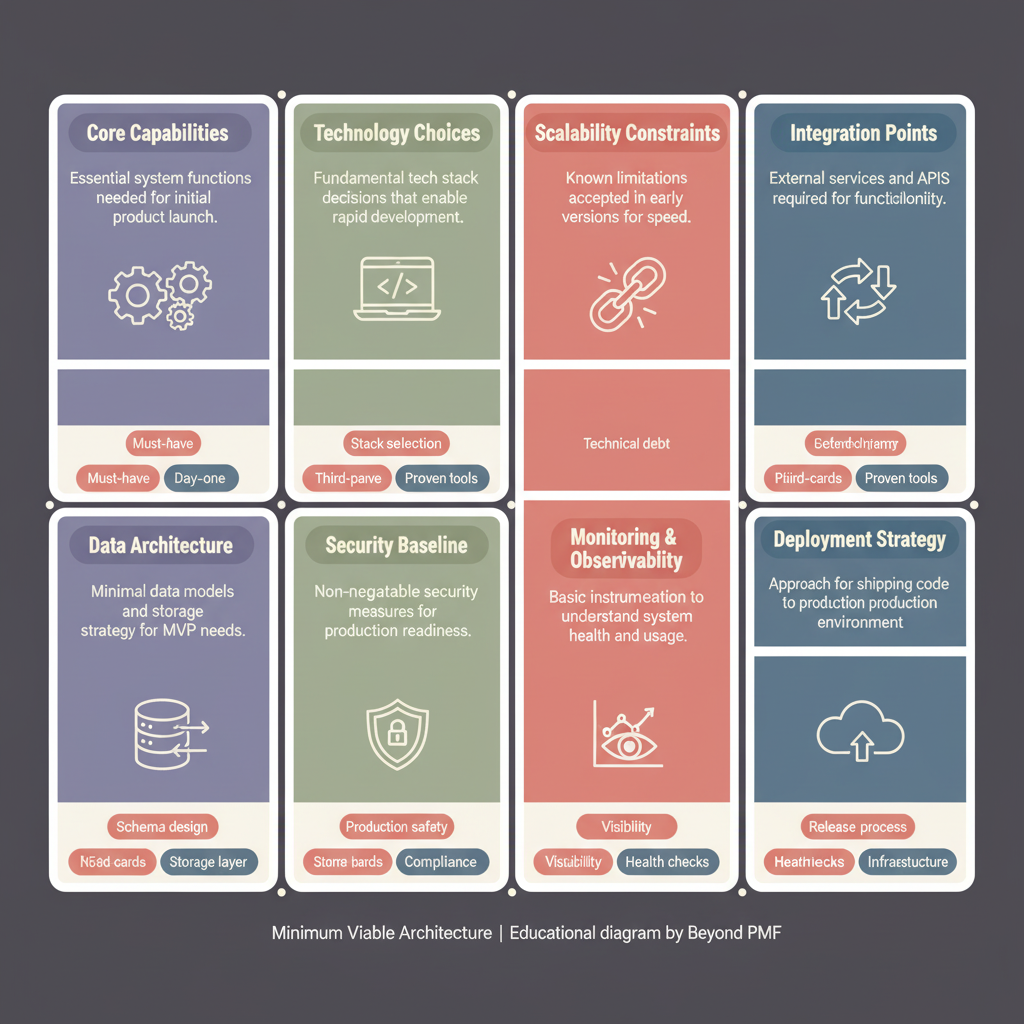
Minimum Viable Architecture

https://ik.imagekit.io/beyondpmf/frameworks/minimum-viable-architecture.png
Minimum Viable Architecture directly addresses execution friction by focusing on the essential architectural elements. This helps to reduce technical complexity and implementation overhead, leading to faster delivery and improved customer experience (UX).

Minimum Viable Architecture is a concept derived from the lean startup methodology, emphasizing the importance of simplicity and minimalism in architectural design. It involves identifying and implementing the least amount of architectural components necessary to satisfy the core business requirements. This approach helps in reducing costs, speeding up development times, and allowing for easier adaptation based on feedback and changing needs.

Steps / Detailed Description

Identify core business requirements: Determine the essential functionalities that the architecture must support. | Define minimal components: Outline the least complex structure that can support these requirements. | Implement incrementally: Build the architecture in small, manageable increments to facilitate quick adjustments. | Gather feedback: Continuously collect feedback from stakeholders and users to refine the architecture. | Iterate and scale: Based on feedback, refine and expand the architecture to meet evolving needs.

Best Practices

Start with a clear understanding of the business goals | Prioritize flexibility in the design to accommodate changes | Regularly review and adjust the architecture based on real-world use

Pros

Reduces initial development and maintenance costs | Speeds up the development process | Facilitates easier updates and scalability

Cons

May require significant revisions as needs evolve | Initial simplicity might overlook future requirements | Risk of underestimating the complexity needed

When to Use

In startup environments where speed and cost are critical | When launching new products that require market validation

When Not to Use

In highly regulated industries where comprehensive systems are necessary from the start | When the project scope and requirements are well understood and stable

Related Frameworks

Lifecycle

Scope

Scope not defined

Maturity Level

Maturity level not specified

Time to Implement

2–4 Weeks
3–6 Months
1–2 Weeks
3–6 Months
1–2 Months
3–6 Months
1–2 Weeks
Less Than 1 Day
1–2 Weeks
Longer Than 6 Months
1–2 Weeks
Longer Than 6 Months
1–2 Weeks
3–6 Months
1–2 Weeks
1–2 Weeks
1–2 Weeks
1–2 Weeks
1–2 Days
1–2 Weeks
1–2 Weeks
1–2 Weeks
1–2 Weeks
1–2 Weeks
1–2 Weeks
3–6 Months
1–2 Weeks
1–2 Weeks
1–2 Weeks
3–6 Months
1–2 Weeks
1–2 Weeks
2–4 Weeks
1–2 Weeks
1–2 Days
1–2 Weeks
Longer Than 6 Months
3–6 Months
Longer Than 6 Months
1–2 Weeks
Longer Than 6 Months
3–6 Months
Less Than 1 Day
3–6 Months
1–2 Months
3–6 Months
Longer Than 6 Months
3–6 Months
Less Than 1 Day
1–2 Weeks
3–6 Months
3–6 Months
1–2 Weeks
3–6 Months
1–2 Weeks
1–2 Weeks
1–2 Days
1–2 Weeks
1–2 Months
Longer Than 6 Months
1–2 Weeks
Longer Than 6 Months
1–2 Weeks
3–6 Months
1–2 Weeks
Less Than 1 Day
1–2 Weeks
3–6 Months
1–2 Weeks
3–6 Months
1–2 Weeks
1–2 Weeks
Longer Than 6 Months
Less Than 1 Day
3–6 Months
Longer Than 6 Months
1–2 Months
1–2 Weeks
Longer Than 6 Months
1–2 Weeks
3–6 Months
1–2 Weeks
1–2 Weeks
3–6 Months
Less Than 1 Day
1–2 Weeks
1–2 Weeks
3–6 Months
3–6 Months
Less Than 1 Day
1–2 Weeks
Longer Than 6 Months
1–2 Months
1–2 Weeks
1–2 Weeks
1–2 Weeks
Longer Than 6 Months

Copyright Information

Autor:
Unknown
N/A
Publication:
Unknown