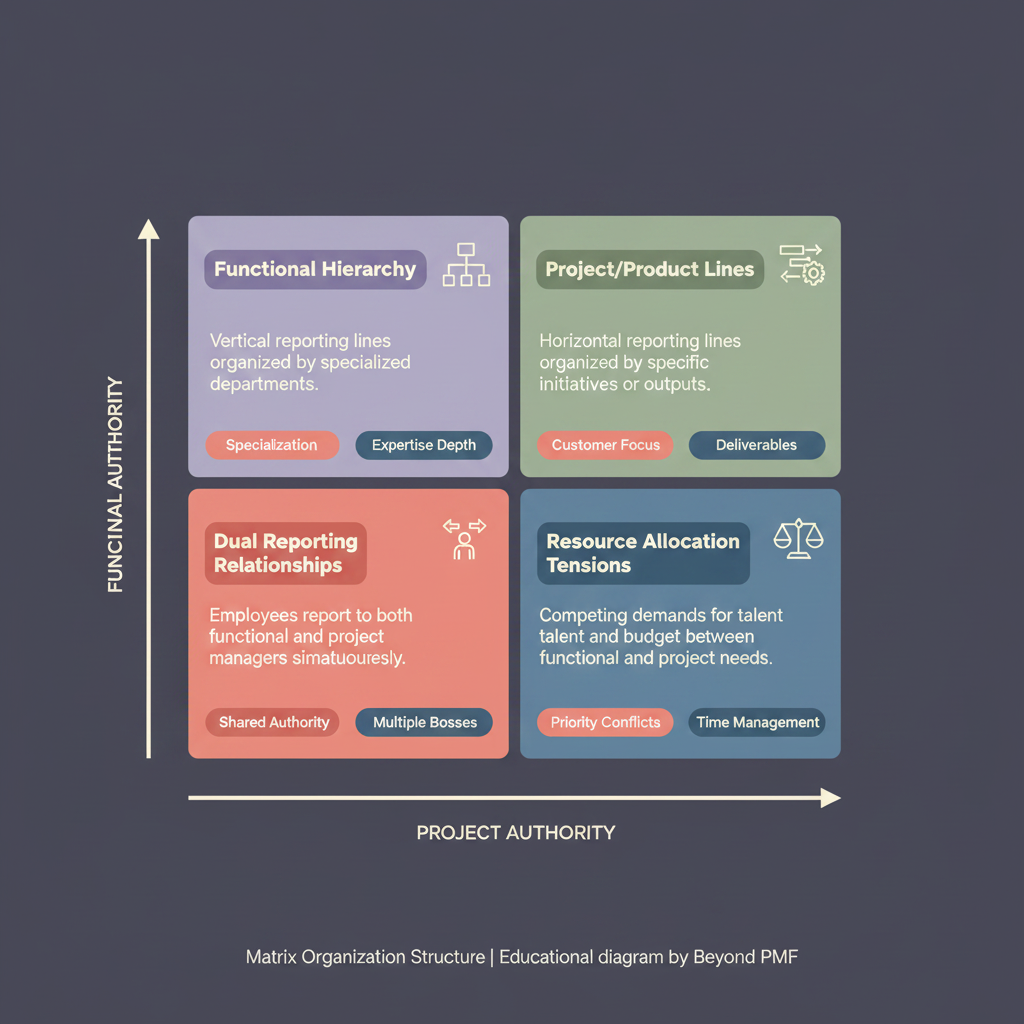
Matrix Organization Structure

https://ik.imagekit.io/beyondpmf/frameworks/matrix-organization-structure.png
The Matrix Organization Structure primarily addresses structural friction by attempting to balance functional specialization with project-based needs. It seeks to resolve issues of unclear ownership, conflicting priorities between functional and project teams, and potential misalignment inherent in a hybrid organizational design.

The Matrix Organization Structure is a complex framework that integrates functional and project or product lines in a dual-authority system. It is used primarily to enhance flexibility, foster interdisciplinary cooperation, and increase responsiveness to changes in the market. This structure allows employees to share information more readily across task boundaries, but it also requires a higher level of conflict management and excellent communication skills.

Steps / Detailed Description

Define the primary functions and projects within the organization. | Assign dual roles to team members based on function and project. | Establish clear reporting lines and communication protocols. | Implement a conflict resolution mechanism to handle overlaps in authority. | Regularly review and adjust the matrix structure to align with organizational goals.

Best Practices

Clearly define roles and responsibilities to avoid confusion. | Maintain open and effective communication channels. | Regularly train managers and staff on conflict resolution and cooperation.

Pros

Enhanced flexibility and adaptability | Improved resource allocation | Facilitates information sharing and interdisciplinary collaboration

Cons

Potential for confusion in reporting lines | Increased complexity in management | Risk of internal conflicts due to dual authority

When to Use

In dynamic industries where rapid response to market changes is crucial | In organizations where projects require input from multiple departments

When Not to Use

In small or less complex organizations where a simple structure is more efficient | Where clear authority and decision-making is a priority

Related Frameworks

Lifecycle

Not tied to a specific lifecycle stage

Scope

Scope not defined

Maturity Level

Maturity level not specified

Time to Implement

2–4 Weeks
3–6 Months
1–2 Weeks
3–6 Months
1–2 Months
3–6 Months
1–2 Weeks
Less Than 1 Day
1–2 Weeks
Longer Than 6 Months
1–2 Weeks
Longer Than 6 Months
1–2 Weeks
3–6 Months
1–2 Weeks
1–2 Weeks
1–2 Weeks
1–2 Weeks
1–2 Days
1–2 Weeks
1–2 Weeks
1–2 Weeks
1–2 Weeks
1–2 Weeks
1–2 Weeks
3–6 Months
1–2 Weeks
1–2 Weeks
1–2 Weeks
3–6 Months
1–2 Weeks
1–2 Weeks
2–4 Weeks
1–2 Weeks
1–2 Days
1–2 Weeks
Longer Than 6 Months
3–6 Months
Longer Than 6 Months
1–2 Weeks
Longer Than 6 Months
3–6 Months
Less Than 1 Day
3–6 Months
1–2 Months
3–6 Months
Longer Than 6 Months
3–6 Months
Less Than 1 Day
1–2 Weeks
3–6 Months
3–6 Months
1–2 Weeks
3–6 Months
1–2 Weeks
1–2 Weeks
1–2 Days
1–2 Weeks
1–2 Months
Longer Than 6 Months
1–2 Weeks
Longer Than 6 Months
1–2 Weeks
3–6 Months
1–2 Weeks
Less Than 1 Day
1–2 Weeks
3–6 Months
1–2 Weeks
3–6 Months
1–2 Weeks
1–2 Weeks
Longer Than 6 Months
Less Than 1 Day
3–6 Months
Longer Than 6 Months
1–2 Months
1–2 Weeks
Longer Than 6 Months
1–2 Weeks
3–6 Months
1–2 Weeks
1–2 Weeks
3–6 Months
Less Than 1 Day
1–2 Weeks
1–2 Weeks
3–6 Months
3–6 Months
Less Than 1 Day
1–2 Weeks
Longer Than 6 Months
1–2 Months
1–2 Weeks
1–2 Weeks
1–2 Weeks
Longer Than 6 Months

Copyright Information

Autor:
Public Domain
N/A
Publication:
Generic Business Tool