Market Sizing (TAM)

https://ik.imagekit.io/beyondpmf/frameworks/market-sizing-tam.png
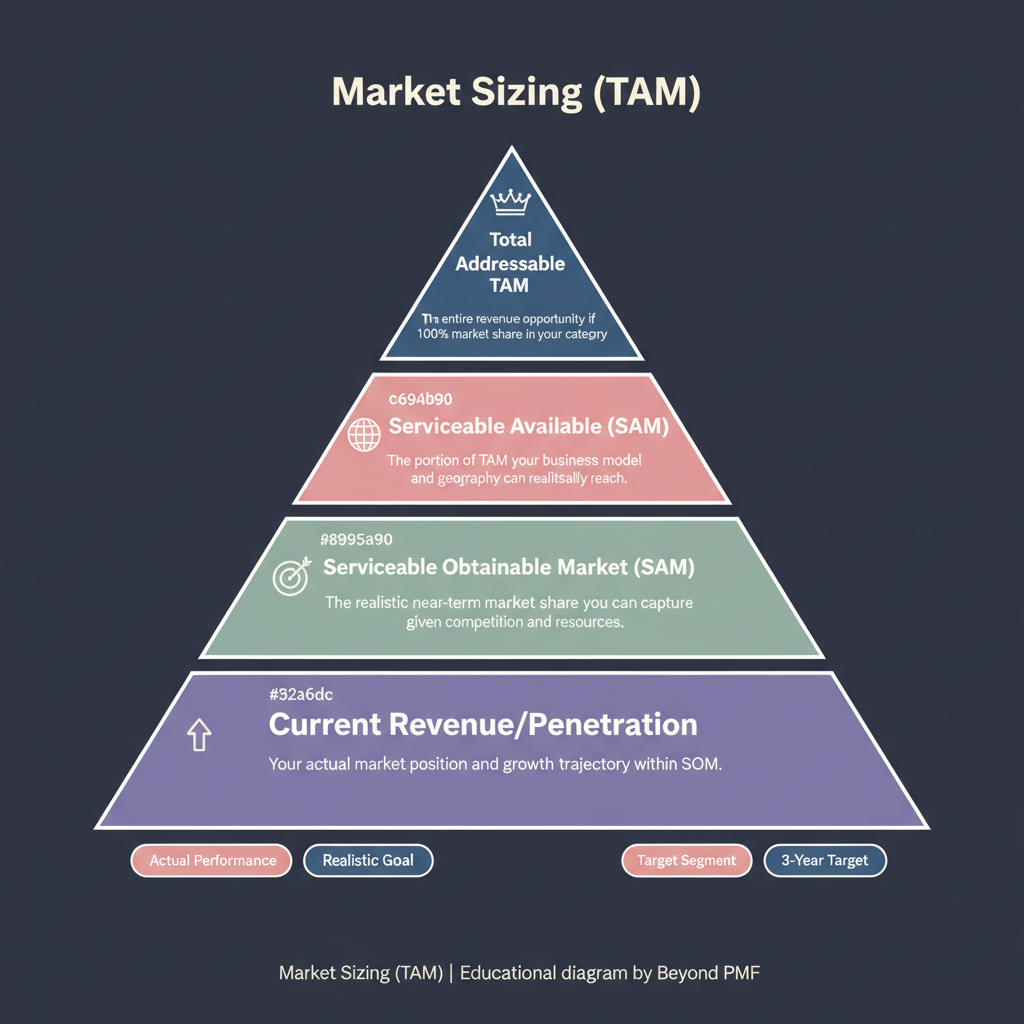
The Market Sizing (TAM) framework primarily addresses the strategic friction of unclear market direction and lack of market alignment. By estimating the total market demand, it informs strategic decisions about market opportunities, product viability, and overall business direction.

Market Sizing, specifically Total Addressable Market (TAM), is a framework used to quantify the revenue opportunity available for a product or service if 100% market share was achieved. It helps businesses understand the maximum potential of the market and guides strategic decisions such as entry into new markets, product development, and prioritization of resources. This framework is crucial for startups and established businesses to align their product offerings with market realities.

Steps / Detailed Description

Define the market: Identify and define the boundaries of the market you are analyzing. | Segment the market: Break down the market into smaller segments that are more manageable and relevant. | Estimate the size: Use available data and statistical methods to estimate the size of each segment. | Aggregate the estimates: Sum the sizes of all segments to get the total addressable market.

Best Practices

Use reliable and updated data sources | Regularly update the TAM as market conditions change | Combine qualitative insights with quantitative data for accuracy

Pros

Provides a clear view of potential market growth | Helps in strategic planning and resource allocation | Aids in attracting investors by quantifying market opportunities

Cons

Can be overly optimistic without accurate data | Time-consuming and requires robust market intelligence | May not account for future market changes and dynamics

When to Use

When entering a new market | When launching a new product

When Not to Use

In highly volatile markets where data is unreliable | When the product does not have a clear market definition

Related Frameworks

Lifecycle

Scope

Scope not defined

Maturity Level

Maturity level not specified

Time to Implement

2–4 Weeks
3–6 Months
1–2 Weeks
3–6 Months
1–2 Months
3–6 Months
1–2 Weeks
Less Than 1 Day
1–2 Weeks
Longer Than 6 Months
1–2 Weeks
Longer Than 6 Months
1–2 Weeks
3–6 Months
1–2 Weeks
1–2 Weeks
1–2 Weeks
1–2 Weeks
1–2 Days
1–2 Weeks
1–2 Weeks
1–2 Weeks
1–2 Weeks
1–2 Weeks
1–2 Weeks
3–6 Months
1–2 Weeks
1–2 Weeks
1–2 Weeks
3–6 Months
1–2 Weeks
1–2 Weeks
2–4 Weeks
1–2 Weeks
1–2 Days
1–2 Weeks
Longer Than 6 Months
3–6 Months
Longer Than 6 Months
1–2 Weeks
Longer Than 6 Months
3–6 Months
Less Than 1 Day
3–6 Months
1–2 Months
3–6 Months
Longer Than 6 Months
3–6 Months
Less Than 1 Day
1–2 Weeks
3–6 Months
3–6 Months
1–2 Weeks
3–6 Months
1–2 Weeks
1–2 Weeks
1–2 Days
1–2 Weeks
1–2 Months
Longer Than 6 Months
1–2 Weeks
Longer Than 6 Months
1–2 Weeks
3–6 Months
1–2 Weeks
Less Than 1 Day
1–2 Weeks
3–6 Months
1–2 Weeks
3–6 Months
1–2 Weeks
1–2 Weeks
Longer Than 6 Months
Less Than 1 Day
3–6 Months
Longer Than 6 Months
1–2 Months
1–2 Weeks
Longer Than 6 Months
1–2 Weeks
3–6 Months
1–2 Weeks
1–2 Weeks
3–6 Months
Less Than 1 Day
1–2 Weeks
1–2 Weeks
3–6 Months
3–6 Months
Less Than 1 Day
1–2 Weeks
Longer Than 6 Months
1–2 Months
1–2 Weeks
1–2 Weeks
1–2 Weeks
Longer Than 6 Months

Copyright Information

Autor:
Public Domain
N/A
Publication:
Generic Business Tool