Ladder of Inference

https://ik.imagekit.io/beyondpmf/frameworks/ladder-of-inference.png
The Ladder of Inference helps individuals improve their decision-making by clarifying their assumptions. This directly addresses execution challenges by improving the quality of decisions that impact delivery, problem-solving, and potentially customer experience.

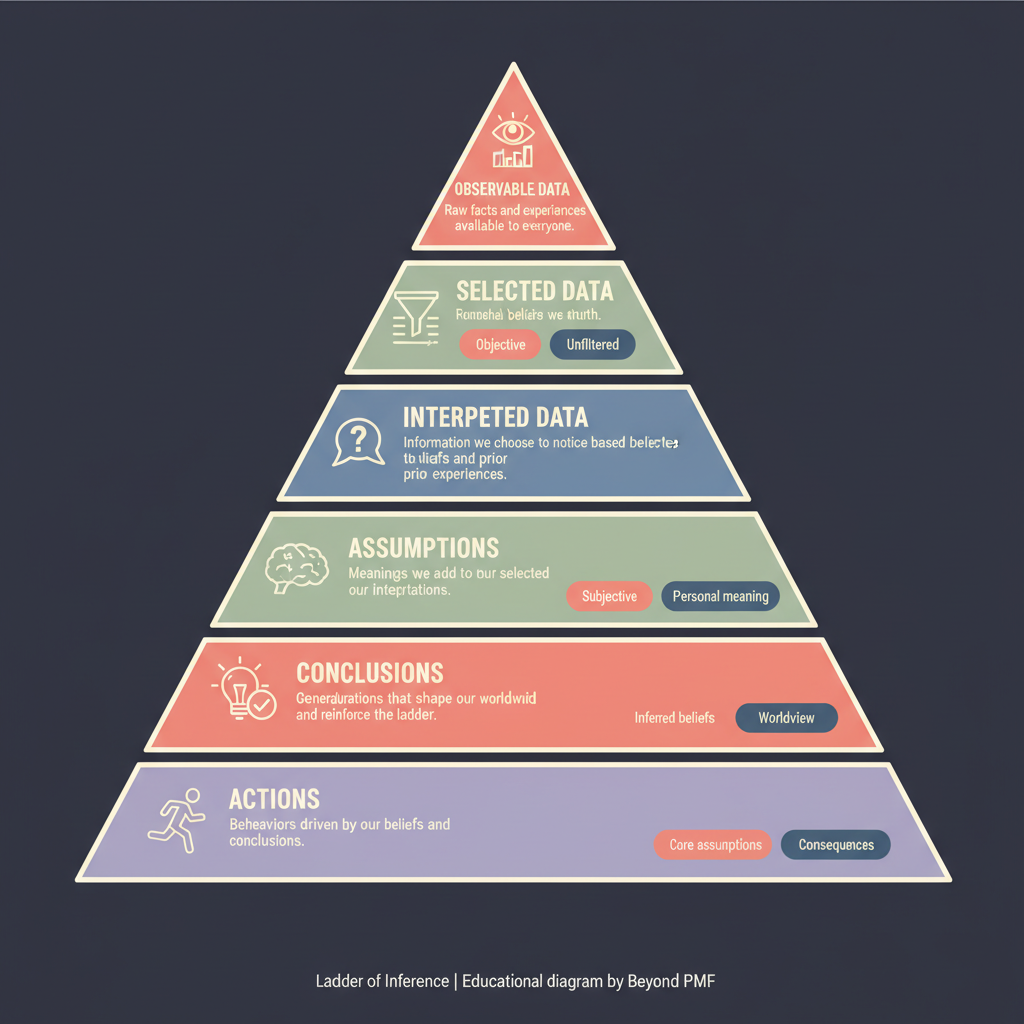
The Ladder of Inference, developed by Chris Argyris and used in organizational psychology, describes the step-by-step process by which individuals move from observable data to a decision or action. The framework helps users understand how their beliefs or assumptions can influence their conclusions, often without their awareness. By making this process explicit, the Ladder of Inference encourages critical thinking and helps reduce biases, leading to more effective decision-making.

Steps / Detailed Description

Observation: Collect factual, observable data. | Selection of data: Select specific data from observations. | Interpretation: Assign meaning to the data selected. | Assumptions: Make assumptions based on the interpretation of data. | Conclusions: Draw conclusions from these assumptions. | Beliefs: Form beliefs based on these conclusions. | Actions: Take actions that seem justified based on these beliefs.

Best Practices

Regularly revisit and challenge your own assumptions. | Encourage open dialogue in teams to explore different perspectives. | Use visual aids like diagrams to map out the inference process.

Pros

Promotes awareness of personal biases and assumptions. | Enhances critical thinking and decision-making quality. | Facilitates better communication and understanding in teams.

Cons

Can be time-consuming to apply thoroughly. | Requires honest self-reflection, which can be challenging. | May not be suitable for quick, on-the-spot decisions.

When to Use

In complex decision-making scenarios. | When resolving conflicts or misunderstandings in teams.

When Not to Use

In situations requiring immediate, rapid decisions. | When there is insufficient data to start the inference process.

Related Frameworks

Categories

Scope

Scope not defined

Maturity Level

Maturity level not specified

Time to Implement

2–4 Weeks
3–6 Months
1–2 Weeks
3–6 Months
1–2 Months
3–6 Months
1–2 Weeks
Less Than 1 Day
1–2 Weeks
Longer Than 6 Months
1–2 Weeks
Longer Than 6 Months
1–2 Weeks
3–6 Months
1–2 Weeks
1–2 Weeks
1–2 Weeks
1–2 Weeks
1–2 Days
1–2 Weeks
1–2 Weeks
1–2 Weeks
1–2 Weeks
1–2 Weeks
1–2 Weeks
3–6 Months
1–2 Weeks
1–2 Weeks
1–2 Weeks
3–6 Months
1–2 Weeks
1–2 Weeks
2–4 Weeks
1–2 Weeks
1–2 Days
1–2 Weeks
Longer Than 6 Months
3–6 Months
Longer Than 6 Months
1–2 Weeks
Longer Than 6 Months
3–6 Months
Less Than 1 Day
3–6 Months
1–2 Months
3–6 Months
Longer Than 6 Months
3–6 Months
Less Than 1 Day
1–2 Weeks
3–6 Months
3–6 Months
1–2 Weeks
3–6 Months
1–2 Weeks
1–2 Weeks
1–2 Days
1–2 Weeks
1–2 Months
Longer Than 6 Months
1–2 Weeks
Longer Than 6 Months
1–2 Weeks
3–6 Months
1–2 Weeks
Less Than 1 Day
1–2 Weeks
3–6 Months
1–2 Weeks
3–6 Months
1–2 Weeks
1–2 Weeks
Longer Than 6 Months
Less Than 1 Day
3–6 Months
Longer Than 6 Months
1–2 Months
1–2 Weeks
Longer Than 6 Months
1–2 Weeks
3–6 Months
1–2 Weeks
1–2 Weeks
3–6 Months
Less Than 1 Day
1–2 Weeks
1–2 Weeks
3–6 Months
3–6 Months
Less Than 1 Day
1–2 Weeks
Longer Than 6 Months
1–2 Months
1–2 Weeks
1–2 Weeks
1–2 Weeks
Longer Than 6 Months

Copyright Information

Autor:
Chris Argyris
1990
Publication:
Harvard Business Review