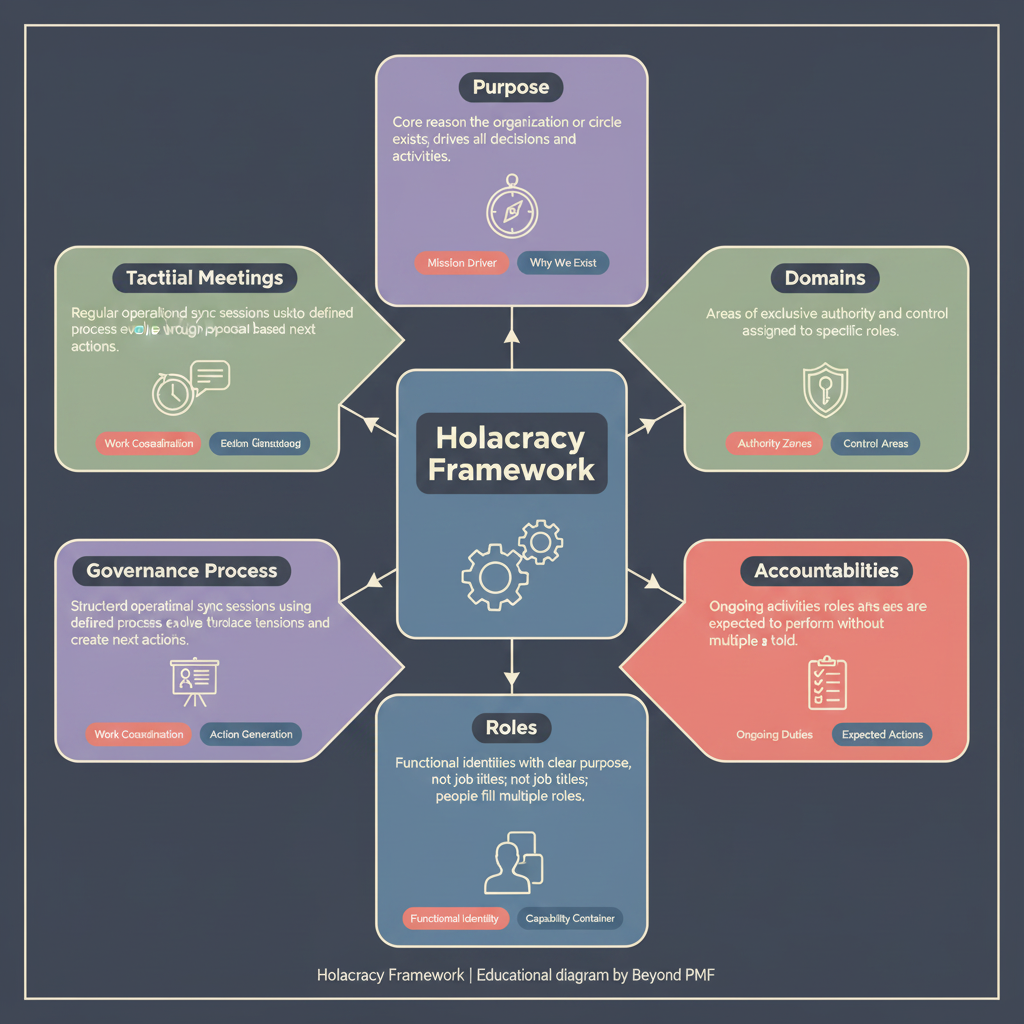
Holacracy Framework

https://ik.imagekit.io/beyondpmf/frameworks/holacracy-framework.png
Holacracy directly addresses structural friction by altering the organizational design and decision-making processes. It aims to eliminate traditional hierarchies and create self-organizing teams, thereby addressing issues related to roles, ownership, and team structure.

Holacracy is a comprehensive practice for structuring, governing, and running an organization. It replaces the traditional management hierarchy with a new peer-to-peer 'operating system' that increases transparency, accountability, and organizational agility. Through a unique power distribution process, Holacracy empowers all employees to take initiative and make decisions, guided by the organization's core purpose. It is particularly useful in environments that require rapid innovation and adaptation.

Steps / Detailed Description

Adopt a Constitution: Establish the core rules and processes of Holacracy. | Define Roles and Accountabilities: Clearly outline each role's responsibilities and expectations. | Governance Meetings: Regularly schedule meetings to review and refine roles, accountabilities, and policies. | Tactical Meetings: Hold meetings to synchronize team actions and address operational issues. | Operational Processes: Implement specific processes for decision-making and conflict resolution.

Best Practices

Ensure thorough training for all members | Start with a pilot project before full implementation | Regularly review and update governance and operational processes

Pros

Increases organizational agility | Enhances transparency and accountability | Empowers employees at all levels

Cons

Can be complex to implement | May lead to initial confusion and resistance | Requires continuous commitment and training

When to Use

Organizations needing to enhance agility and innovation | Companies looking for a decentralized decision-making process

When Not to Use

In highly regulated industries requiring strict control | Where traditional hierarchical structures are preferred

Related Frameworks

Lifecycle

Not tied to a specific lifecycle stage

Scope

Scope not defined

Maturity Level

Maturity level not specified

Time to Implement

2–4 Weeks
3–6 Months
1–2 Weeks
3–6 Months
1–2 Months
3–6 Months
1–2 Weeks
Less Than 1 Day
1–2 Weeks
Longer Than 6 Months
1–2 Weeks
Longer Than 6 Months
1–2 Weeks
3–6 Months
1–2 Weeks
1–2 Weeks
1–2 Weeks
1–2 Weeks
1–2 Days
1–2 Weeks
1–2 Weeks
1–2 Weeks
1–2 Weeks
1–2 Weeks
1–2 Weeks
3–6 Months
1–2 Weeks
1–2 Weeks
1–2 Weeks
3–6 Months
1–2 Weeks
1–2 Weeks
2–4 Weeks
1–2 Weeks
1–2 Days
1–2 Weeks
Longer Than 6 Months
3–6 Months
Longer Than 6 Months
1–2 Weeks
Longer Than 6 Months
3–6 Months
Less Than 1 Day
3–6 Months
1–2 Months
3–6 Months
Longer Than 6 Months
3–6 Months
Less Than 1 Day
1–2 Weeks
3–6 Months
3–6 Months
1–2 Weeks
3–6 Months
1–2 Weeks
1–2 Weeks
1–2 Days
1–2 Weeks
1–2 Months
Longer Than 6 Months
1–2 Weeks
Longer Than 6 Months
1–2 Weeks
3–6 Months
1–2 Weeks
Less Than 1 Day
1–2 Weeks
3–6 Months
1–2 Weeks
3–6 Months
1–2 Weeks
1–2 Weeks
Longer Than 6 Months
Less Than 1 Day
3–6 Months
Longer Than 6 Months
1–2 Months
1–2 Weeks
Longer Than 6 Months
1–2 Weeks
3–6 Months
1–2 Weeks
1–2 Weeks
3–6 Months
Less Than 1 Day
1–2 Weeks
1–2 Weeks
3–6 Months
3–6 Months
Less Than 1 Day
1–2 Weeks
Longer Than 6 Months
1–2 Months
1–2 Weeks
1–2 Weeks
1–2 Weeks
Longer Than 6 Months

Copyright Information

Autor:
Brian Robertson
2007
Publication:
HolacracyOne