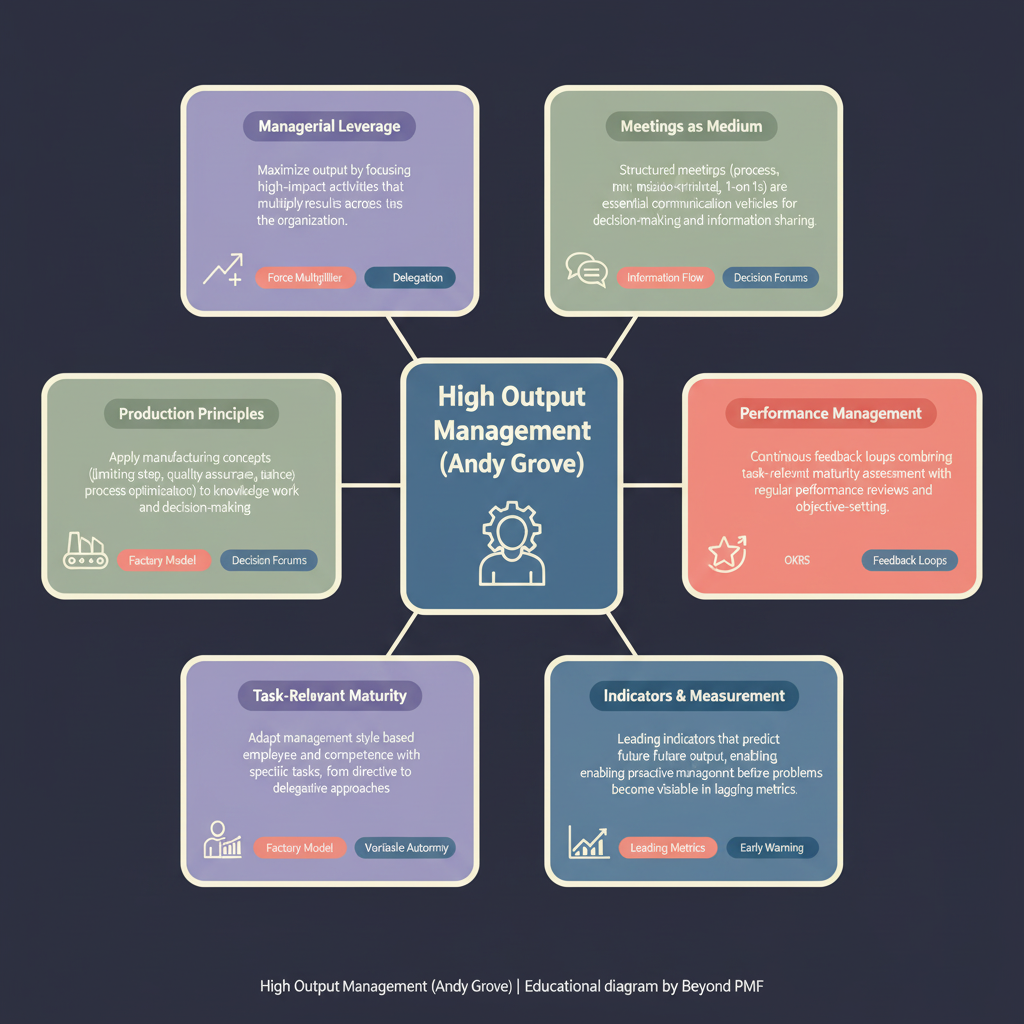
High Output Management (Andy Grove)

https://ik.imagekit.io/beyondpmf/frameworks/high-output-management-andy-grove.png
High Output Management primarily addresses friction in how work gets done within an organization. It focuses on improving managerial practices, processes, and productivity to ensure efficient operations and effective coordination.

High Output Management, developed by former Intel CEO Andy Grove, is a framework that guides managers in effectively managing their teams and operations to maximize output. The framework emphasizes the importance of measuring outputs rather than inputs and advocates for a rigorous approach to management that includes setting clear objectives, focusing on results, and fostering a culture of accountability. It is widely used for its practical advice on productivity, decision-making, and leveraging managerial leverage.

Steps / Detailed Description

Identify key result areas: Focus on the outputs that significantly impact the organization's success. | Set clear objectives: Establish measurable and achievable goals for teams and individuals. | Monitor your process: Implement regular check-ins and updates to ensure goals are on track. | Leverage managerial activities: Maximize the output of the organization by optimizing the work done by others. | Conduct one-on-ones: Regular, structured meetings between a manager and their direct reports to provide feedback and align on objectives. | Focus on teaching: Use training and development as tools to increase the capability and output of the team.

Best Practices

Regularly review and adjust objectives to ensure they remain relevant | Foster open communication to ensure alignment and address issues promptly | Encourage continuous learning and adaptation within teams

Pros

Enhances productivity by focusing on outputs rather than inputs | Promotes accountability and clear goal-setting | Improves decision-making through structured managerial processes

Cons

Can be overly rigid and not suitable for all types of creative work | May emphasize quantifiable outputs at the expense of qualitative factors | Requires significant discipline and structure which may not fit all organizational cultures

When to Use

In environments where outputs are clear and measurable | When needing to improve efficiency and productivity in management

When Not to Use

In highly creative fields where outputs are less quantifiable | When flexibility and adaptability are more valuable than strict output metrics

Related Frameworks

Lifecycle

Not tied to a specific lifecycle stage

Scope

Scope not defined

Maturity Level

Maturity level not specified

Time to Implement

2–4 Weeks
3–6 Months
1–2 Weeks
3–6 Months
1–2 Months
3–6 Months
1–2 Weeks
Less Than 1 Day
1–2 Weeks
Longer Than 6 Months
1–2 Weeks
Longer Than 6 Months
1–2 Weeks
3–6 Months
1–2 Weeks
1–2 Weeks
1–2 Weeks
1–2 Weeks
1–2 Days
1–2 Weeks
1–2 Weeks
1–2 Weeks
1–2 Weeks
1–2 Weeks
1–2 Weeks
3–6 Months
1–2 Weeks
1–2 Weeks
1–2 Weeks
3–6 Months
1–2 Weeks
1–2 Weeks
2–4 Weeks
1–2 Weeks
1–2 Days
1–2 Weeks
Longer Than 6 Months
3–6 Months
Longer Than 6 Months
1–2 Weeks
Longer Than 6 Months
3–6 Months
Less Than 1 Day
3–6 Months
1–2 Months
3–6 Months
Longer Than 6 Months
3–6 Months
Less Than 1 Day
1–2 Weeks
3–6 Months
3–6 Months
1–2 Weeks
3–6 Months
1–2 Weeks
1–2 Weeks
1–2 Days
1–2 Weeks
1–2 Months
Longer Than 6 Months
1–2 Weeks
Longer Than 6 Months
1–2 Weeks
3–6 Months
1–2 Weeks
Less Than 1 Day
1–2 Weeks
3–6 Months
1–2 Weeks
3–6 Months
1–2 Weeks
1–2 Weeks
Longer Than 6 Months
Less Than 1 Day
3–6 Months
Longer Than 6 Months
1–2 Months
1–2 Weeks
Longer Than 6 Months
1–2 Weeks
3–6 Months
1–2 Weeks
1–2 Weeks
3–6 Months
Less Than 1 Day
1–2 Weeks
1–2 Weeks
3–6 Months
3–6 Months
Less Than 1 Day
1–2 Weeks
Longer Than 6 Months
1–2 Months
1–2 Weeks
1–2 Weeks
1–2 Weeks
Longer Than 6 Months

Copyright Information

Autor:
Andy Grove
1983
Publication:
Unknown