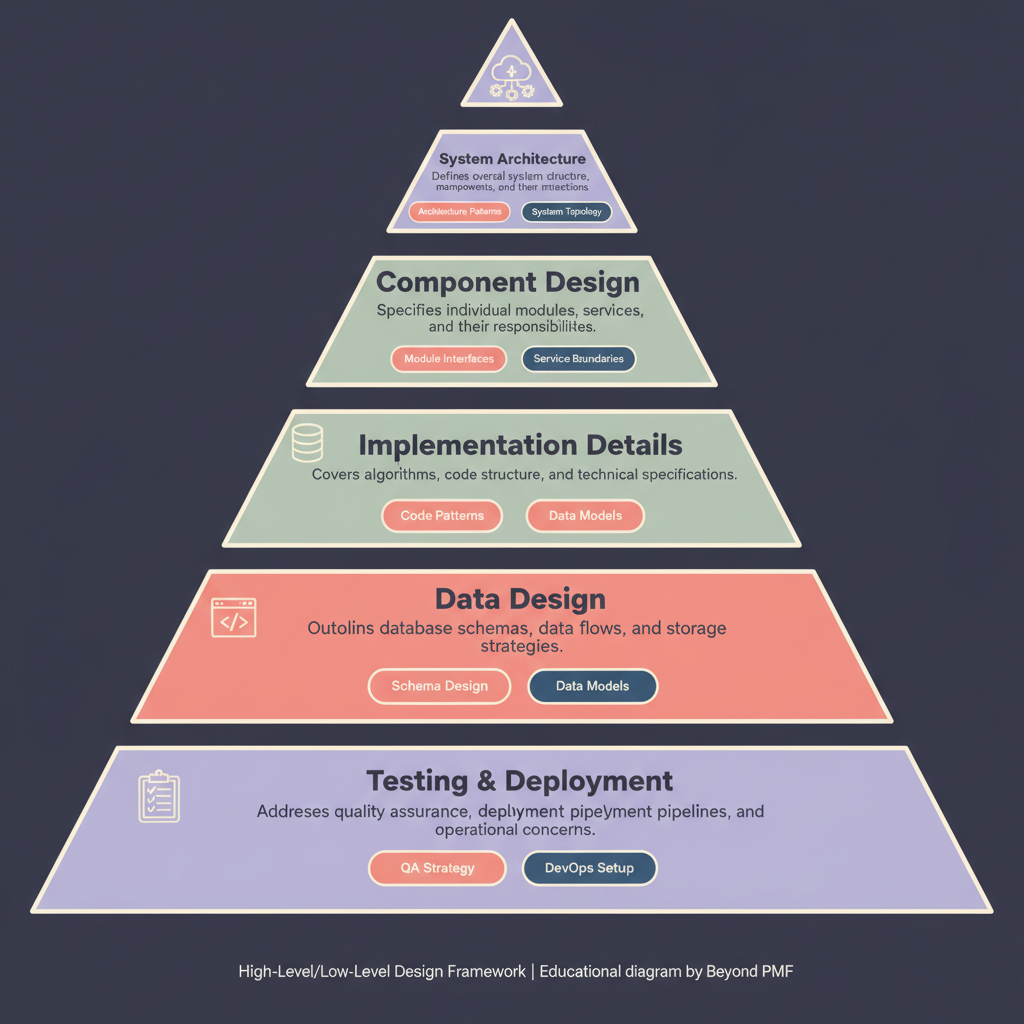
The High-Level/Low-Level Design Framework is a strategic approach used in software development to structure the planning process into two distinct phases: High-Level Design (HLD) and Low-Level Design (LLD). HLD focuses on system architecture and design elements that relate to the overall system, such as modules and their interactions, while LLD details the actual implementation specifics, such as algorithms and detailed logic. This bifurcation helps in managing complexity by allowing designers to focus on broad system architecture before delving into detailed implementation, ensuring a thorough approach to software development.
Define the scope and requirements of the system to establish the foundation for HLD. | Develop the High-Level Design by outlining system architecture, including major components and their interactions. | Review and finalize the HLD with all stakeholders to ensure alignment with business goals. | Proceed to Low-Level Design by detailing out the components specified in the HLD with exact logic, data models, and algorithms. | Conduct thorough reviews of the LLD with technical teams to ensure feasibility and correctness. | Iterate on the designs as needed based on feedback and testing results.
Ensure clear and comprehensive documentation at each stage | Regularly involve stakeholders in reviews to align HLD and LLD with business needs | Maintain flexibility to adapt designs based on evolving requirements and feedback
Facilitates better understanding and management of system complexity | Ensures alignment between technical design and business requirements | Allows for incremental validation and feedback through phased design stages
Can be time-consuming due to the depth of detail required | Requires high levels of coordination between different design phases | Potential for misalignment if initial requirements are not clear or change significantly
In complex software development projects requiring detailed planning | When building systems that need clear modular separation and detailed specifications
For small-scale or less complex projects where a simple design is sufficient | When rapid development and deployment are more critical than detailed planning