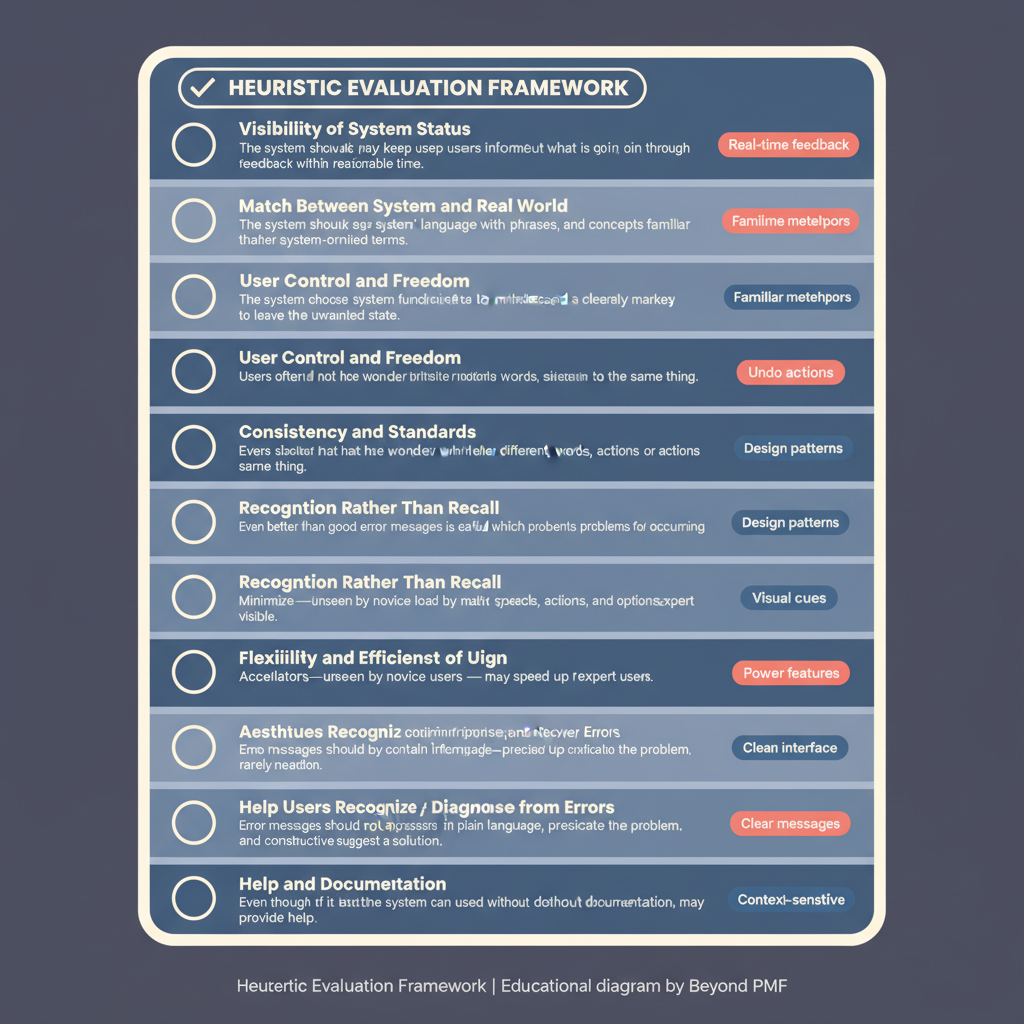
The Heuristic Evaluation Framework is a method for evaluating a user interface design based on predefined heuristics or general principles. It involves a small group of evaluators who independently assess the interface and identify usability issues. This framework is widely used because it is cost-effective, quick, and can be conducted without the involvement of actual users. It helps in improving the usability of products by identifying intuitive and user-centric design flaws.
Select a set of appropriate heuristics. | Assemble a group of evaluators. | Brief the evaluators on the process and the heuristics. | Evaluators independently assess the product. | Compile the findings from all evaluators. | Discuss discrepancies and aggregate the results. | Provide a list of usability issues and potential improvements.
Use evaluators with varied expertise and familiarity with similar systems. | Ensure evaluators understand the heuristics thoroughly. | Review and discuss the findings collectively to minimize subjectivity.
Cost-effective compared to other usability testing methods. | Quick turnaround time, often requiring only a few days. | Can be performed without actual users, reducing the need for extensive user recruitment and scheduling.
Relies heavily on the expertise of the evaluators. | May not uncover all usability issues, as it does not involve real users. | Subjective differences between evaluators can affect consistency.
Early stages of design to refine user interfaces. | When quick, iterative feedback on a product is needed.
For detailed understanding of user behaviors and motivations. | When comprehensive and empirical usability testing is required.