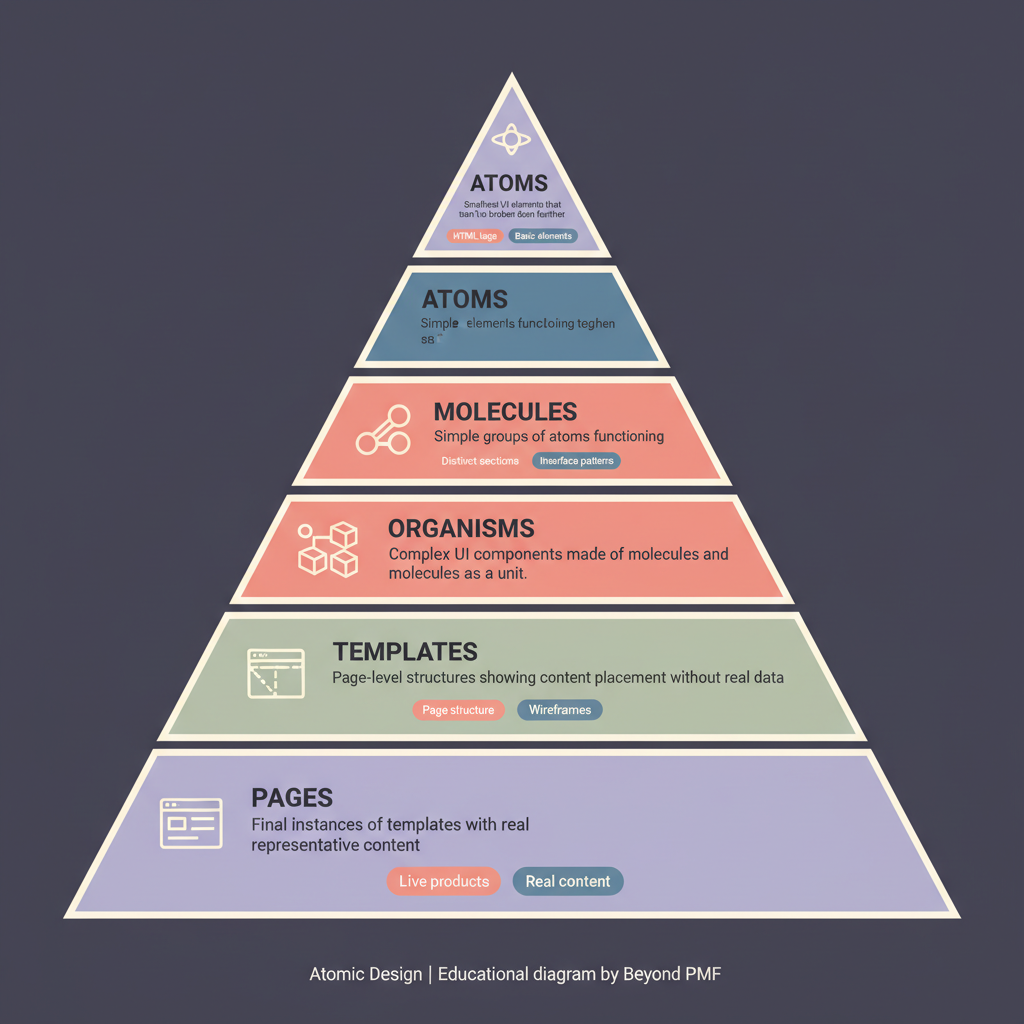
Atomic Design is a framework developed by Brad Frost that helps designers build consistent, cohesive interfaces by breaking down components into fundamental building blocks. These blocks are categorized into atoms, molecules, organisms, templates, and pages, allowing for scalability and reusability. This approach mirrors the chemical structure from simple to complex, making it easier to manage design systems in a modular way.
Define atoms: Identify the basic building blocks of the interface, such as buttons, input fields, and icons. | Create molecules: Combine atoms to form molecules, which are relatively simple groups of UI elements functioning together as a unit. | Assemble organisms: Group molecules together to form organisms, which are complex UI components that form distinct sections of an interface. | Construct templates: Arrange organisms into templates, which lay out the structure but are devoid of content-specific details. | Develop pages: Populate templates with real content to create pages, which are the final and most concrete stage.
Start with a thorough inventory of components | Encourage collaboration between designers and developers | Regularly update the design system as the project evolves
Enhances design consistency | Facilitates reusability of components | Simplifies the process of scaling design systems
Can be overly rigid in less modular projects | Initial setup can be time-consuming | May not be suitable for very small projects
Developing large-scale applications | Creating a design system from scratch
Very small or simple projects | Projects requiring unique, non-reusable components