CIRCLES Method

https://ik.imagekit.io/beyondpmf/frameworks/circles-method.png
The CIRCLES Method focuses on product design and user experience evaluation. This directly addresses friction in the customer-facing delivery and implementation, including the user's interaction with the product.

The CIRCLES Method is a framework designed to help professionals systematically evaluate and improve product designs. It provides a comprehensive approach to breaking down complex design problems into manageable components, ensuring thorough analysis and thoughtful solutions. The method is widely used in user experience (UX) design and product management to enhance the usability and appeal of products.

Steps / Detailed Description

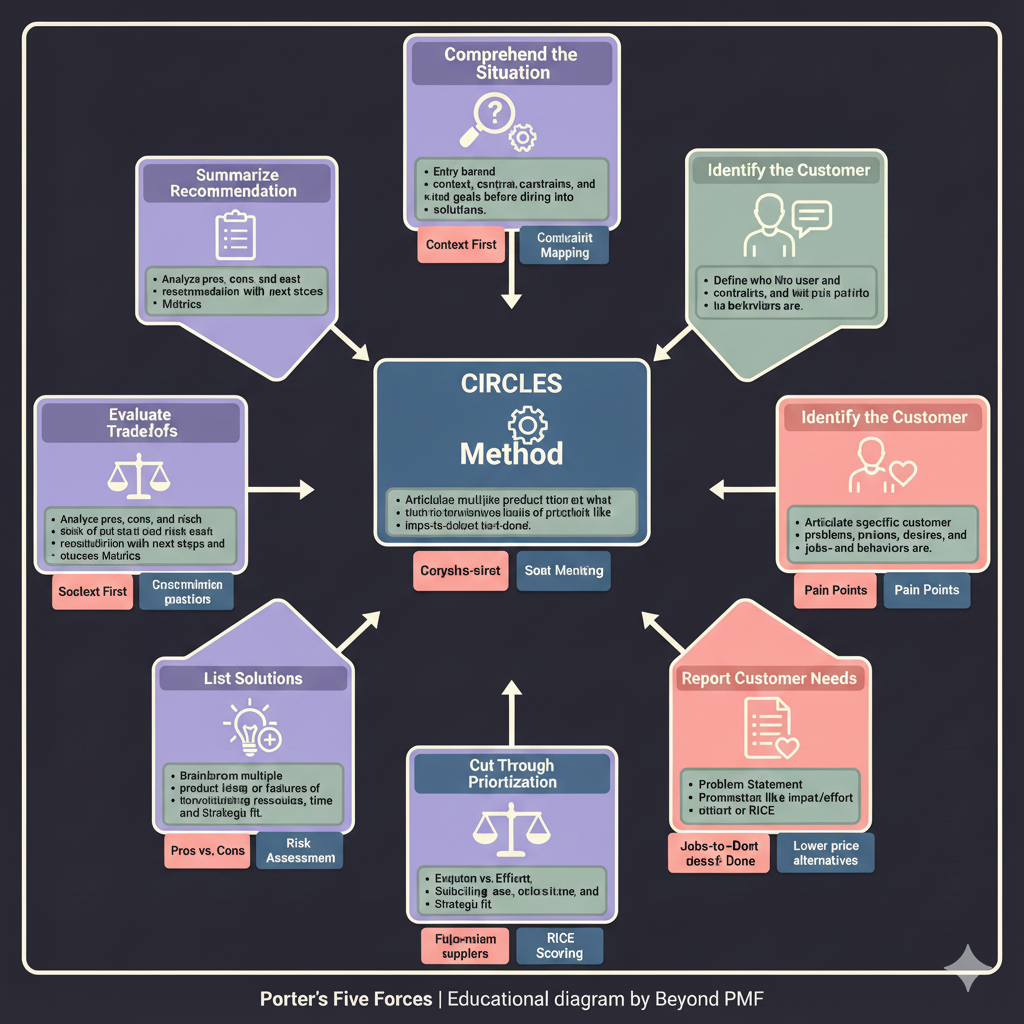
Comprehend the Situation: Understand the context and the user needs. | Identify the Customer: Specify the target user demographics and behaviors. | Report the Customer's Needs: List out what the user needs from the product. | Cut through Prioritization: Prioritize the needs based on importance and feasibility. | List Solutions: Generate a range of solutions to address the prioritized needs. | Evaluate Trade-offs: Assess the pros and cons of each solution. | Summarize Recommendations: Provide a final recommendation with justifications.

Best Practices

Thoroughly research user demographics and behaviors | Regularly update and validate user needs | Encourage creativity in the solution generation phase

Pros

Provides a structured approach to problem-solving | Enhances focus on user needs and experiences | Facilitates thorough analysis and informed decision-making

Cons

Can be time-consuming | May require substantial user research data | Potentially overlooks non-user-centric factors

When to Use

When designing or redesigning a product | When evaluating user experience for improvements

When Not to Use

For quick, minor product updates | When the product's user base is not clearly defined

Related Frameworks

Categories

Scope

Scope not defined

Maturity Level

Maturity level not specified

Time to Implement

2–4 Weeks
3–6 Months
1–2 Weeks
3–6 Months
1–2 Months
3–6 Months
1–2 Weeks
Less Than 1 Day
1–2 Weeks
Longer Than 6 Months
1–2 Weeks
Longer Than 6 Months
1–2 Weeks
3–6 Months
1–2 Weeks
1–2 Weeks
1–2 Weeks
1–2 Weeks
1–2 Days
1–2 Weeks
1–2 Weeks
1–2 Weeks
1–2 Weeks
1–2 Weeks
1–2 Weeks
3–6 Months
1–2 Weeks
1–2 Weeks
1–2 Weeks
3–6 Months
1–2 Weeks
1–2 Weeks
2–4 Weeks
1–2 Weeks
1–2 Days
1–2 Weeks
Longer Than 6 Months
3–6 Months
Longer Than 6 Months
1–2 Weeks
Longer Than 6 Months
3–6 Months
Less Than 1 Day
3–6 Months
1–2 Months
3–6 Months
Longer Than 6 Months
3–6 Months
Less Than 1 Day
1–2 Weeks
3–6 Months
3–6 Months
1–2 Weeks
3–6 Months
1–2 Weeks
1–2 Weeks
1–2 Days
1–2 Weeks
1–2 Months
Longer Than 6 Months
1–2 Weeks
Longer Than 6 Months
1–2 Weeks
3–6 Months
1–2 Weeks
Less Than 1 Day
1–2 Weeks
3–6 Months
1–2 Weeks
3–6 Months
1–2 Weeks
1–2 Weeks
Longer Than 6 Months
Less Than 1 Day
3–6 Months
Longer Than 6 Months
1–2 Months
1–2 Weeks
Longer Than 6 Months
1–2 Weeks
3–6 Months
1–2 Weeks
1–2 Weeks
3–6 Months
Less Than 1 Day
1–2 Weeks
1–2 Weeks
3–6 Months
3–6 Months
Less Than 1 Day
1–2 Weeks
Longer Than 6 Months
1–2 Months
1–2 Weeks
1–2 Weeks
1–2 Weeks
Longer Than 6 Months

Copyright Information

Autor:
Lewis C. Lin
2015
Publication:
Impact Interview