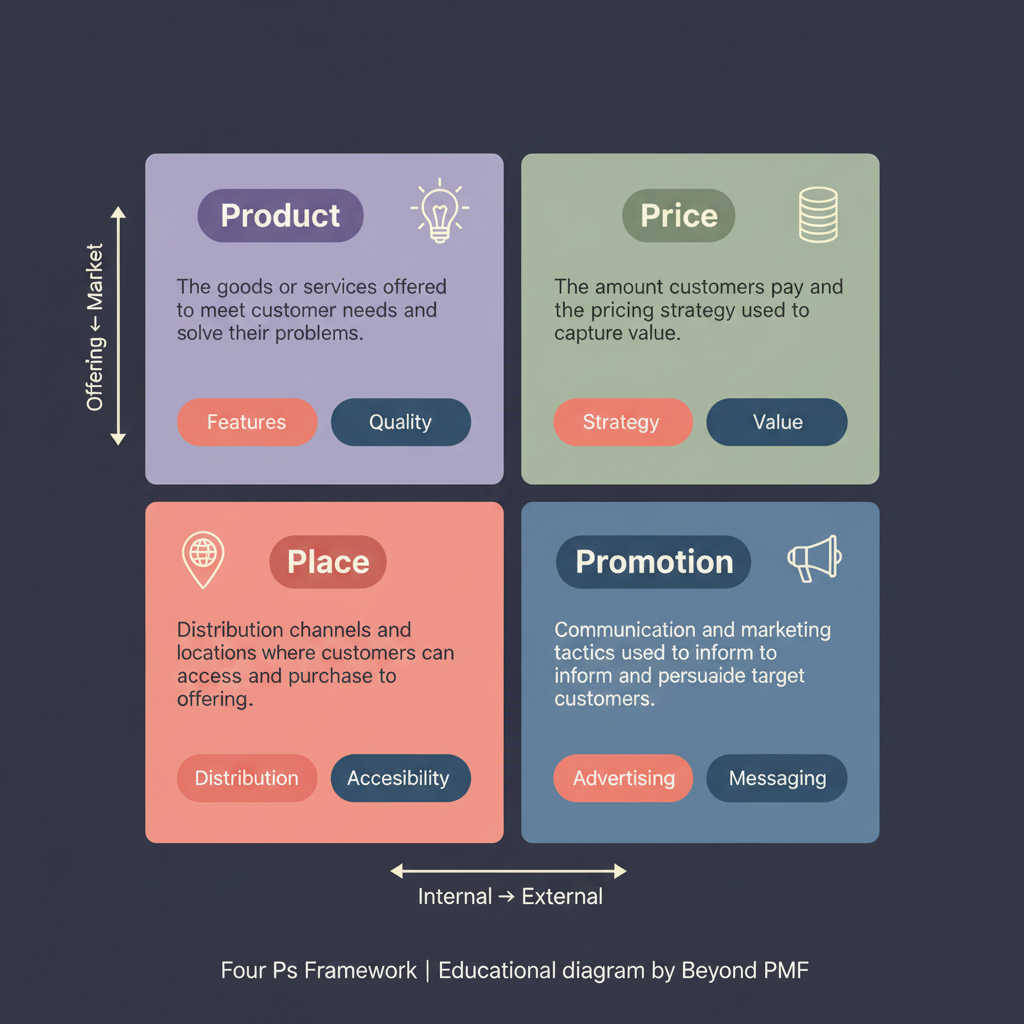
Four Ps Framework

The Four Ps Framework helps businesses define and refine their market offering by considering Product, Price, Place, and Promotion. It primarily addresses strategic friction by ensuring alignment between the market offering and the target customer.

The Four Ps Framework is a foundational concept in marketing that outlines four key components of marketing strategies: Product, Price, Place, and Promotion. These elements are used to look at a business's offerings from multiple angles to ensure a comprehensive approach to market strategy. The framework helps companies to define marketing options in terms of product development, pricing strategies, distribution channels, and promotional tactics. It is widely used due to its simplicity and effectiveness in structuring marketing decisions.

Steps / Detailed Description

Define the Product: Determine the characteristics, functionality, and benefits of the product or service being offered. | Set the Price: Establish pricing strategies that reflect the perceived value, market demand, and cost of production. | Plan the Place (Distribution): Decide on distribution channels that will best reach the target market and ensure product availability. | Organize the Promotion: Develop promotional strategies to communicate the product’s benefits and value proposition to the target audience.

Best Practices

Regularly review and adjust each of the Four Ps as market conditions and consumer preferences change. | Use market research to inform decisions in each area of the Four Ps. | Integrate digital marketing strategies into the traditional Four Ps framework.

Pros

Provides a clear and structured approach to marketing decisions. | Easy to understand and implement across different levels of marketing expertise. | Flexible enough to be applicable in various industries and markets.

Cons

Can be overly simplistic, ignoring other important marketing factors like customer experience and service. | May not adapt well to the modern digital marketing environment without adjustments. | Focuses mainly on tactical rather than strategic aspects of marketing.

When to Use

When launching a new product or service. | When reevaluating or refining existing market strategies.

When Not to Use

In highly dynamic markets where more agile, real-time marketing strategies are required. | When the business model or market does not align with traditional marketing channels or methods.

Related Frameworks

Lifecycle

Scope

Scope not defined

Maturity Level

Maturity level not specified

Time to Implement

2–4 Weeks
3–6 Months
1–2 Weeks
3–6 Months
1–2 Months
3–6 Months
1–2 Weeks
Less Than 1 Day
1–2 Weeks
Longer Than 6 Months
1–2 Weeks
Longer Than 6 Months
1–2 Weeks
3–6 Months
1–2 Weeks
1–2 Weeks
1–2 Weeks
1–2 Weeks
1–2 Days
1–2 Weeks
1–2 Weeks
1–2 Weeks
1–2 Weeks
1–2 Weeks
1–2 Weeks
3–6 Months
1–2 Weeks
1–2 Weeks
1–2 Weeks
3–6 Months
1–2 Weeks
1–2 Weeks
2–4 Weeks
1–2 Weeks
1–2 Days
1–2 Weeks
Longer Than 6 Months
3–6 Months
Longer Than 6 Months
1–2 Weeks
Longer Than 6 Months
3–6 Months
Less Than 1 Day
3–6 Months
1–2 Months
3–6 Months
Longer Than 6 Months
3–6 Months
Less Than 1 Day
1–2 Weeks
3–6 Months
3–6 Months
1–2 Weeks
3–6 Months
1–2 Weeks
1–2 Weeks
1–2 Days
1–2 Weeks
1–2 Months
Longer Than 6 Months
1–2 Weeks
Longer Than 6 Months
1–2 Weeks
3–6 Months
1–2 Weeks
Less Than 1 Day
1–2 Weeks
3–6 Months
1–2 Weeks
3–6 Months
1–2 Weeks
1–2 Weeks
Longer Than 6 Months
Less Than 1 Day
3–6 Months
Longer Than 6 Months
1–2 Months
1–2 Weeks
Longer Than 6 Months
1–2 Weeks
3–6 Months
1–2 Weeks
1–2 Weeks
3–6 Months
Less Than 1 Day
1–2 Weeks
1–2 Weeks
3–6 Months
3–6 Months
Less Than 1 Day
1–2 Weeks
Longer Than 6 Months
1–2 Months
1–2 Weeks
1–2 Weeks
1–2 Weeks
Longer Than 6 Months

Copyright Information

Autor:
E. Jerome McCarthy
1960
Publication:
Basic Marketing: A Managerial Approach