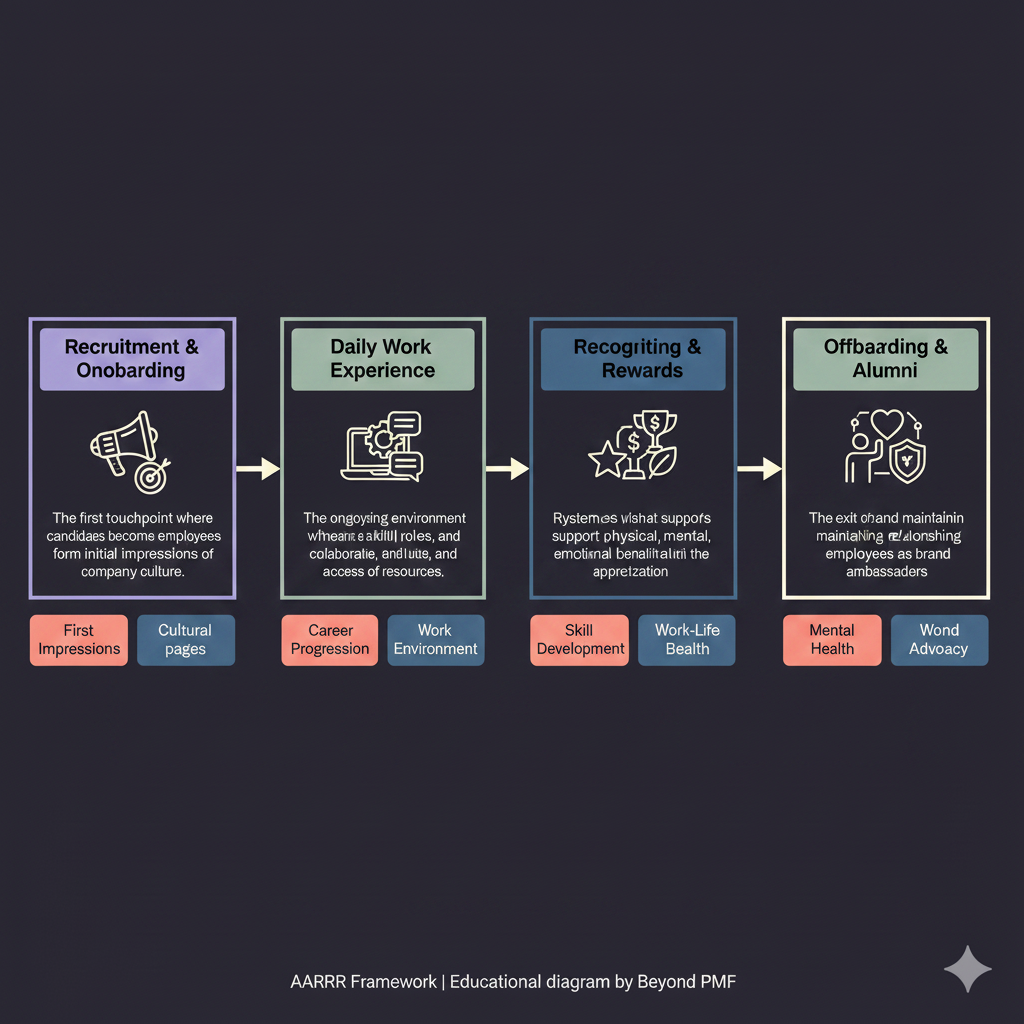
Employee Experience Framework

https://ik.imagekit.io/beyondpmf/frameworks/employee-experience-framework.png
The Employee Experience Framework aims to improve the 'entire employee lifecycle,' implying a focus on how employees experience the organization. This suggests a direct impact on the day-to-day interactions and perceived value provided by the company, making it primarily focused on execution and the experience delivered to employees.

The Employee Experience Framework is a comprehensive approach that organizations use to manage and improve every aspect of an employee's journey within the company. It encompasses everything from recruitment and onboarding to development, retention, and exit processes. By focusing on creating a positive, engaging, and supportive environment, this framework aims to boost employee satisfaction, increase retention rates, and enhance overall organizational performance.

Steps / Detailed Description

Define the employee journey stages: Map out the key phases of the employee lifecycle within the organization. | Gather employee feedback: Use surveys, interviews, and other tools to understand employee needs and expectations. | Implement targeted initiatives: Develop programs and policies tailored to improve experiences at each stage of the employee journey. | Measure and analyze: Regularly assess the effectiveness of implemented initiatives through metrics and feedback. | Iterate and improve: Continuously refine strategies based on analytical insights and changing employee expectations.

Best Practices

Regularly update and adapt the framework to align with organizational changes and employee feedback | Ensure top management buy-in and involvement for effective implementation | Use a personalized approach to address diverse employee needs and expectations

Pros

Increases employee satisfaction and engagement | Improves retention rates and reduces turnover | Enhances overall organizational performance

Cons

Can be resource-intensive to implement and maintain | Requires continuous investment in feedback tools and employee development programs | May not yield immediate results, as cultural shifts take time

When to Use

When aiming to improve overall employee satisfaction and engagement | During organizational restructuring or significant changes to enhance employee adaptation and morale

When Not to Use

In very small organizations where informal feedback and adjustments may suffice | When immediate, short-term results are required, as the benefits of this framework develop over time

Related Frameworks

Lifecycle

Not tied to a specific lifecycle stage

Scope

Scope not defined

Maturity Level

Maturity level not specified

Time to Implement

2–4 Weeks
3–6 Months
1–2 Weeks
3–6 Months
1–2 Months
3–6 Months
1–2 Weeks
Less Than 1 Day
1–2 Weeks
Longer Than 6 Months
1–2 Weeks
Longer Than 6 Months
1–2 Weeks
3–6 Months
1–2 Weeks
1–2 Weeks
1–2 Weeks
1–2 Weeks
1–2 Days
1–2 Weeks
1–2 Weeks
1–2 Weeks
1–2 Weeks
1–2 Weeks
1–2 Weeks
3–6 Months
1–2 Weeks
1–2 Weeks
1–2 Weeks
3–6 Months
1–2 Weeks
1–2 Weeks
2–4 Weeks
1–2 Weeks
1–2 Days
1–2 Weeks
Longer Than 6 Months
3–6 Months
Longer Than 6 Months
1–2 Weeks
Longer Than 6 Months
3–6 Months
Less Than 1 Day
3–6 Months
1–2 Months
3–6 Months
Longer Than 6 Months
3–6 Months
Less Than 1 Day
1–2 Weeks
3–6 Months
3–6 Months
1–2 Weeks
3–6 Months
1–2 Weeks
1–2 Weeks
1–2 Days
1–2 Weeks
1–2 Months
Longer Than 6 Months
1–2 Weeks
Longer Than 6 Months
1–2 Weeks
3–6 Months
1–2 Weeks
Less Than 1 Day
1–2 Weeks
3–6 Months
1–2 Weeks
3–6 Months
1–2 Weeks
1–2 Weeks
Longer Than 6 Months
Less Than 1 Day
3–6 Months
Longer Than 6 Months
1–2 Months
1–2 Weeks
Longer Than 6 Months
1–2 Weeks
3–6 Months
1–2 Weeks
1–2 Weeks
3–6 Months
Less Than 1 Day
1–2 Weeks
1–2 Weeks
3–6 Months
3–6 Months
Less Than 1 Day
1–2 Weeks
Longer Than 6 Months
1–2 Months
1–2 Weeks
1–2 Weeks
1–2 Weeks
Longer Than 6 Months

Copyright Information

Autor:
Unknown
N/A
Publication:
Generic Business Tool