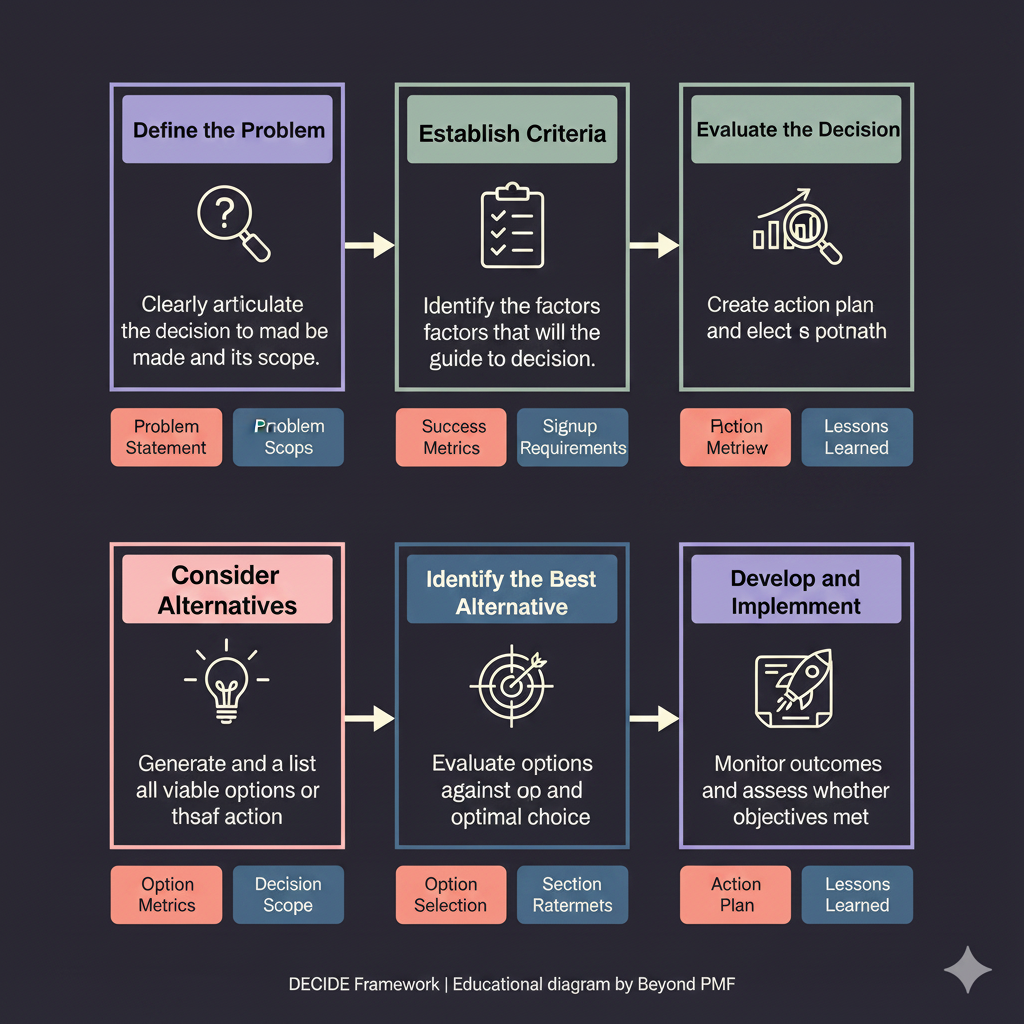
DECIDE Framework

https://ik.imagekit.io/beyondpmf/frameworks/decide-framework.png
The DECIDE framework helps organizations systematically evaluate options, which primarily addresses friction related to poor decision-making processes and a lack of clear governance. It aims to improve workflows around choices, leading to more coordinated action.

The DECIDE Framework is a structured approach used by businesses and organizations to enhance decision-making processes. It stands for Define the problem, Establish the criteria, Consider the alternatives, Identify the best alternative, Develop and implement a plan, and Evaluate the decision. This framework is beneficial because it ensures thoroughness in decision-making and helps prevent oversight by guiding users through a series of logical steps.

Steps / Detailed Description

Define the problem: Clearly identify the issue that needs resolution. | Establish the criteria: Set the standards that the ideal solution must meet. | Consider the alternatives: Generate a list of possible solutions. | Identify the best alternative: Evaluate each alternative against the established criteria and select the most suitable one. | Develop and implement a plan: Formulate a plan to implement the chosen alternative. | Evaluate the decision: Review the outcomes of the decision to ensure that the desired results are achieved.

Best Practices

Clearly define and communicate the problem to all stakeholders | Use objective criteria for decision-making | Regularly review and refine the decision-making process

Pros

Promotes systematic and thorough analysis | Helps in identifying the best possible solution | Facilitates accountability and transparency in decision-making

Cons

Can be time-consuming | May not be suitable for quick decision needs | Possibility of over-analysis or paralysis by analysis

When to Use

When facing complex decisions with long-term impacts | When multiple stakeholders are involved and require a structured decision process

When Not to Use

In crisis situations requiring immediate action | When decisions are minor and do not justify a detailed analysis

Related Frameworks

Categories

Lifecycle

Scope

Scope not defined

Maturity Level

Maturity level not specified

Time to Implement

2–4 Weeks
3–6 Months
1–2 Weeks
3–6 Months
1–2 Months
3–6 Months
1–2 Weeks
Less Than 1 Day
1–2 Weeks
Longer Than 6 Months
1–2 Weeks
Longer Than 6 Months
1–2 Weeks
3–6 Months
1–2 Weeks
1–2 Weeks
1–2 Weeks
1–2 Weeks
1–2 Days
1–2 Weeks
1–2 Weeks
1–2 Weeks
1–2 Weeks
1–2 Weeks
1–2 Weeks
3–6 Months
1–2 Weeks
1–2 Weeks
1–2 Weeks
3–6 Months
1–2 Weeks
1–2 Weeks
2–4 Weeks
1–2 Weeks
1–2 Days
1–2 Weeks
Longer Than 6 Months
3–6 Months
Longer Than 6 Months
1–2 Weeks
Longer Than 6 Months
3–6 Months
Less Than 1 Day
3–6 Months
1–2 Months
3–6 Months
Longer Than 6 Months
3–6 Months
Less Than 1 Day
1–2 Weeks
3–6 Months
3–6 Months
1–2 Weeks
3–6 Months
1–2 Weeks
1–2 Weeks
1–2 Days
1–2 Weeks
1–2 Months
Longer Than 6 Months
1–2 Weeks
Longer Than 6 Months
1–2 Weeks
3–6 Months
1–2 Weeks
Less Than 1 Day
1–2 Weeks
3–6 Months
1–2 Weeks
3–6 Months
1–2 Weeks
1–2 Weeks
Longer Than 6 Months
Less Than 1 Day
3–6 Months
Longer Than 6 Months
1–2 Months
1–2 Weeks
Longer Than 6 Months
1–2 Weeks
3–6 Months
1–2 Weeks
1–2 Weeks
3–6 Months
Less Than 1 Day
1–2 Weeks
1–2 Weeks
3–6 Months
3–6 Months
Less Than 1 Day
1–2 Weeks
Longer Than 6 Months
1–2 Months
1–2 Weeks
1–2 Weeks
1–2 Weeks
Longer Than 6 Months

Copyright Information

Autor:
Public Domain
N/A
Publication:
Generic Business Tool