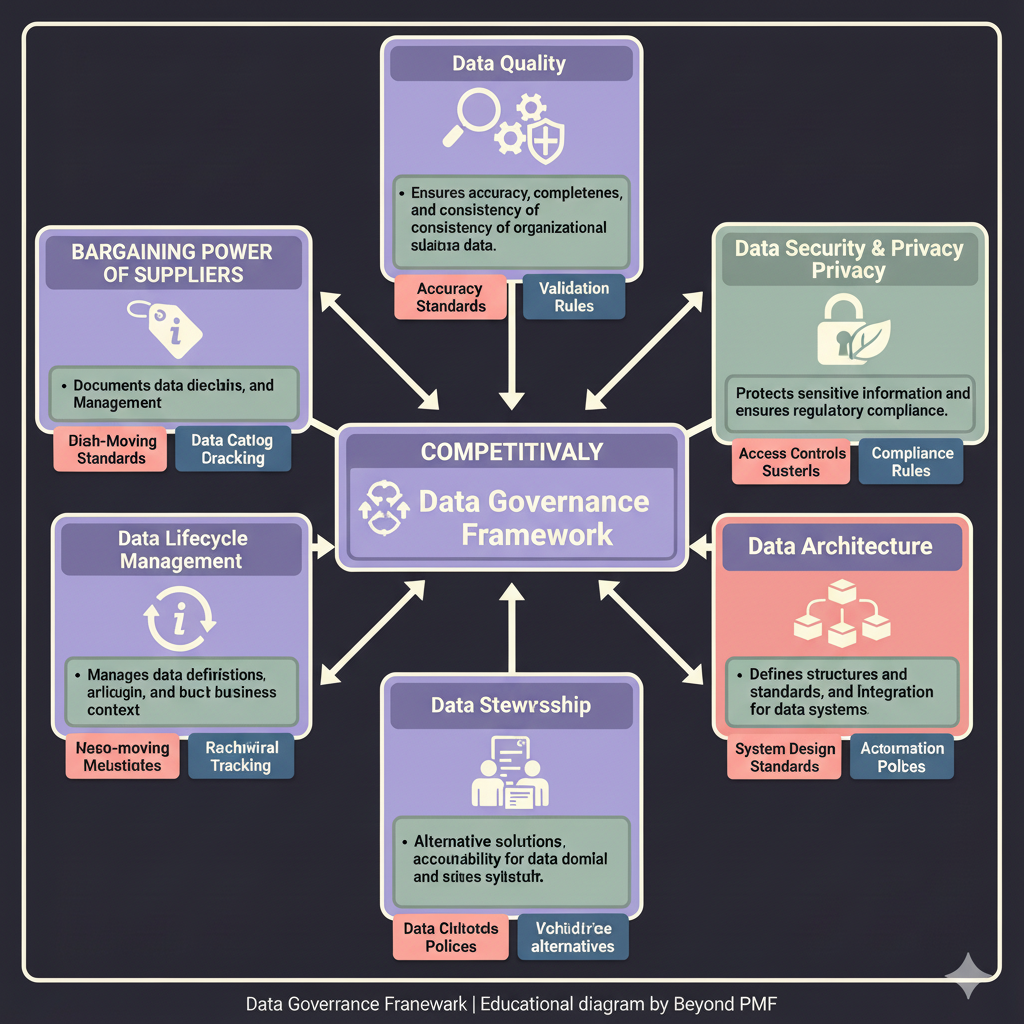
Data Governance Framework

https://ik.imagekit.io/beyondpmf/frameworks/data-governance-framework.png
The Data Governance Framework primarily addresses friction in data management processes, workflows, and the overall coordination required to ensure data availability, usability, integrity, and security across the enterprise. It focuses on establishing clear governance mechanisms to streamline data-related activities.

The Data Governance Framework is a set of processes, policies, standards, and metrics that ensure the effective and efficient use of information in enabling an organization to achieve its goals. It encompasses the roles, responsibilities, and controls to ensure data accuracy, privacy, and access. This framework helps organizations in consistent data handling, enhances decision-making, and ensures compliance with regulations and standards.

Steps / Detailed Description

Define data governance goals aligned with business objectives. | Establish data governance structure including roles and responsibilities. | Develop and implement data policies and standards. | Monitor and enforce compliance with data governance policies. | Continuously improve data governance practices based on feedback and changing needs.

Best Practices

Engage stakeholders from all levels of the organization. | Regularly review and update data governance policies. | Invest in training and awareness programs for all employees.

Pros

Improves data quality and consistency across the organization. | Enhances compliance with legal and regulatory requirements. | Facilitates better decision-making by providing accurate and timely data.

Cons

Can be resource-intensive to implement and maintain. | May encounter resistance from staff due to changes in processes. | Risk of becoming overly bureaucratic, slowing down data-related processes.

When to Use

When managing large volumes of data across various departments. | When compliance with data protection regulations is required.

When Not to Use

In very small organizations where data handling is minimal. | When rapid, ad-hoc decision making is more valued than data accuracy.

Related Frameworks

Lifecycle

Not tied to a specific lifecycle stage

Scope

Scope not defined

Maturity Level

Maturity level not specified

Time to Implement

2–4 Weeks
3–6 Months
1–2 Weeks
3–6 Months
1–2 Months
3–6 Months
1–2 Weeks
Less Than 1 Day
1–2 Weeks
Longer Than 6 Months
1–2 Weeks
Longer Than 6 Months
1–2 Weeks
3–6 Months
1–2 Weeks
1–2 Weeks
1–2 Weeks
1–2 Weeks
1–2 Days
1–2 Weeks
1–2 Weeks
1–2 Weeks
1–2 Weeks
1–2 Weeks
1–2 Weeks
3–6 Months
1–2 Weeks
1–2 Weeks
1–2 Weeks
3–6 Months
1–2 Weeks
1–2 Weeks
2–4 Weeks
1–2 Weeks
1–2 Days
1–2 Weeks
Longer Than 6 Months
3–6 Months
Longer Than 6 Months
1–2 Weeks
Longer Than 6 Months
3–6 Months
Less Than 1 Day
3–6 Months
1–2 Months
3–6 Months
Longer Than 6 Months
3–6 Months
Less Than 1 Day
1–2 Weeks
3–6 Months
3–6 Months
1–2 Weeks
3–6 Months
1–2 Weeks
1–2 Weeks
1–2 Days
1–2 Weeks
1–2 Months
Longer Than 6 Months
1–2 Weeks
Longer Than 6 Months
1–2 Weeks
3–6 Months
1–2 Weeks
Less Than 1 Day
1–2 Weeks
3–6 Months
1–2 Weeks
3–6 Months
1–2 Weeks
1–2 Weeks
Longer Than 6 Months
Less Than 1 Day
3–6 Months
Longer Than 6 Months
1–2 Months
1–2 Weeks
Longer Than 6 Months
1–2 Weeks
3–6 Months
1–2 Weeks
1–2 Weeks
3–6 Months
Less Than 1 Day
1–2 Weeks
1–2 Weeks
3–6 Months
3–6 Months
Less Than 1 Day
1–2 Weeks
Longer Than 6 Months
1–2 Months
1–2 Weeks
1–2 Weeks
1–2 Weeks
Longer Than 6 Months

Copyright Information

Autor:
Unknown
N/A
Publication:
Generic Business Tool