
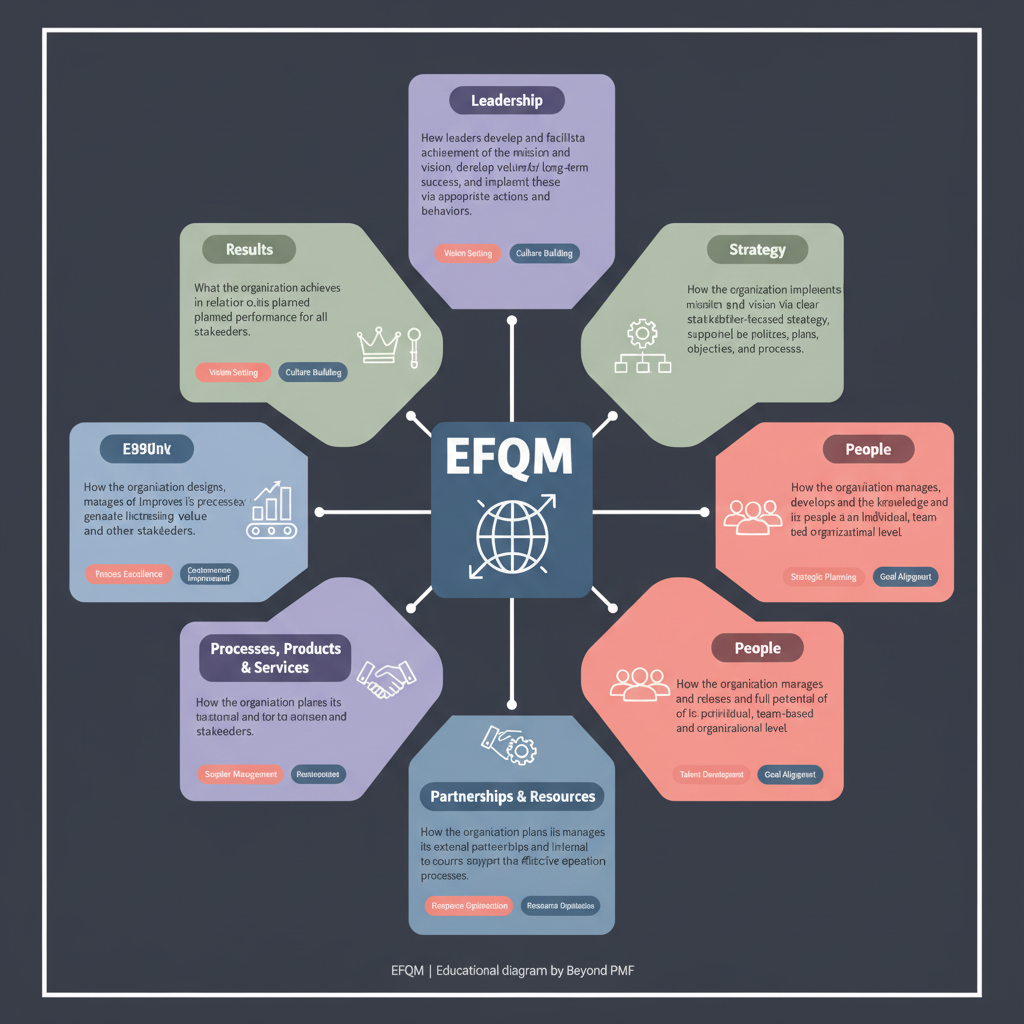
The EFQM (European Foundation for Quality Management) Model is a comprehensive management framework used by organizations to improve performance and achieve excellence. It provides a holistic tool for assessing where organizations are on the path to excellence, helping them understand their gaps, and offering solutions for improvement. The framework encourages organizations to be sustainable by balancing the needs of all stakeholders. It is widely used across Europe and globally by organizations seeking to implement a culture of continuous improvement.
Understand the EFQM Model and its criteria. | Conduct a self-assessment of the organization against the EFQM criteria. | Analyze the results to identify gaps and areas of improvement. | Develop an action plan based on the assessment findings. | Implement the action plan and monitor progress. | Review and refine the strategy and processes based on feedback and new insights.
Regularly update training and development for staff on the EFQM model. | Engage all stakeholders in the assessment and improvement processes. | Use the model as a guide rather than a strict rulebook.
Promotes a holistic approach to organizational improvement. | Facilitates benchmarking and self-assessment. | Encourages continuous improvement and innovation.
Can be complex and time-consuming to implement. | May require significant resources and training. | Risk of focusing too much on scoring rather than actual improvement.
When seeking a structured approach to improve organizational performance. | When aiming to align various aspects of the organization towards common goals.
If the organization lacks the resources to fully commit to the comprehensive assessment process. | When immediate, short-term fixes are needed over long-term strategic improvement.