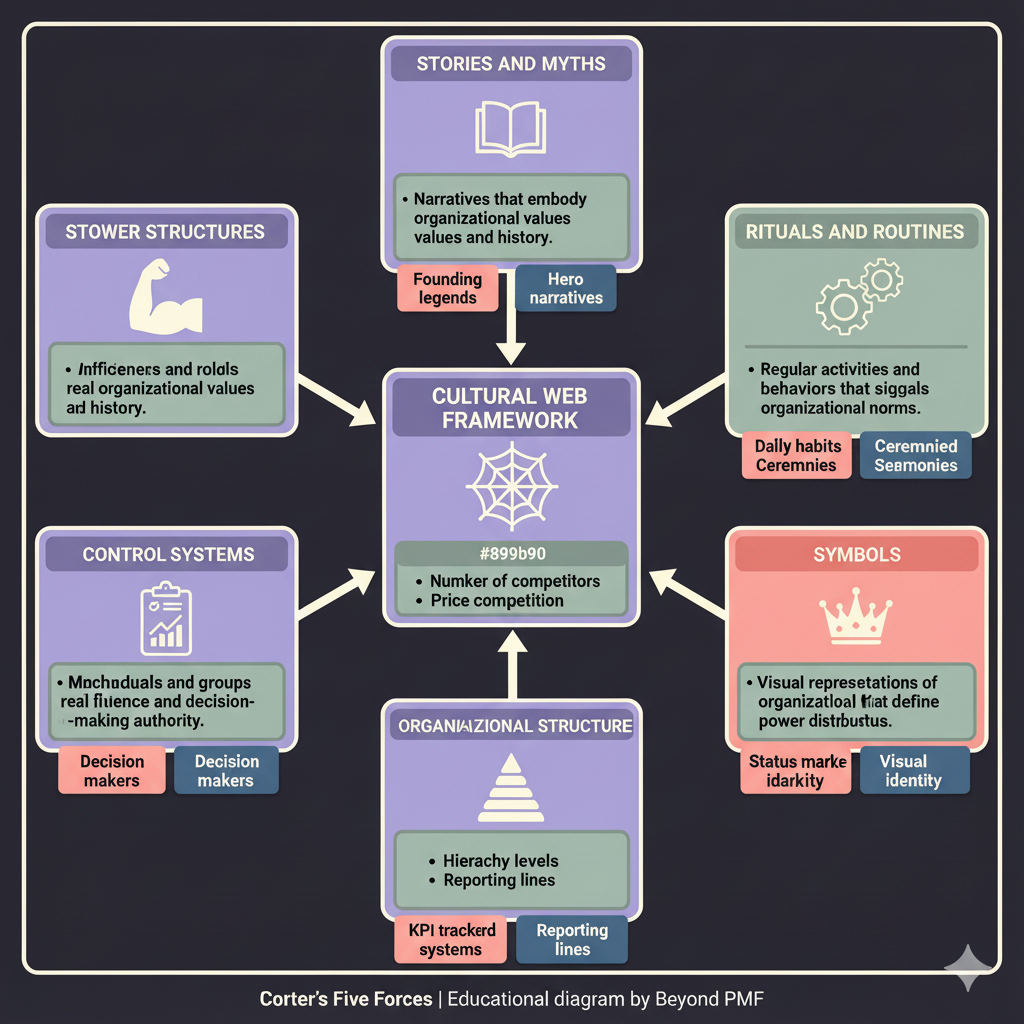
Cultural Web Framework

https://ik.imagekit.io/beyondpmf/frameworks/cultural-web-framework.png
The Cultural Web Framework primarily addresses the friction caused by misaligned organizational structures and the impact of cultural paradigms on these structures. It helps uncover hidden assumptions and behaviors that may impede effective organizational design, cross-functional collaboration, and clear ownership.

The Cultural Web Framework, developed by Gerry Johnson and Kevan Scholes, is a strategic tool focused on examining the cultural aspects of an organization. It assesses six elements that contribute to the organizational culture: stories, symbols, power structures, organizational structures, control systems, and rituals and routines. This framework is particularly useful for understanding the underlying assumptions and practices that shape the behavior and decisions within an organization, thereby aiding in effective cultural change management.

Steps / Detailed Description

Identify and describe the six elements of the cultural web: stories, symbols, power structures, organizational structures, control systems, and rituals and routines. | Analyze how these elements currently support or contradict the desired organizational culture. | Identify the paradigm - the set of assumptions that are taken for granted within the organization. | Develop strategies to reinforce or change elements of the cultural web to better align with strategic goals.

Best Practices

Engage a wide range of employees to get a holistic view of the culture | Regularly review and update the cultural analysis | Use findings to inform strategic decisions and change management initiatives

Pros

Provides a comprehensive view of organizational culture | Facilitates targeted cultural change | Enhances understanding of informal influences within an organization

Cons

Can be time-consuming to implement | Requires deep insight into informal organizational behaviors | May face resistance from employees accustomed to the existing culture

When to Use

During periods of strategic change | When merging with or acquiring another company

When Not to Use

In very small or newly established organizations | When there is no clear need for cultural assessment or change

Related Frameworks

Lifecycle

Not tied to a specific lifecycle stage

Scope

Scope not defined

Maturity Level

Maturity level not specified

Time to Implement

2–4 Weeks
3–6 Months
1–2 Weeks
3–6 Months
1–2 Months
3–6 Months
1–2 Weeks
Less Than 1 Day
1–2 Weeks
Longer Than 6 Months
1–2 Weeks
Longer Than 6 Months
1–2 Weeks
3–6 Months
1–2 Weeks
1–2 Weeks
1–2 Weeks
1–2 Weeks
1–2 Days
1–2 Weeks
1–2 Weeks
1–2 Weeks
1–2 Weeks
1–2 Weeks
1–2 Weeks
3–6 Months
1–2 Weeks
1–2 Weeks
1–2 Weeks
3–6 Months
1–2 Weeks
1–2 Weeks
2–4 Weeks
1–2 Weeks
1–2 Days
1–2 Weeks
Longer Than 6 Months
3–6 Months
Longer Than 6 Months
1–2 Weeks
Longer Than 6 Months
3–6 Months
Less Than 1 Day
3–6 Months
1–2 Months
3–6 Months
Longer Than 6 Months
3–6 Months
Less Than 1 Day
1–2 Weeks
3–6 Months
3–6 Months
1–2 Weeks
3–6 Months
1–2 Weeks
1–2 Weeks
1–2 Days
1–2 Weeks
1–2 Months
Longer Than 6 Months
1–2 Weeks
Longer Than 6 Months
1–2 Weeks
3–6 Months
1–2 Weeks
Less Than 1 Day
1–2 Weeks
3–6 Months
1–2 Weeks
3–6 Months
1–2 Weeks
1–2 Weeks
Longer Than 6 Months
Less Than 1 Day
3–6 Months
Longer Than 6 Months
1–2 Months
1–2 Weeks
Longer Than 6 Months
1–2 Weeks
3–6 Months
1–2 Weeks
1–2 Weeks
3–6 Months
Less Than 1 Day
1–2 Weeks
1–2 Weeks
3–6 Months
3–6 Months
Less Than 1 Day
1–2 Weeks
Longer Than 6 Months
1–2 Months
1–2 Weeks
1–2 Weeks
1–2 Weeks
Longer Than 6 Months

Copyright Information

Autor:
Johnson, Scholes and Whittington
2005
Publication:
Exploring Corporate Strategy