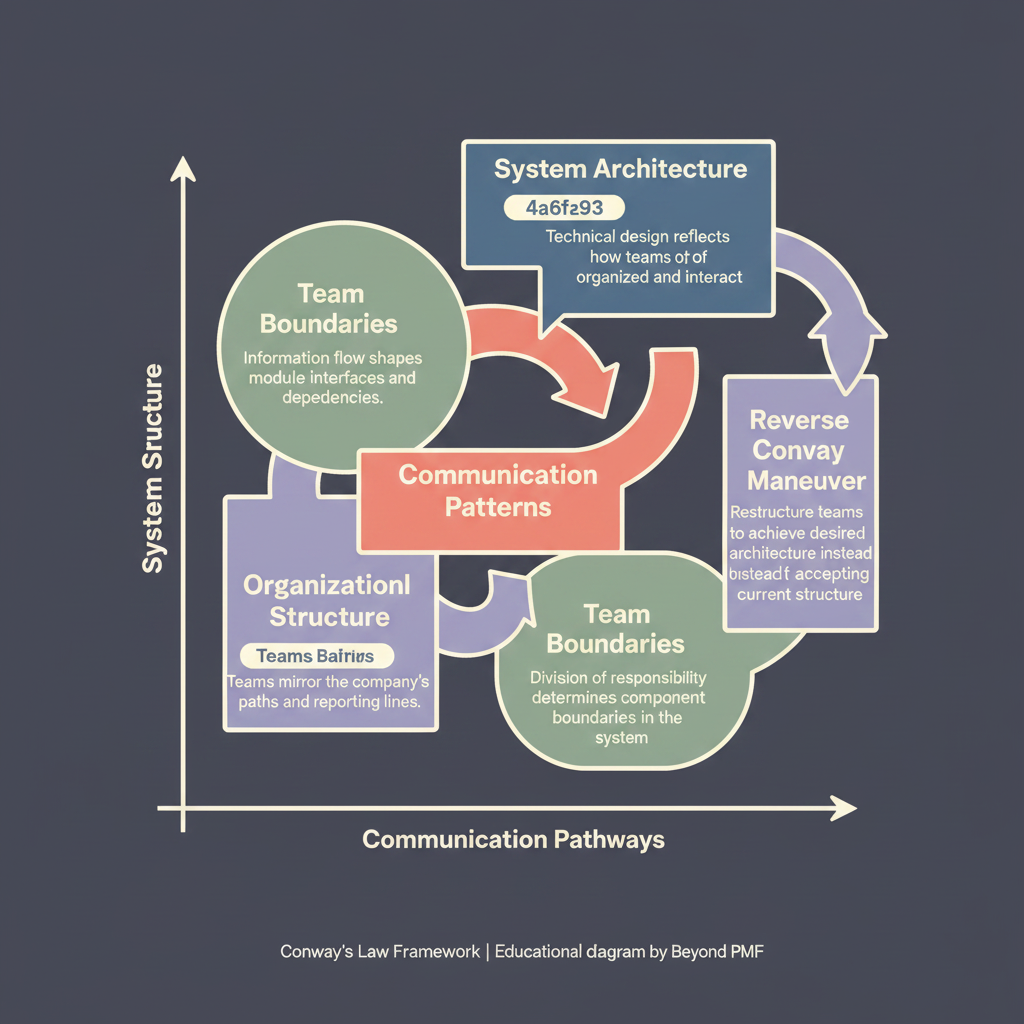
Conway's Law Framework

https://ik.imagekit.io/beyondpmf/frameworks/conways-law-framework.png
Conway's Law highlights friction caused by misaligned organizational structures. It predicts that the architecture of a system will reflect the communication structure of the organization, leading to issues if the organization isn't designed to support the desired system architecture.

Conway's Law Framework is based on the observation by Melvin Conway in 1967 that organizations are constrained to produce designs which are copies of their own communication structures. This framework is used to understand and predict the structure of systems based on the structure of the organization. It is particularly beneficial in the context of software development and organizational design, helping businesses align their system architectures with their organizational structures for more coherent and efficient outcomes.

Steps / Detailed Description

Analyze the current organizational structure. | Identify the communication patterns within the organization. | Map these patterns against the architecture of the current systems. | Identify discrepancies and areas for improvement. | Implement changes to the organizational structure or systems architecture as needed.

Best Practices

Regularly review and update communication structures and system architectures | Encourage cross-departmental communication to foster more integrated system designs | Use organizational changes as opportunities to rethink and realign system architectures

Pros

Promotes alignment between organizational structure and system architecture | Enhances understanding of the impact of organizational decisions on system design | Facilitates more efficient communication and system development

Cons

Can limit design options to existing communication structures | May require significant organizational change to align with optimal system architectures | Potentially overlooks external factors influencing system design

When to Use

When designing new systems or overhauling existing ones | During organizational restructuring

When Not to Use

In highly dynamic environments where organizational structures frequently change | When external factors dictate system architecture more than internal communication

Related Frameworks

Lifecycle

Not tied to a specific lifecycle stage

Scope

Scope not defined

Maturity Level

Maturity level not specified

Time to Implement

2–4 Weeks
3–6 Months
1–2 Weeks
3–6 Months
1–2 Months
3–6 Months
1–2 Weeks
Less Than 1 Day
1–2 Weeks
Longer Than 6 Months
1–2 Weeks
Longer Than 6 Months
1–2 Weeks
3–6 Months
1–2 Weeks
1–2 Weeks
1–2 Weeks
1–2 Weeks
1–2 Days
1–2 Weeks
1–2 Weeks
1–2 Weeks
1–2 Weeks
1–2 Weeks
1–2 Weeks
3–6 Months
1–2 Weeks
1–2 Weeks
1–2 Weeks
3–6 Months
1–2 Weeks
1–2 Weeks
2–4 Weeks
1–2 Weeks
1–2 Days
1–2 Weeks
Longer Than 6 Months
3–6 Months
Longer Than 6 Months
1–2 Weeks
Longer Than 6 Months
3–6 Months
Less Than 1 Day
3–6 Months
1–2 Months
3–6 Months
Longer Than 6 Months
3–6 Months
Less Than 1 Day
1–2 Weeks
3–6 Months
3–6 Months
1–2 Weeks
3–6 Months
1–2 Weeks
1–2 Weeks
1–2 Days
1–2 Weeks
1–2 Months
Longer Than 6 Months
1–2 Weeks
Longer Than 6 Months
1–2 Weeks
3–6 Months
1–2 Weeks
Less Than 1 Day
1–2 Weeks
3–6 Months
1–2 Weeks
3–6 Months
1–2 Weeks
1–2 Weeks
Longer Than 6 Months
Less Than 1 Day
3–6 Months
Longer Than 6 Months
1–2 Months
1–2 Weeks
Longer Than 6 Months
1–2 Weeks
3–6 Months
1–2 Weeks
1–2 Weeks
3–6 Months
Less Than 1 Day
1–2 Weeks
1–2 Weeks
3–6 Months
3–6 Months
Less Than 1 Day
1–2 Weeks
Longer Than 6 Months
1–2 Months
1–2 Weeks
1–2 Weeks
1–2 Weeks
Longer Than 6 Months

Copyright Information

Autor:
Melvin Conway
1968
Publication:
Datamation