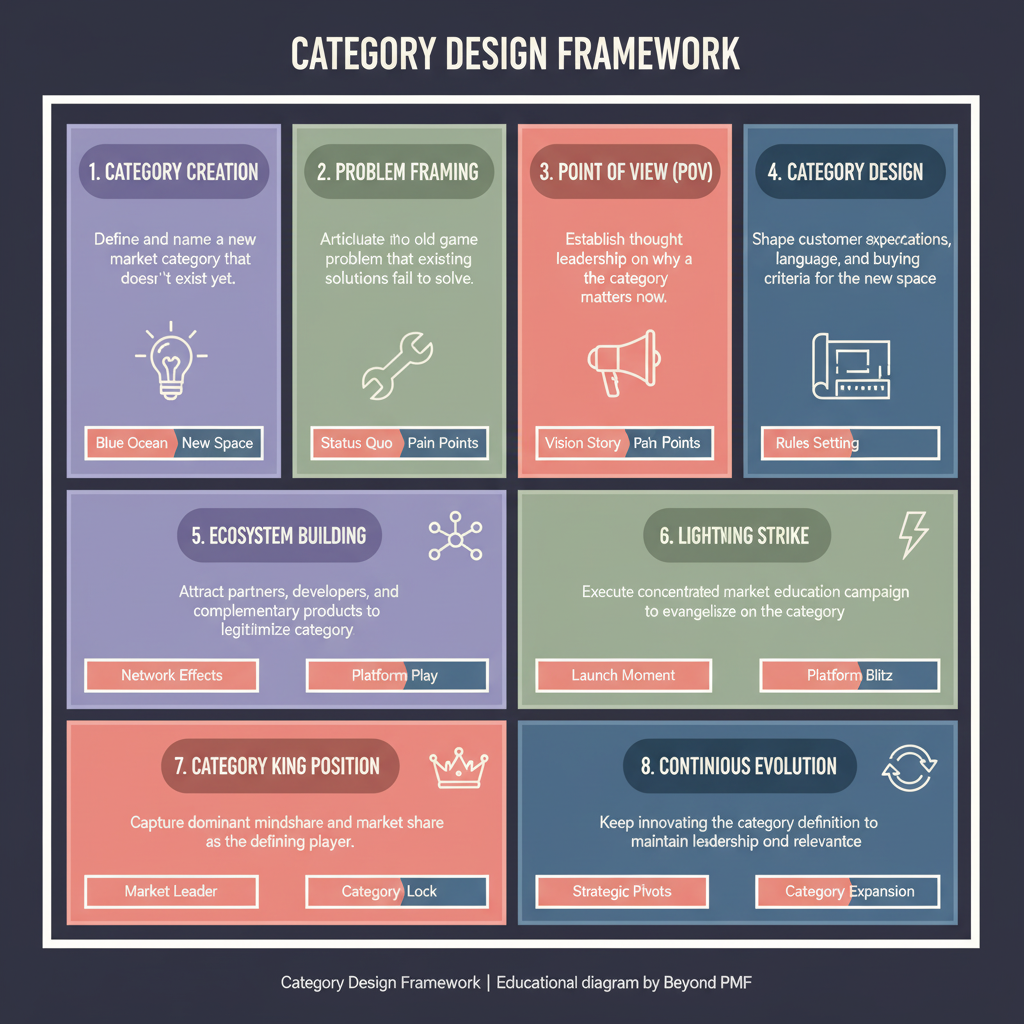
Category Design Framework

https://ik.imagekit.io/beyondpmf/frameworks/category-design-framework.png
The Category Design Framework focuses on creating new markets, which inherently involves defining vision, strategy, and market positioning. It addresses the friction of unclear market direction and the need for a well-defined business model in a new category.

The Category Design Framework involves identifying a market need that is not currently being met and developing a new category within that space to address it. This approach not only involves product innovation but also focuses on creating demand and establishing market leadership. The framework is used to help companies become category kings, capturing the majority of the market share and defining the terms on which competition occurs.

Steps / Detailed Description

Identify the Market White Space: Analyze the market to find unmet needs that offer the opportunity for a new category. | Define the Category: Clearly define what the new category is, how it differs from existing ones, and why it is necessary. | Create a Category POV (Point of View): Develop a unique narrative that explains the category's importance and its future impact. | Mobilize the Ecosystem: Engage with other companies, influencers, and thought leaders to promote and validate the new category. | Execute Category Launch: Implement a go-to-market strategy that includes product release, marketing campaigns, and sales strategies. | Iterate and Scale: Continuously refine the category definition and scale operations to maintain category leadership.

Best Practices

Continuously gather and incorporate feedback from early adopters | Align all company departments (marketing, sales, product) around the category design | Educate the market through thought leadership and content marketing

Pros

Establishes market leadership | Creates a loyal customer base | Allows for premium pricing due to unique positioning

Cons

High risk if the new category does not resonate with customers | Requires significant investment in market education | Potential isolation if competitors do not adopt the category

When to Use

When entering a saturated market with a unique product | When seeking to redefine an existing market with innovation

When Not to Use

In markets where customers are highly resistant to change | When immediate returns are necessary, as category design often requires long-term investment

Related Frameworks

Lifecycle

Scope

Scope not defined

Maturity Level

Maturity level not specified

Time to Implement

2–4 Weeks
3–6 Months
1–2 Weeks
3–6 Months
1–2 Months
3–6 Months
1–2 Weeks
Less Than 1 Day
1–2 Weeks
Longer Than 6 Months
1–2 Weeks
Longer Than 6 Months
1–2 Weeks
3–6 Months
1–2 Weeks
1–2 Weeks
1–2 Weeks
1–2 Weeks
1–2 Days
1–2 Weeks
1–2 Weeks
1–2 Weeks
1–2 Weeks
1–2 Weeks
1–2 Weeks
3–6 Months
1–2 Weeks
1–2 Weeks
1–2 Weeks
3–6 Months
1–2 Weeks
1–2 Weeks
2–4 Weeks
1–2 Weeks
1–2 Days
1–2 Weeks
Longer Than 6 Months
3–6 Months
Longer Than 6 Months
1–2 Weeks
Longer Than 6 Months
3–6 Months
Less Than 1 Day
3–6 Months
1–2 Months
3–6 Months
Longer Than 6 Months
3–6 Months
Less Than 1 Day
1–2 Weeks
3–6 Months
3–6 Months
1–2 Weeks
3–6 Months
1–2 Weeks
1–2 Weeks
1–2 Days
1–2 Weeks
1–2 Months
Longer Than 6 Months
1–2 Weeks
Longer Than 6 Months
1–2 Weeks
3–6 Months
1–2 Weeks
Less Than 1 Day
1–2 Weeks
3–6 Months
1–2 Weeks
3–6 Months
1–2 Weeks
1–2 Weeks
Longer Than 6 Months
Less Than 1 Day
3–6 Months
Longer Than 6 Months
1–2 Months
1–2 Weeks
Longer Than 6 Months
1–2 Weeks
3–6 Months
1–2 Weeks
1–2 Weeks
3–6 Months
Less Than 1 Day
1–2 Weeks
1–2 Weeks
3–6 Months
3–6 Months
Less Than 1 Day
1–2 Weeks
Longer Than 6 Months
1–2 Months
1–2 Weeks
1–2 Weeks
1–2 Weeks
Longer Than 6 Months

Copyright Information

Autor:
Unknown
N/A
Publication:
Unknown