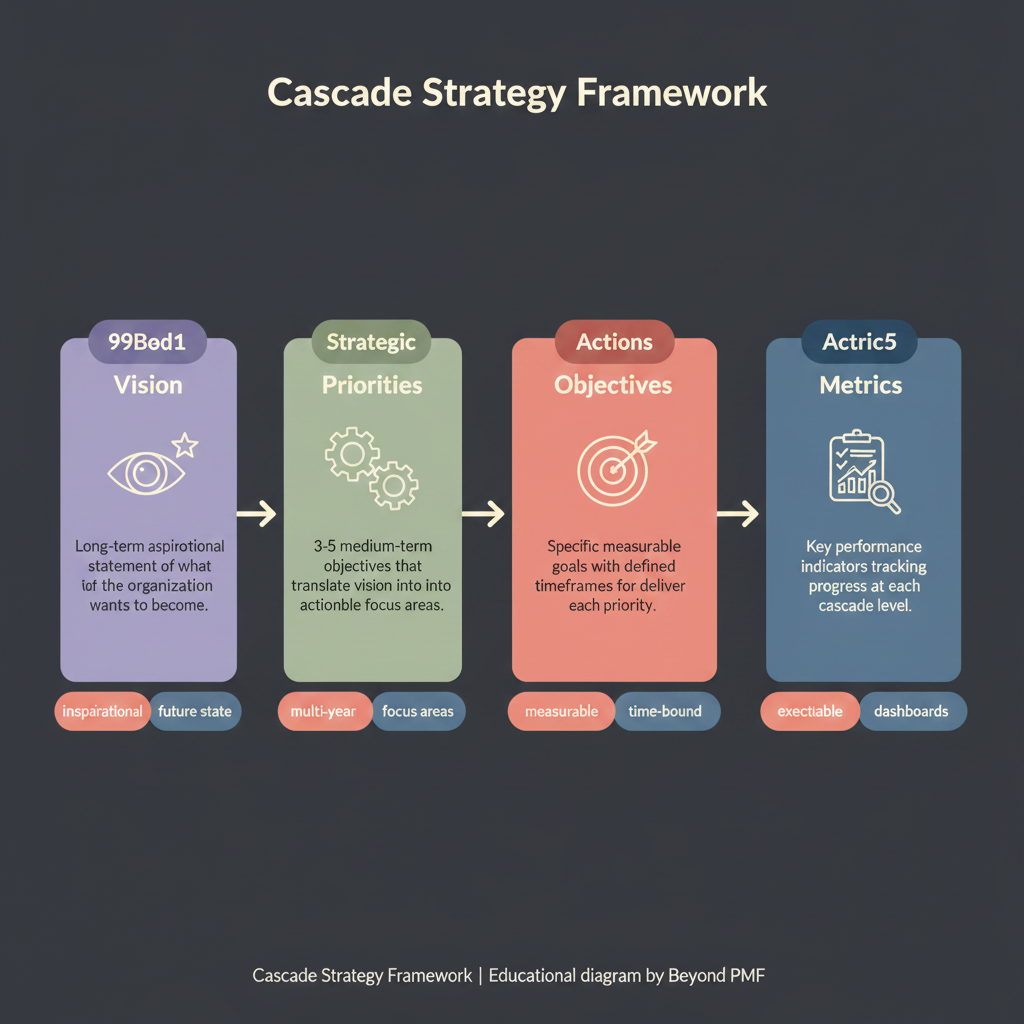
Cascade Strategy Framework

https://ik.imagekit.io/beyondpmf/frameworks/cascade-strategy-framework.png
The Cascade Strategy Framework primarily addresses structural friction by focusing on aligning strategic objectives across different organizational levels. This helps clarify roles, responsibilities, and decision-making, reducing ambiguity and improving cross-functional alignment.

The Cascade Strategy Framework is designed to help organizations effectively translate high-level strategic goals into actionable and specific objectives at various organizational levels. By ensuring that the strategic vision is understood and implemented across all departments, the framework facilitates a unified approach to achieving business goals. This alignment enhances accountability, improves performance tracking, and boosts overall organizational coherence and efficiency.

Steps / Detailed Description

Define the organization's vision and strategic goals at the top level. | Break down these high-level objectives into more specific goals for each department or team. | Communicate these goals clearly to all relevant stakeholders to ensure understanding and alignment. | Implement action plans at various levels to achieve these objectives. | Monitor progress and performance against these objectives regularly. | Adjust strategies and objectives as needed based on performance data and changing conditions.

Best Practices

Ensure clear communication of strategic goals at all levels | Regularly review and adjust goals as necessary | Encourage feedback from all levels to improve implementation

Pros

Enhances strategic alignment across the organization | Improves clarity and focus by breaking down goals | Facilitates better tracking and management of performance

Cons

Can be time-consuming to implement effectively | Requires high levels of communication and coordination | May lead to rigidity in adapting to new opportunities

When to Use

When aligning departmental goals with overall corporate strategy | When there is a need to improve organizational coherence and focus

When Not to Use

In very small or less hierarchical organizations where simpler methods may suffice | When rapid flexibility and adaptation to change are required

Related Frameworks

Lifecycle

Scope

Scope not defined

Maturity Level

Maturity level not specified

Time to Implement

2–4 Weeks
3–6 Months
1–2 Weeks
3–6 Months
1–2 Months
3–6 Months
1–2 Weeks
Less Than 1 Day
1–2 Weeks
Longer Than 6 Months
1–2 Weeks
Longer Than 6 Months
1–2 Weeks
3–6 Months
1–2 Weeks
1–2 Weeks
1–2 Weeks
1–2 Weeks
1–2 Days
1–2 Weeks
1–2 Weeks
1–2 Weeks
1–2 Weeks
1–2 Weeks
1–2 Weeks
3–6 Months
1–2 Weeks
1–2 Weeks
1–2 Weeks
3–6 Months
1–2 Weeks
1–2 Weeks
2–4 Weeks
1–2 Weeks
1–2 Days
1–2 Weeks
Longer Than 6 Months
3–6 Months
Longer Than 6 Months
1–2 Weeks
Longer Than 6 Months
3–6 Months
Less Than 1 Day
3–6 Months
1–2 Months
3–6 Months
Longer Than 6 Months
3–6 Months
Less Than 1 Day
1–2 Weeks
3–6 Months
3–6 Months
1–2 Weeks
3–6 Months
1–2 Weeks
1–2 Weeks
1–2 Days
1–2 Weeks
1–2 Months
Longer Than 6 Months
1–2 Weeks
Longer Than 6 Months
1–2 Weeks
3–6 Months
1–2 Weeks
Less Than 1 Day
1–2 Weeks
3–6 Months
1–2 Weeks
3–6 Months
1–2 Weeks
1–2 Weeks
Longer Than 6 Months
Less Than 1 Day
3–6 Months
Longer Than 6 Months
1–2 Months
1–2 Weeks
Longer Than 6 Months
1–2 Weeks
3–6 Months
1–2 Weeks
1–2 Weeks
3–6 Months
Less Than 1 Day
1–2 Weeks
1–2 Weeks
3–6 Months
3–6 Months
Less Than 1 Day
1–2 Weeks
Longer Than 6 Months
1–2 Months
1–2 Weeks
1–2 Weeks
1–2 Weeks
Longer Than 6 Months

Copyright Information

Autor:
Unknown
N/A
Publication:
Generic Business Tool