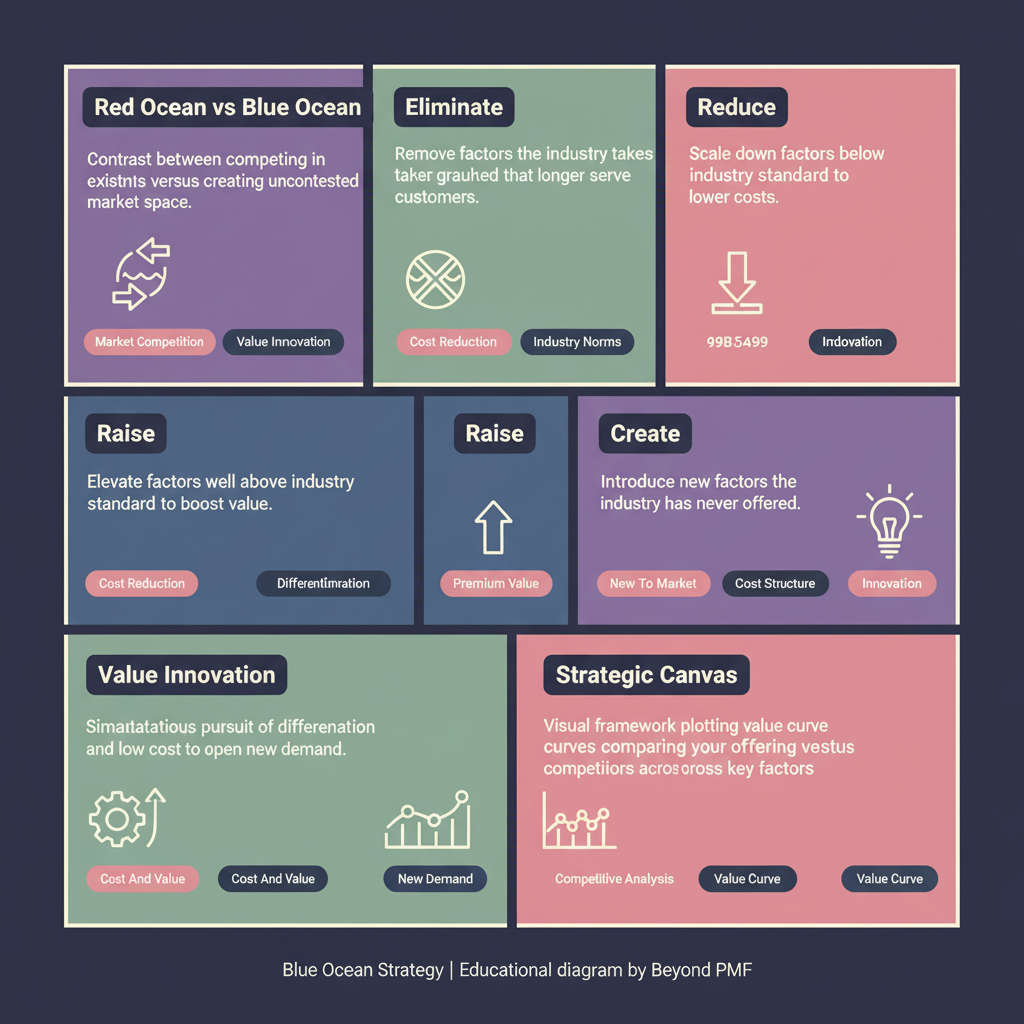
Blue Ocean Strategy

https://ik.imagekit.io/beyondpmf/frameworks/blue-ocean-strategy.png
Blue Ocean Strategy directly addresses the strategic friction of market positioning and business model. It helps organizations define a new strategic direction by creating uncontested market space, shifting focus from competing in existing, saturated markets (red oceans).

The Blue Ocean Strategy is a strategic planning model that posits that companies can succeed not by battling competitors, but rather by systematically creating new markets and demand in uncontested market spaces, thereby making the competition irrelevant. This approach encourages companies to innovate and create value in ways that render rivals obsolete, leading to higher profits and growth. The framework emphasizes the simultaneous pursuit of differentiation and low cost to open up a new market space and create new demand.

Steps / Detailed Description

Reconstruct market boundaries to break away from the competition. | Focus on the big picture, not the numbers. | Reach beyond existing demand to tap into non-customers. | Get the strategic sequence right to ensure viability. | Overcome organizational hurdles and embed execution into strategy.

Best Practices

Conduct thorough market research to identify non-customers. | Use visual tools to understand the current market landscape and explore new possibilities. | Regularly reassess and adapt strategies based on market feedback and changes.

Pros

Encourages innovation and differentiation. | Reduces competition by creating new market spaces. | Can lead to substantial and sustainable growth.

Cons

Risk of uncertainty and failure in untested markets. | Requires significant investment in research and development. | Difficult to predict market response and customer behavior in new markets.

When to Use

When a company seeks to escape a highly competitive market. | When there is a need to innovate and capture new demand.

When Not to Use

In highly regulated industries where changes are limited. | When immediate returns are necessary and resources are limited.

Related Frameworks

Lifecycle

Scope

Scope not defined

Maturity Level

Maturity level not specified

Time to Implement

2–4 Weeks
3–6 Months
1–2 Weeks
3–6 Months
1–2 Months
3–6 Months
1–2 Weeks
Less Than 1 Day
1–2 Weeks
Longer Than 6 Months
1–2 Weeks
Longer Than 6 Months
1–2 Weeks
3–6 Months
1–2 Weeks
1–2 Weeks
1–2 Weeks
1–2 Weeks
1–2 Days
1–2 Weeks
1–2 Weeks
1–2 Weeks
1–2 Weeks
1–2 Weeks
1–2 Weeks
3–6 Months
1–2 Weeks
1–2 Weeks
1–2 Weeks
3–6 Months
1–2 Weeks
1–2 Weeks
2–4 Weeks
1–2 Weeks
1–2 Days
1–2 Weeks
Longer Than 6 Months
3–6 Months
Longer Than 6 Months
1–2 Weeks
Longer Than 6 Months
3–6 Months
Less Than 1 Day
3–6 Months
1–2 Months
3–6 Months
Longer Than 6 Months
3–6 Months
Less Than 1 Day
1–2 Weeks
3–6 Months
3–6 Months
1–2 Weeks
3–6 Months
1–2 Weeks
1–2 Weeks
1–2 Days
1–2 Weeks
1–2 Months
Longer Than 6 Months
1–2 Weeks
Longer Than 6 Months
1–2 Weeks
3–6 Months
1–2 Weeks
Less Than 1 Day
1–2 Weeks
3–6 Months
1–2 Weeks
3–6 Months
1–2 Weeks
1–2 Weeks
Longer Than 6 Months
Less Than 1 Day
3–6 Months
Longer Than 6 Months
1–2 Months
1–2 Weeks
Longer Than 6 Months
1–2 Weeks
3–6 Months
1–2 Weeks
1–2 Weeks
3–6 Months
Less Than 1 Day
1–2 Weeks
1–2 Weeks
3–6 Months
3–6 Months
Less Than 1 Day
1–2 Weeks
Longer Than 6 Months
1–2 Months
1–2 Weeks
1–2 Weeks
1–2 Weeks
Longer Than 6 Months

Copyright Information

Autor:
W. Chan Kim and RenΓ©e Mauborgne
2005
Publication:
Harvard Business Review