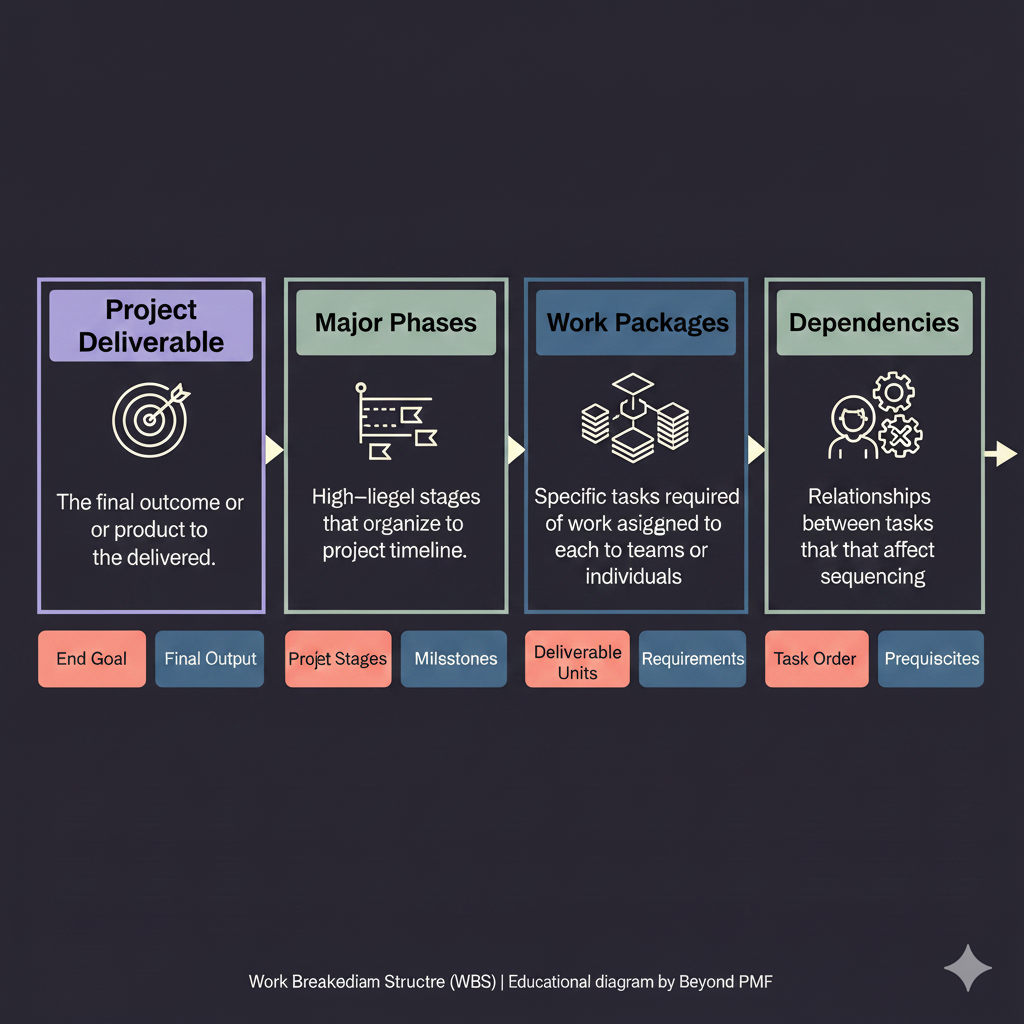
Work Breakdown Structure (WBS)

https://ik.imagekit.io/beyondpmf/frameworks/work-breakdown-structure-wbs.png
The Work Breakdown Structure primarily addresses the operational friction of ineffective project coordination and workflow management. It helps to break down complex projects into manageable components, improving the orchestration of tasks and handoffs.

The Work Breakdown Structure (WBS) is a hierarchical decomposition of a project into smaller, manageable components. It helps project managers and teams visualize the scope of work and ensure that all aspects of the project are covered. By breaking down projects into smaller tasks, the WBS facilitates better estimation, scheduling, and resource allocation, leading to more efficient project execution.

Steps / Detailed Description

  • Define the project and understand its scope.
  • Identify the major deliverables or phases.
  • Break down the deliverables into smaller components.
  • Assign responsibilities for each component.
  • Develop a detailed schedule and budget based on the breakdown.

Best Practices

  • Involve all stakeholders in the creation process
  • Keep the structure flexible for adjustments
  • Use software tools for efficient management

Pros

  • Improves project clarity and focus
  • Facilitates resource and time allocation
  • Enhances accountability and tracking

Cons

  • Can be time-consuming to develop
  • May become overly complex for small projects
  • Requires updates as project scope changes

When to Use

  • Complex projects requiring detailed planning
  • Projects with multiple teams and stakeholders

When Not to Use

  • Very small or straightforward projects
  • Projects with very tight timelines

Related Frameworks

Lifecycle

Scope

Scope not defined

Maturity Level

Maturity level not specified

Time to Implement

2–4 Weeks
3–6 Months
1–2 Weeks
3–6 Months
1–2 Months
3–6 Months
1–2 Weeks
Less Than 1 Day
1–2 Weeks
Longer Than 6 Months
1–2 Weeks
Longer Than 6 Months
1–2 Weeks
3–6 Months
1–2 Weeks
1–2 Weeks
1–2 Weeks
1–2 Weeks
1–2 Days
1–2 Weeks
1–2 Weeks
1–2 Weeks
1–2 Weeks
1–2 Weeks
1–2 Weeks
3–6 Months
1–2 Weeks
1–2 Weeks
1–2 Weeks
3–6 Months
1–2 Weeks
1–2 Weeks
2–4 Weeks
1–2 Weeks
1–2 Days
1–2 Weeks
Longer Than 6 Months
3–6 Months
Longer Than 6 Months
1–2 Weeks
Longer Than 6 Months
3–6 Months
Less Than 1 Day
3–6 Months
1–2 Months
3–6 Months
Longer Than 6 Months
3–6 Months
Less Than 1 Day
1–2 Weeks
3–6 Months
3–6 Months
1–2 Weeks
3–6 Months
1–2 Weeks
1–2 Weeks
1–2 Days
1–2 Weeks
1–2 Months
Longer Than 6 Months
1–2 Weeks
Longer Than 6 Months
1–2 Weeks
3–6 Months
1–2 Weeks
Less Than 1 Day
1–2 Weeks
3–6 Months
1–2 Weeks
3–6 Months
1–2 Weeks
1–2 Weeks
Longer Than 6 Months
Less Than 1 Day
3–6 Months
Longer Than 6 Months
1–2 Months
1–2 Weeks
Longer Than 6 Months
1–2 Weeks
3–6 Months
1–2 Weeks
1–2 Weeks
3–6 Months
Less Than 1 Day
1–2 Weeks
1–2 Weeks
3–6 Months
3–6 Months
Less Than 1 Day
1–2 Weeks
Longer Than 6 Months
1–2 Months
1–2 Weeks
1–2 Weeks
1–2 Weeks
Longer Than 6 Months

Copyright Information

Autor:
Public Domain
N/A
Publication:
Generic Business Tool