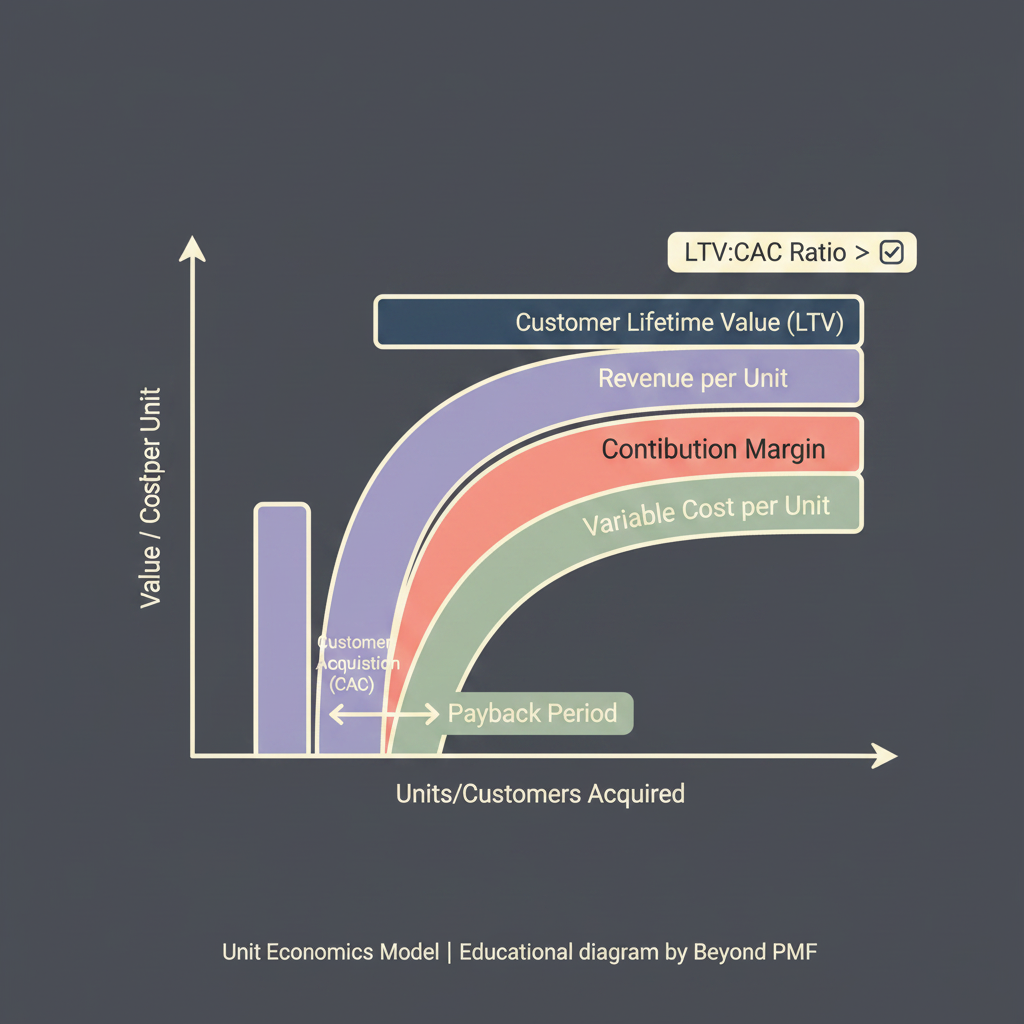
Unit Economics Model

https://ik.imagekit.io/beyondpmf/frameworks/unit-economics-model.png
The Unit Economics Model directly addresses the strategic friction of understanding and aligning the business model with profitability. It helps clarify financial viability by analyzing the revenue and costs associated with each unit sold, aiding in making informed decisions about product pricing, market segmentation, and overall business strategy.

The Unit Economics Model focuses on the profitability of a single unit of product or service sold by a company. It calculates the revenue and costs associated with one unit, providing insights into the direct revenues and costs related to a product or service. This model is crucial for businesses to determine whether their products are financially viable on a per-unit basis. It helps in pricing strategies, cost management, and overall financial planning, making it a fundamental tool for startups and established businesses alike.

Steps / Detailed Description

Identify the unit: Define what constitutes a 'unit' for your business (e.g., a single product, service hour, subscription). | Calculate unit revenue: Determine the revenue generated per unit sold. | Determine unit cost: Calculate all direct costs associated with producing or providing one unit. | Compute unit profit: Subtract the unit cost from the unit revenue to find the profit per unit. | Analyze results: Use the profit per unit to make strategic decisions about pricing, scaling, and product development.

Best Practices

Regularly update cost and revenue data to maintain accuracy | Consider both direct and indirect costs where applicable | Use historical data to forecast future unit economics

Pros

Provides clear insight into profitability per unit | Helps in making informed pricing and production decisions | Facilitates financial planning and forecasting

Cons

Does not account for fixed costs or overhead expenses | Can be misleading if unit costs are not constant | May oversimplify complex business models

When to Use

Assessing the viability of a new product | Optimizing pricing strategies for maximum profitability

When Not to Use

When fixed costs dominate the cost structure | In cases where unit costs are not easily attributable

Related Frameworks

Categories

Lifecycle

Not tied to a specific lifecycle stage

Scope

Scope not defined

Maturity Level

Maturity level not specified

Time to Implement

2–4 Weeks
3–6 Months
1–2 Weeks
3–6 Months
1–2 Months
3–6 Months
1–2 Weeks
Less Than 1 Day
1–2 Weeks
Longer Than 6 Months
1–2 Weeks
Longer Than 6 Months
1–2 Weeks
3–6 Months
1–2 Weeks
1–2 Weeks
1–2 Weeks
1–2 Weeks
1–2 Days
1–2 Weeks
1–2 Weeks
1–2 Weeks
1–2 Weeks
1–2 Weeks
1–2 Weeks
3–6 Months
1–2 Weeks
1–2 Weeks
1–2 Weeks
3–6 Months
1–2 Weeks
1–2 Weeks
2–4 Weeks
1–2 Weeks
1–2 Days
1–2 Weeks
Longer Than 6 Months
3–6 Months
Longer Than 6 Months
1–2 Weeks
Longer Than 6 Months
3–6 Months
Less Than 1 Day
3–6 Months
1–2 Months
3–6 Months
Longer Than 6 Months
3–6 Months
Less Than 1 Day
1–2 Weeks
3–6 Months
3–6 Months
1–2 Weeks
3–6 Months
1–2 Weeks
1–2 Weeks
1–2 Days
1–2 Weeks
1–2 Months
Longer Than 6 Months
1–2 Weeks
Longer Than 6 Months
1–2 Weeks
3–6 Months
1–2 Weeks
Less Than 1 Day
1–2 Weeks
3–6 Months
1–2 Weeks
3–6 Months
1–2 Weeks
1–2 Weeks
Longer Than 6 Months
Less Than 1 Day
3–6 Months
Longer Than 6 Months
1–2 Months
1–2 Weeks
Longer Than 6 Months
1–2 Weeks
3–6 Months
1–2 Weeks
1–2 Weeks
3–6 Months
Less Than 1 Day
1–2 Weeks
1–2 Weeks
3–6 Months
3–6 Months
Less Than 1 Day
1–2 Weeks
Longer Than 6 Months
1–2 Months
1–2 Weeks
1–2 Weeks
1–2 Weeks
Longer Than 6 Months

Copyright Information

Autor:
Public Domain
N/A
Publication:
Generic Business Tool