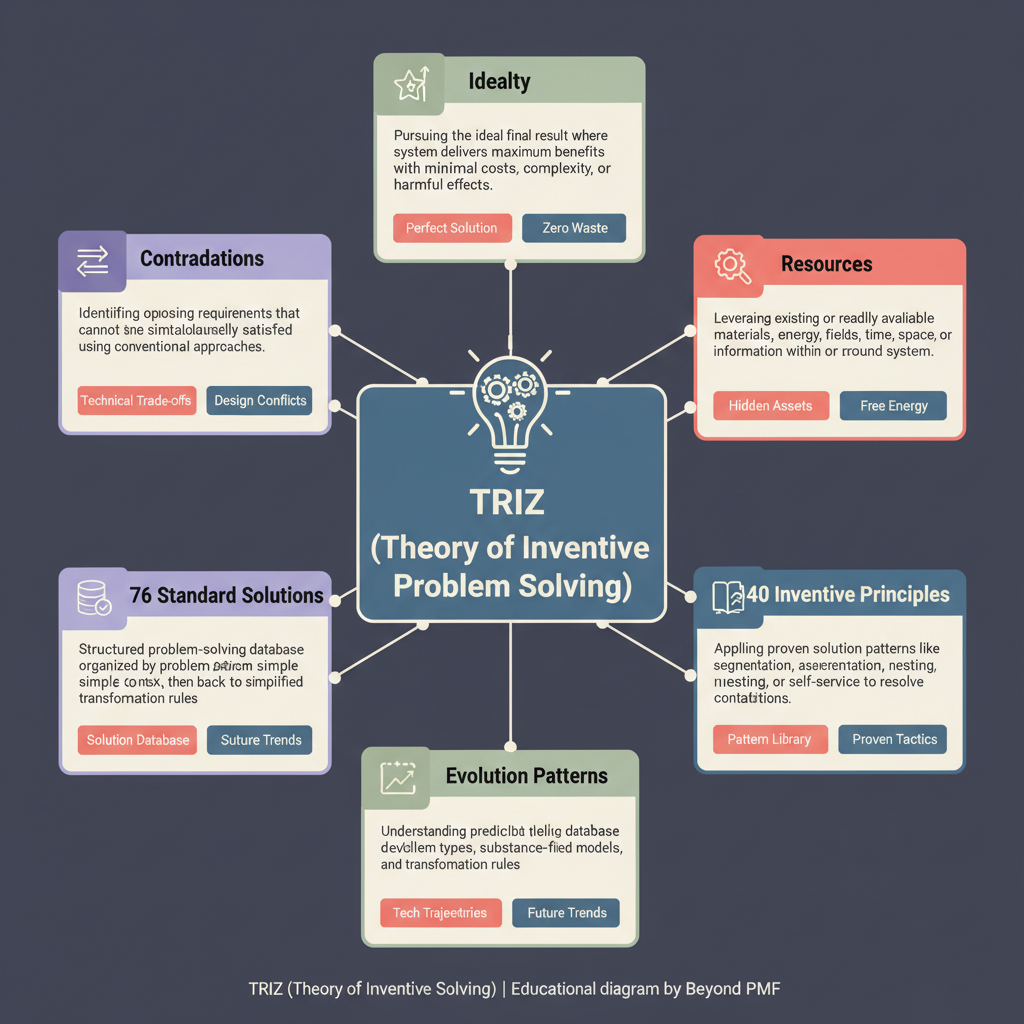
TRIZ (Theory of Inventive Problem Solving)

https://ik.imagekit.io/beyondpmf/frameworks/triz-theory-of-inventive-problem-solving.png
TRIZ is fundamentally a problem-solving methodology designed to overcome technical and practical challenges. While it might indirectly influence other areas, its core function is to facilitate the invention and resolution of technical problems, thus directly impacting the execution of projects and product development.

TRIZ is a systematic framework that aims to enhance the process of invention and creativity. It was developed by Soviet inventor and science fiction writer Genrich Altshuller and his colleagues, starting in 1946. The framework is based on the premise that the evolution of systems follows predictable patterns, and by understanding these patterns, inventors can more quickly develop innovative solutions to problems. TRIZ provides tools and strategies for problem analysis, idea generation, and the overcoming of technical contradictions.

Steps / Detailed Description

Define the problem and identify the need for an inventive solution. | Analyze the problem to find contradictions. | Use TRIZ principles to resolve contradictions and generate solutions. | Evaluate and select the best solution. | Implement the solution and verify its effectiveness.

Best Practices

Thoroughly define the problem before applying TRIZ. | Combine TRIZ with other innovation and design thinking tools. | Regularly update skills and knowledge in TRIZ methodologies.

Pros

Provides systematic approach to innovation. | Helps to overcome complex technical challenges. | Reduces the time and cost of development by leveraging existing solutions.

Cons

Requires training to use effectively. | Can be overly complex for simple problems. | May not be as effective in non-technical or highly unique situations.

When to Use

When needing to solve complex engineering or technical problems. | When looking for innovative solutions that bypass traditional trade-offs.

When Not to Use

For simple or straightforward problems where simpler tools can suffice. | In non-technical contexts where the assumptions of TRIZ may not apply.

Related Frameworks

Lifecycle

Not tied to a specific lifecycle stage

Scope

Scope not defined

Maturity Level

Maturity level not specified

Time to Implement

2–4 Weeks
3–6 Months
1–2 Weeks
3–6 Months
1–2 Months
3–6 Months
1–2 Weeks
Less Than 1 Day
1–2 Weeks
Longer Than 6 Months
1–2 Weeks
Longer Than 6 Months
1–2 Weeks
3–6 Months
1–2 Weeks
1–2 Weeks
1–2 Weeks
1–2 Weeks
1–2 Days
1–2 Weeks
1–2 Weeks
1–2 Weeks
1–2 Weeks
1–2 Weeks
1–2 Weeks
3–6 Months
1–2 Weeks
1–2 Weeks
1–2 Weeks
3–6 Months
1–2 Weeks
1–2 Weeks
2–4 Weeks
1–2 Weeks
1–2 Days
1–2 Weeks
Longer Than 6 Months
3–6 Months
Longer Than 6 Months
1–2 Weeks
Longer Than 6 Months
3–6 Months
Less Than 1 Day
3–6 Months
1–2 Months
3–6 Months
Longer Than 6 Months
3–6 Months
Less Than 1 Day
1–2 Weeks
3–6 Months
3–6 Months
1–2 Weeks
3–6 Months
1–2 Weeks
1–2 Weeks
1–2 Days
1–2 Weeks
1–2 Months
Longer Than 6 Months
1–2 Weeks
Longer Than 6 Months
1–2 Weeks
3–6 Months
1–2 Weeks
Less Than 1 Day
1–2 Weeks
3–6 Months
1–2 Weeks
3–6 Months
1–2 Weeks
1–2 Weeks
Longer Than 6 Months
Less Than 1 Day
3–6 Months
Longer Than 6 Months
1–2 Months
1–2 Weeks
Longer Than 6 Months
1–2 Weeks
3–6 Months
1–2 Weeks
1–2 Weeks
3–6 Months
Less Than 1 Day
1–2 Weeks
1–2 Weeks
3–6 Months
3–6 Months
Less Than 1 Day
1–2 Weeks
Longer Than 6 Months
1–2 Months
1–2 Weeks
1–2 Weeks
1–2 Weeks
Longer Than 6 Months

Copyright Information

Autor:
Genrich Altshuller
1946
Publication:
Unknown