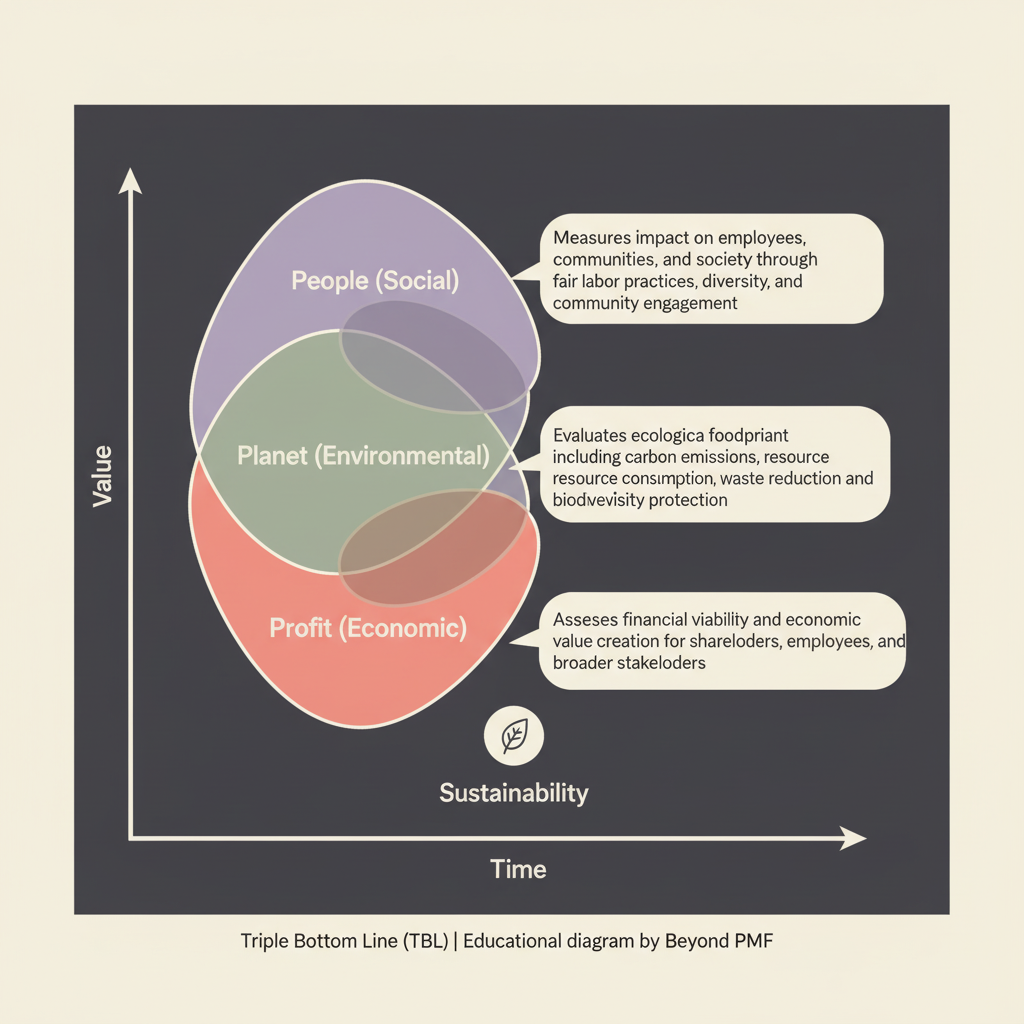
Triple Bottom Line (TBL)

https://ik.imagekit.io/beyondpmf/frameworks/triple-bottom-line-tbl.png
The Triple Bottom Line framework primarily addresses strategic friction by providing a framework for companies to define their purpose and success beyond purely financial metrics. It helps companies establish a broader vision and strategy by considering social and environmental impacts in addition to financial performance.

The Triple Bottom Line (TBL) framework encourages organizations to focus beyond the traditional financial bottom line to include social and environmental considerations. By evaluating performance in these three areasβ€”often referred to as 'people, planet, profit'β€”companies can aim for sustainability in their business practices, ensuring they are socially responsible, environmentally sound, and economically viable. The TBL framework helps businesses identify potential areas for improvement and align their operations with broader societal goals.

Steps / Detailed Description

Identify the key stakeholders and define their interests and concerns. | Establish clear metrics for measuring performance in the three areas: social, environmental, and financial. | Collect data and assess current performance against these metrics. | Develop strategies and initiatives to improve performance in each of the three areas. | Implement the strategies and monitor progress regularly. | Report the results to stakeholders and use feedback to refine approaches.

Best Practices

Engage stakeholders early and often to gain diverse insights. | Use standardized metrics for transparency and comparability. | Regularly review and update sustainability goals and practices.

Pros

Promotes a holistic approach to business sustainability. | Enhances corporate reputation and stakeholder trust. | Identifies new opportunities for innovation and cost savings.

Cons

Can be complex to implement and measure effectively. | May lead to conflicts between profit and social/environmental goals. | Requires significant resources and commitment.

When to Use

When aiming to enhance sustainability practices. | When seeking to balance financial performance with social and environmental responsibilities.

When Not to Use

If the organization lacks resources to implement comprehensive changes. | When immediate financial recovery is the sole focus.

Related Frameworks

Categories

Lifecycle

Not tied to a specific lifecycle stage

Scope

Scope not defined

Maturity Level

Maturity level not specified

Time to Implement

2–4 Weeks
3–6 Months
1–2 Weeks
3–6 Months
1–2 Months
3–6 Months
1–2 Weeks
Less Than 1 Day
1–2 Weeks
Longer Than 6 Months
1–2 Weeks
Longer Than 6 Months
1–2 Weeks
3–6 Months
1–2 Weeks
1–2 Weeks
1–2 Weeks
1–2 Weeks
1–2 Days
1–2 Weeks
1–2 Weeks
1–2 Weeks
1–2 Weeks
1–2 Weeks
1–2 Weeks
3–6 Months
1–2 Weeks
1–2 Weeks
1–2 Weeks
3–6 Months
1–2 Weeks
1–2 Weeks
2–4 Weeks
1–2 Weeks
1–2 Days
1–2 Weeks
Longer Than 6 Months
3–6 Months
Longer Than 6 Months
1–2 Weeks
Longer Than 6 Months
3–6 Months
Less Than 1 Day
3–6 Months
1–2 Months
3–6 Months
Longer Than 6 Months
3–6 Months
Less Than 1 Day
1–2 Weeks
3–6 Months
3–6 Months
1–2 Weeks
3–6 Months
1–2 Weeks
1–2 Weeks
1–2 Days
1–2 Weeks
1–2 Months
Longer Than 6 Months
1–2 Weeks
Longer Than 6 Months
1–2 Weeks
3–6 Months
1–2 Weeks
Less Than 1 Day
1–2 Weeks
3–6 Months
1–2 Weeks
3–6 Months
1–2 Weeks
1–2 Weeks
Longer Than 6 Months
Less Than 1 Day
3–6 Months
Longer Than 6 Months
1–2 Months
1–2 Weeks
Longer Than 6 Months
1–2 Weeks
3–6 Months
1–2 Weeks
1–2 Weeks
3–6 Months
Less Than 1 Day
1–2 Weeks
1–2 Weeks
3–6 Months
3–6 Months
Less Than 1 Day
1–2 Weeks
Longer Than 6 Months
1–2 Months
1–2 Weeks
1–2 Weeks
1–2 Weeks
Longer Than 6 Months

Copyright Information

Autor:
John Elkington
1994
Publication:
Unknown