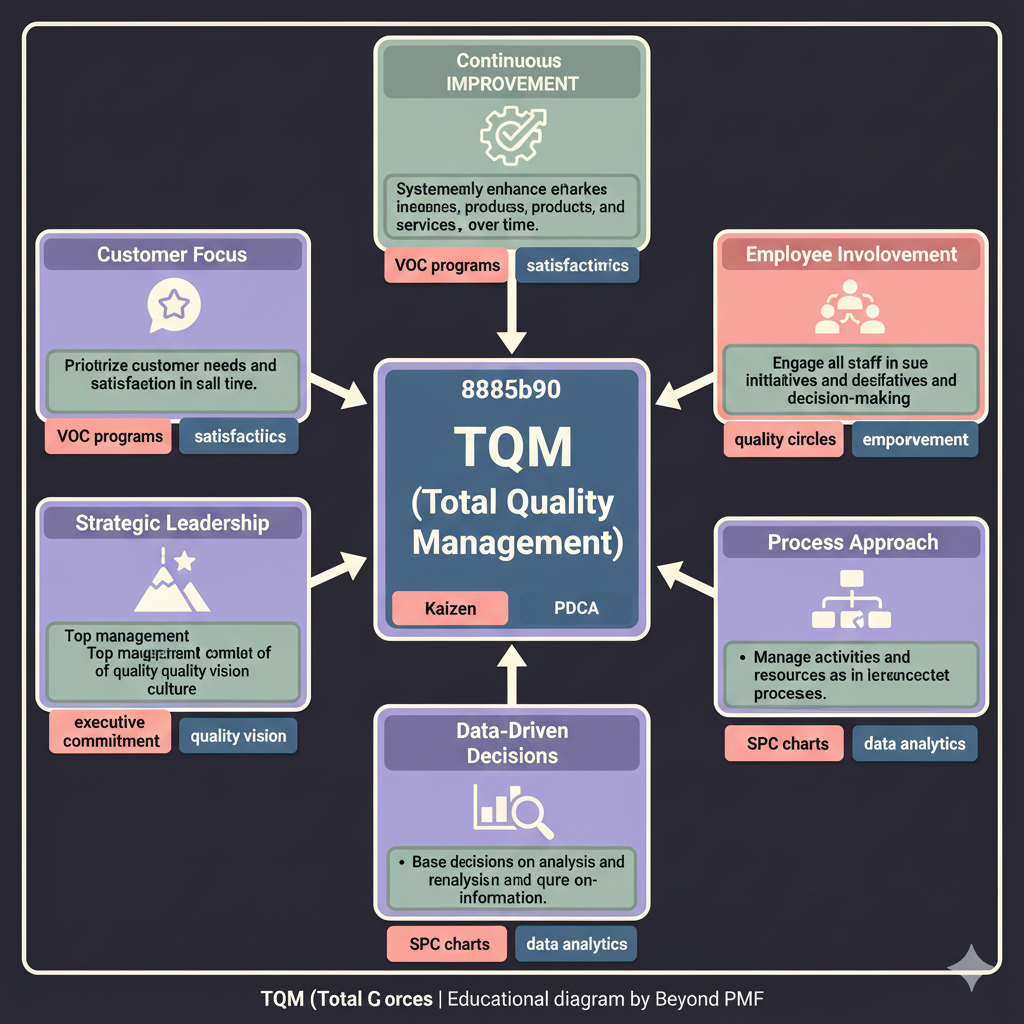
TQM (Total Quality Management)

https://ik.imagekit.io/beyondpmf/frameworks/tqm-total-quality-management.png
TQM primarily addresses friction related to the quality of processes and workflows. It seeks to improve these processes through continuous improvement, ultimately reducing operational inefficiencies and defects.

Total Quality Management (TQM) is an extensive and structured approach to organizational management that seeks to improve the quality of products and services through ongoing refinements in response to continuous feedback. TQM requirements may involve the use of quality management tools like Six Sigma methodologies and quality control circles to facilitate and streamline this continuous improvement. The primary goal is enhancing customer satisfaction, which inherently drives a decrease in product defects and an increase in efficiencies across the organization.

Steps / Detailed Description

Define quality goals and objectives based on customer feedback. | Integrate these quality goals into company processes. | Train employees on the importance of quality standards and how to achieve them. | Use continuous feedback to refine processes. | Implement control tools to monitor quality and make adjustments as needed.

Best Practices

Ensure top management commitment and involvement | Maintain open communication channels at all levels | Regularly review and revise quality objectives

Pros

Improves customer satisfaction | Reduces defects and waste | Enhances employee morale and involvement

Cons

Can be time-consuming to implement | Requires significant training and commitment | May lead to initial costs without immediate financial return

When to Use

When quality improvement is a strategic focus | In industries where quality directly impacts customer satisfaction and safety

When Not to Use

In very small or resource-constrained startups | When quick fixes are needed over systemic changes

Related Frameworks

Lifecycle

Not tied to a specific lifecycle stage

Scope

Scope not defined

Maturity Level

Maturity level not specified

Time to Implement

2–4 Weeks
3–6 Months
1–2 Weeks
3–6 Months
1–2 Months
3–6 Months
1–2 Weeks
Less Than 1 Day
1–2 Weeks
Longer Than 6 Months
1–2 Weeks
Longer Than 6 Months
1–2 Weeks
3–6 Months
1–2 Weeks
1–2 Weeks
1–2 Weeks
1–2 Weeks
1–2 Days
1–2 Weeks
1–2 Weeks
1–2 Weeks
1–2 Weeks
1–2 Weeks
1–2 Weeks
3–6 Months
1–2 Weeks
1–2 Weeks
1–2 Weeks
3–6 Months
1–2 Weeks
1–2 Weeks
2–4 Weeks
1–2 Weeks
1–2 Days
1–2 Weeks
Longer Than 6 Months
3–6 Months
Longer Than 6 Months
1–2 Weeks
Longer Than 6 Months
3–6 Months
Less Than 1 Day
3–6 Months
1–2 Months
3–6 Months
Longer Than 6 Months
3–6 Months
Less Than 1 Day
1–2 Weeks
3–6 Months
3–6 Months
1–2 Weeks
3–6 Months
1–2 Weeks
1–2 Weeks
1–2 Days
1–2 Weeks
1–2 Months
Longer Than 6 Months
1–2 Weeks
Longer Than 6 Months
1–2 Weeks
3–6 Months
1–2 Weeks
Less Than 1 Day
1–2 Weeks
3–6 Months
1–2 Weeks
3–6 Months
1–2 Weeks
1–2 Weeks
Longer Than 6 Months
Less Than 1 Day
3–6 Months
Longer Than 6 Months
1–2 Months
1–2 Weeks
Longer Than 6 Months
1–2 Weeks
3–6 Months
1–2 Weeks
1–2 Weeks
3–6 Months
Less Than 1 Day
1–2 Weeks
1–2 Weeks
3–6 Months
3–6 Months
Less Than 1 Day
1–2 Weeks
Longer Than 6 Months
1–2 Months
1–2 Weeks
1–2 Weeks
1–2 Weeks
Longer Than 6 Months

Copyright Information

Autor:
Unknown
N/A
Publication:
Generic Business Tool