Six Sigma

https://ik.imagekit.io/beyondpmf/frameworks/six-sigma.png
Six Sigma directly targets process defects and inefficiencies within existing processes. Its data-driven approach focuses on improving workflows, reducing errors, and enhancing the overall execution of established operational processes.

Six Sigma is a set of techniques and tools for process improvement, originally developed by Motorola in 1986. It seeks to improve the quality of output by identifying and removing the causes of defects and minimizing variability in manufacturing and business processes. It uses a range of quality management methods, mainly empirical, statistical methods, and creates a special infrastructure of people within the organization who are experts in these methods. The benefits of implementing Six Sigma include increased customer satisfaction, reduced operational costs, and improved product quality.

Steps / Detailed Description

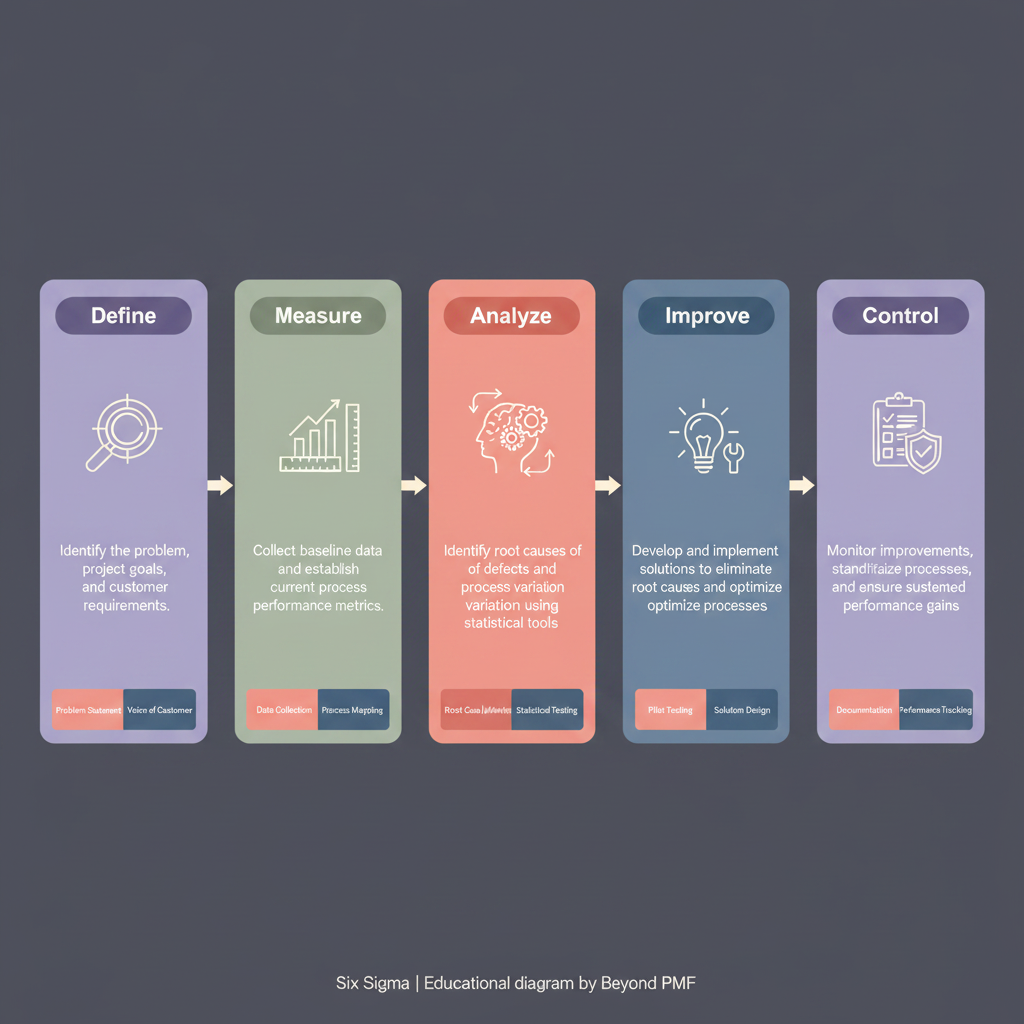
Define the problems and the project goals, specifically what needs improvement. | Measure key aspects of the current process and collect relevant data. | Analyze the data to investigate and verify cause-and-effect relationships. Determine what the relationships are, and attempt to ensure that all factors have been considered. | Improve or optimize the current process based upon data analysis using techniques such as design of experiments, poka-yoke or mistake proofing, and standard work to create a new, future state process. | Control the future state process to ensure that any deviations from target are corrected before they result in defects. Implement control systems such as statistical process control, production boards, visual workplaces, and continuously monitor the process.

Best Practices

Ensure full commitment and support from top management. | Focus on continuous training and development of employees. | Select projects carefully to align with strategic objectives.

Pros

Improves quality by reducing defects and variability in processes. | Increases customer satisfaction by delivering products and services that meet customer needs. | Reduces costs by streamlining operations and improving efficiency.

Cons

Can be overly complex and require significant resources and training. | May focus too much on quantifiable outcomes, potentially neglecting innovation and human factors. | Implementation can be time-consuming and may disrupt existing processes.

When to Use

When precise data is available and processes are repeatable. | When quality improvement and defect reduction are critical.

When Not to Use

In small-scale or less structured environments where innovation is prioritized over process. | When immediate results are required, as Six Sigma projects can take time to show benefits.

Related Frameworks

Lifecycle

Not tied to a specific lifecycle stage

Scope

Scope not defined

Maturity Level

Maturity level not specified

Time to Implement

2–4 Weeks
3–6 Months
1–2 Weeks
3–6 Months
1–2 Months
3–6 Months
1–2 Weeks
Less Than 1 Day
1–2 Weeks
Longer Than 6 Months
1–2 Weeks
Longer Than 6 Months
1–2 Weeks
3–6 Months
1–2 Weeks
1–2 Weeks
1–2 Weeks
1–2 Weeks
1–2 Days
1–2 Weeks
1–2 Weeks
1–2 Weeks
1–2 Weeks
1–2 Weeks
1–2 Weeks
3–6 Months
1–2 Weeks
1–2 Weeks
1–2 Weeks
3–6 Months
1–2 Weeks
1–2 Weeks
2–4 Weeks
1–2 Weeks
1–2 Days
1–2 Weeks
Longer Than 6 Months
3–6 Months
Longer Than 6 Months
1–2 Weeks
Longer Than 6 Months
3–6 Months
Less Than 1 Day
3–6 Months
1–2 Months
3–6 Months
Longer Than 6 Months
3–6 Months
Less Than 1 Day
1–2 Weeks
3–6 Months
3–6 Months
1–2 Weeks
3–6 Months
1–2 Weeks
1–2 Weeks
1–2 Days
1–2 Weeks
1–2 Months
Longer Than 6 Months
1–2 Weeks
Longer Than 6 Months
1–2 Weeks
3–6 Months
1–2 Weeks
Less Than 1 Day
1–2 Weeks
3–6 Months
1–2 Weeks
3–6 Months
1–2 Weeks
1–2 Weeks
Longer Than 6 Months
Less Than 1 Day
3–6 Months
Longer Than 6 Months
1–2 Months
1–2 Weeks
Longer Than 6 Months
1–2 Weeks
3–6 Months
1–2 Weeks
1–2 Weeks
3–6 Months
Less Than 1 Day
1–2 Weeks
1–2 Weeks
3–6 Months
3–6 Months
Less Than 1 Day
1–2 Weeks
Longer Than 6 Months
1–2 Months
1–2 Weeks
1–2 Weeks
1–2 Weeks
Longer Than 6 Months

Copyright Information

Autor:
Motorola
1986
Publication:
Motorola