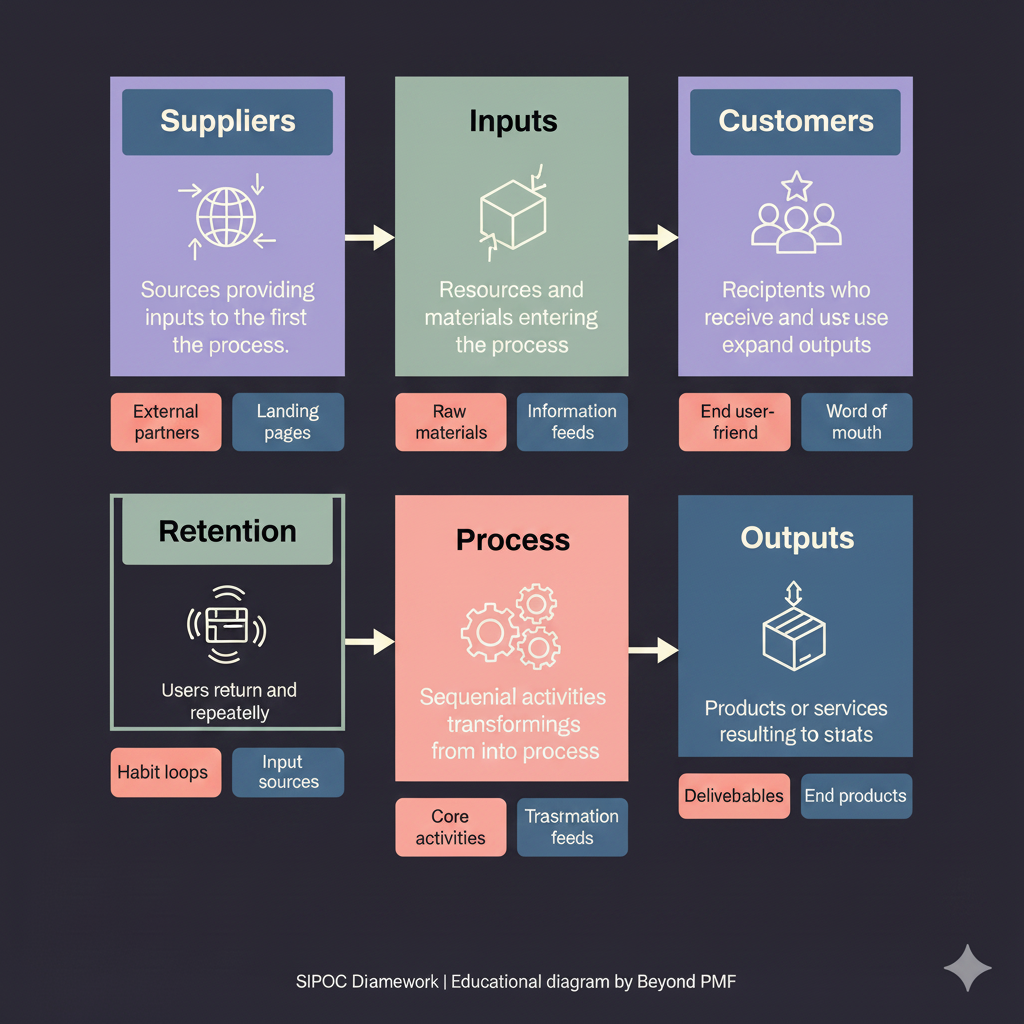
SIPOC Diagram

https://ik.imagekit.io/beyondpmf/frameworks/sipoc-diagram.png
The SIPOC diagram primarily addresses friction related to the processes and workflows within an organization. It helps to clarify the steps involved in a process, identify potential bottlenecks, and improve coordination by providing a shared understanding of the process from start to finish.

A SIPOC Diagram is a comprehensive framework that stands for Suppliers, Inputs, Process, Outputs, and Customers. It helps organizations to visually map out all relevant elements of a process before it begins. This diagram is primarily used to give everyone involved a high-level overview of the process, ensuring that all aspects are considered and understood. The SIPOC diagram is particularly beneficial in identifying errors and inefficiencies, aligning process improvements with customer requirements, and fostering clear communication among stakeholders.

Steps / Detailed Description

Identify the process you want to analyze and define its scope. | List down the Suppliers who provide the inputs to the process. | Define the Inputs necessary for the process to operate. | Map out the key steps in the Process from start to finish. | Determine the Outputs of the process, including products or services. | Identify the Customers who receive the outputs of the process.

Best Practices

Involve representatives from each role in the process while creating the diagram | Regularly update the SIPOC diagram as processes and roles evolve | Use clear and concise language to ensure understanding across all stakeholders

Pros

Improves understanding of the process by providing a high-level overview | Helps in identifying inefficiencies and areas for improvement | Enhances communication and alignment among stakeholders

Cons

Can be overly simplistic for complex processes | May not provide detailed analysis needed for in-depth improvements | Relies heavily on the accuracy of the initial input data

When to Use

When initiating a new process improvement project | Before starting detailed process mapping or analysis

When Not to Use

For detailed, step-by-step process analysis | When a quick, tactical change is required

Related Frameworks

Scope

Scope not defined

Maturity Level

Maturity level not specified

Time to Implement

2–4 Weeks
3–6 Months
1–2 Weeks
3–6 Months
1–2 Months
3–6 Months
1–2 Weeks
Less Than 1 Day
1–2 Weeks
Longer Than 6 Months
1–2 Weeks
Longer Than 6 Months
1–2 Weeks
3–6 Months
1–2 Weeks
1–2 Weeks
1–2 Weeks
1–2 Weeks
1–2 Days
1–2 Weeks
1–2 Weeks
1–2 Weeks
1–2 Weeks
1–2 Weeks
1–2 Weeks
3–6 Months
1–2 Weeks
1–2 Weeks
1–2 Weeks
3–6 Months
1–2 Weeks
1–2 Weeks
2–4 Weeks
1–2 Weeks
1–2 Days
1–2 Weeks
Longer Than 6 Months
3–6 Months
Longer Than 6 Months
1–2 Weeks
Longer Than 6 Months
3–6 Months
Less Than 1 Day
3–6 Months
1–2 Months
3–6 Months
Longer Than 6 Months
3–6 Months
Less Than 1 Day
1–2 Weeks
3–6 Months
3–6 Months
1–2 Weeks
3–6 Months
1–2 Weeks
1–2 Weeks
1–2 Days
1–2 Weeks
1–2 Months
Longer Than 6 Months
1–2 Weeks
Longer Than 6 Months
1–2 Weeks
3–6 Months
1–2 Weeks
Less Than 1 Day
1–2 Weeks
3–6 Months
1–2 Weeks
3–6 Months
1–2 Weeks
1–2 Weeks
Longer Than 6 Months
Less Than 1 Day
3–6 Months
Longer Than 6 Months
1–2 Months
1–2 Weeks
Longer Than 6 Months
1–2 Weeks
3–6 Months
1–2 Weeks
1–2 Weeks
3–6 Months
Less Than 1 Day
1–2 Weeks
1–2 Weeks
3–6 Months
3–6 Months
Less Than 1 Day
1–2 Weeks
Longer Than 6 Months
1–2 Months
1–2 Weeks
1–2 Weeks
1–2 Weeks
Longer Than 6 Months

Copyright Information

Autor:
Unknown
N/A
Publication:
Generic Business Tool