Service Blueprint

https://ik.imagekit.io/beyondpmf/frameworks/service-blueprint.png
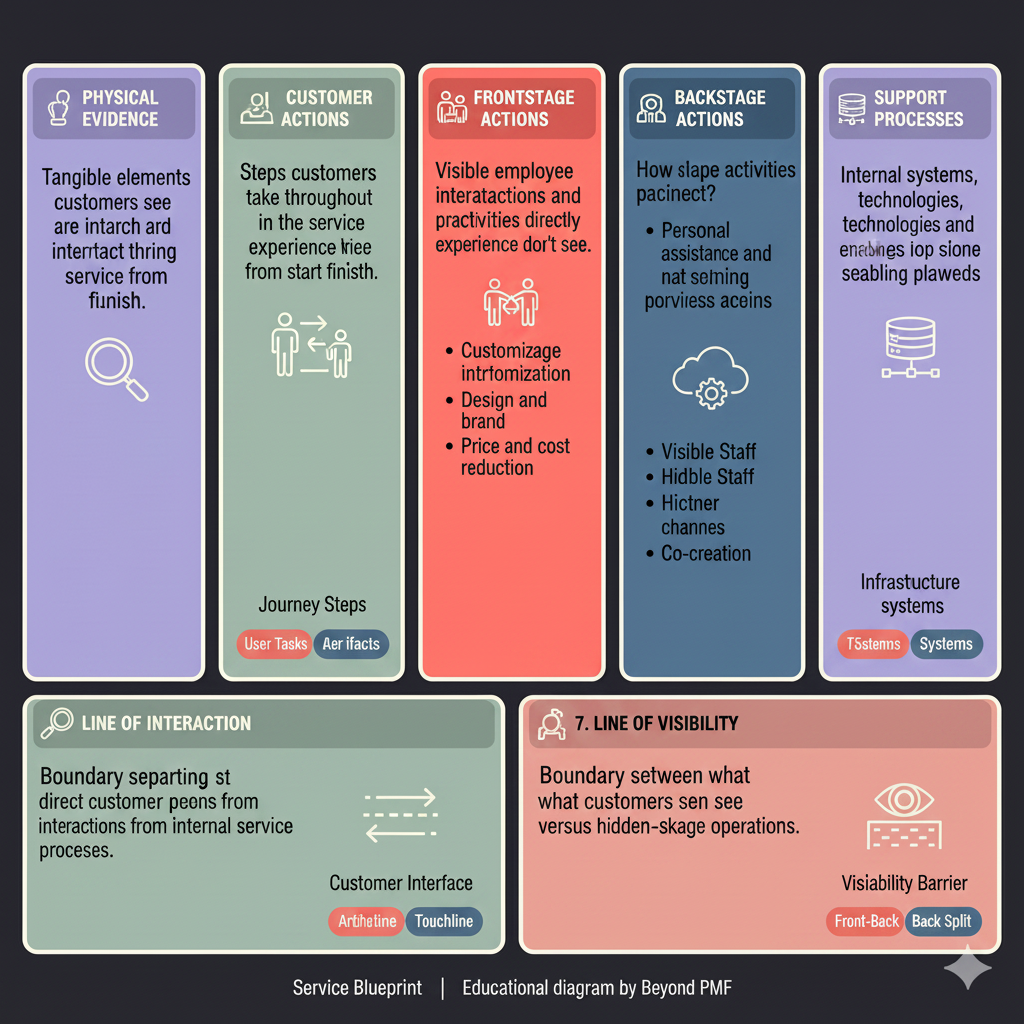
The Service Blueprint primarily addresses friction in the customer experience and the delivery of the service. By visualizing the customer journey and frontstage/backstage interactions, it aims to improve the service's quality and customer UX.

A Service Blueprint is a detailed diagram that visually depicts the service delivery process, highlighting the customer interactions and the roles of frontstage and backstage staff. It is used to gain a comprehensive understanding of the service process, identify potential bottlenecks, and enhance the overall service experience. This framework is beneficial for improving service efficiency, enhancing customer satisfaction, and facilitating cross-functional collaboration.

Steps / Detailed Description

Identify key customer actions and touchpoints. | Map out frontstage employee actions that directly interact with customers. | Detail backstage actions and support processes that facilitate frontstage activities. | Link contact points to the physical or digital evidence that the customer experiences. | Analyze the blueprint to identify improvement areas and implement changes.

Best Practices

Involve a diverse team from multiple departments | Regularly update the blueprint to reflect changes in service processes | Use customer feedback to refine and improve the blueprint

Pros

Improves understanding of the customer journey | Facilitates cross-departmental collaboration and efficiency | Identifies redundancies and gaps in service delivery

Cons

Can be time-consuming to create and maintain | Requires detailed and accurate input from all service areas | May overlook emotional aspects of customer experience

When to Use

When designing or redesigning a service | When trying to improve service efficiency and customer satisfaction

When Not to Use

For simple or well-established services that do not require changes | When there is insufficient data about service processes

Related Frameworks

Lifecycle

Not tied to a specific lifecycle stage

Scope

Scope not defined

Maturity Level

Maturity level not specified

Time to Implement

2–4 Weeks
3–6 Months
1–2 Weeks
3–6 Months
1–2 Months
3–6 Months
1–2 Weeks
Less Than 1 Day
1–2 Weeks
Longer Than 6 Months
1–2 Weeks
Longer Than 6 Months
1–2 Weeks
3–6 Months
1–2 Weeks
1–2 Weeks
1–2 Weeks
1–2 Weeks
1–2 Days
1–2 Weeks
1–2 Weeks
1–2 Weeks
1–2 Weeks
1–2 Weeks
1–2 Weeks
3–6 Months
1–2 Weeks
1–2 Weeks
1–2 Weeks
3–6 Months
1–2 Weeks
1–2 Weeks
2–4 Weeks
1–2 Weeks
1–2 Days
1–2 Weeks
Longer Than 6 Months
3–6 Months
Longer Than 6 Months
1–2 Weeks
Longer Than 6 Months
3–6 Months
Less Than 1 Day
3–6 Months
1–2 Months
3–6 Months
Longer Than 6 Months
3–6 Months
Less Than 1 Day
1–2 Weeks
3–6 Months
3–6 Months
1–2 Weeks
3–6 Months
1–2 Weeks
1–2 Weeks
1–2 Days
1–2 Weeks
1–2 Months
Longer Than 6 Months
1–2 Weeks
Longer Than 6 Months
1–2 Weeks
3–6 Months
1–2 Weeks
Less Than 1 Day
1–2 Weeks
3–6 Months
1–2 Weeks
3–6 Months
1–2 Weeks
1–2 Weeks
Longer Than 6 Months
Less Than 1 Day
3–6 Months
Longer Than 6 Months
1–2 Months
1–2 Weeks
Longer Than 6 Months
1–2 Weeks
3–6 Months
1–2 Weeks
1–2 Weeks
3–6 Months
Less Than 1 Day
1–2 Weeks
1–2 Weeks
3–6 Months
3–6 Months
Less Than 1 Day
1–2 Weeks
Longer Than 6 Months
1–2 Months
1–2 Weeks
1–2 Weeks
1–2 Weeks
Longer Than 6 Months

Copyright Information

Autor:
Unknown
N/A
Publication:
Generic Business Tool