RICE+T Scoring

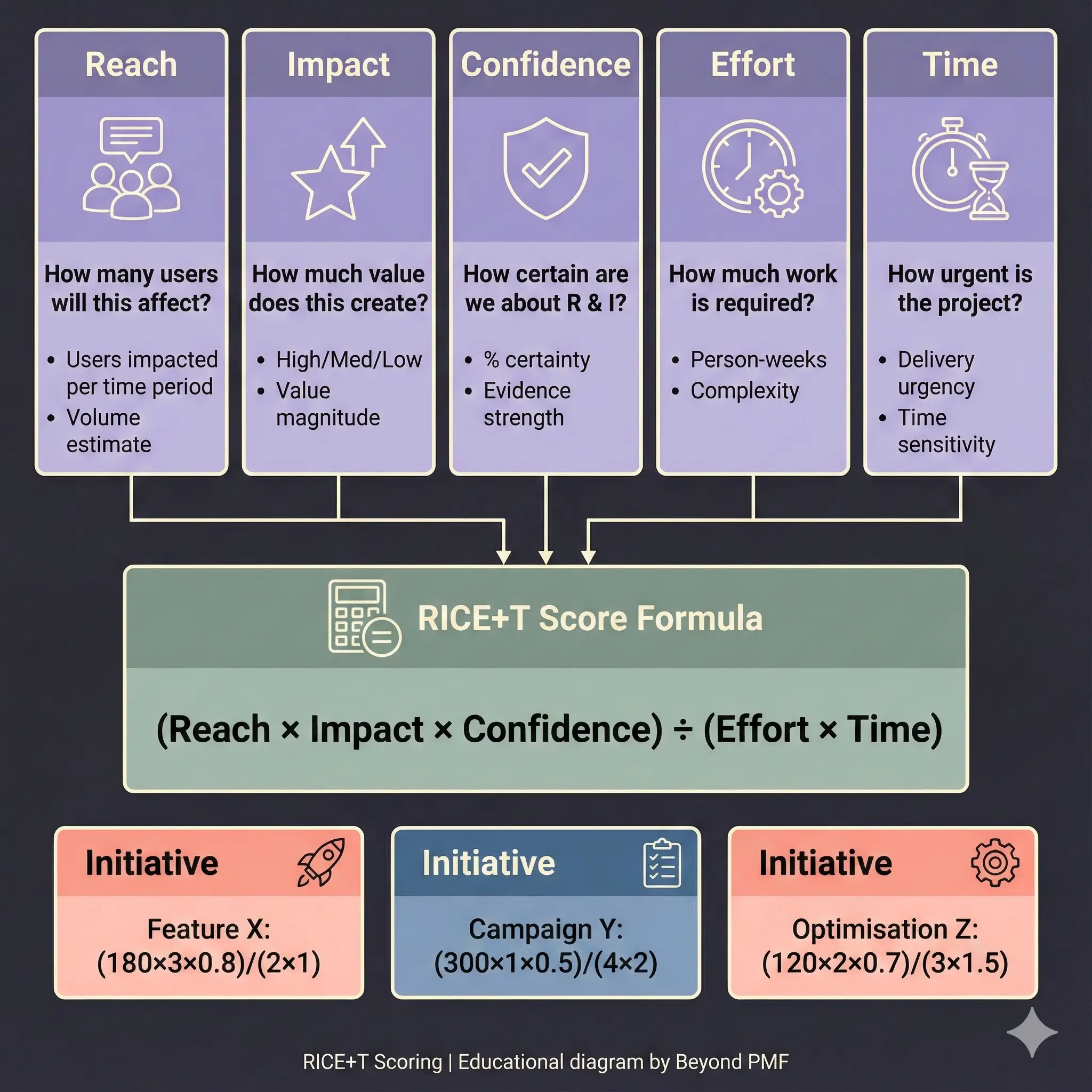
Diagram of the RICE+T Scoring Framework showing five factorsβ€”Reach, Impact, Confidence, Effort, and Timeβ€”used to prioritize initiatives. Each factor includes guiding questions and example criteria. The formula (Reach Γ— Impact Γ— Confidence) Γ· (Effort Γ— Time) is highlighted, followed by sample scored initiatives for comparison.
RICE+T Scoring addresses the operational friction of prioritizing projects and allocating resources effectively. By incorporating 'Time' as a factor, it helps streamline workflows and improve coordination in project selection.

RICE+T Scoring is a prioritization framework used primarily in project management and product development. It extends the traditional RICE framework (Reach, Impact, Confidence, Effort) by incorporating 'Time' as an additional factor. This adjustment allows teams to better gauge the urgency and timing of projects, enhancing decision-making processes. The framework is beneficial for aligning projects with strategic goals and optimizing resource allocation.

Steps / Detailed Description

Identify the project or feature to be scored. | Estimate the 'Reach'β€”how many people the project will affect within a certain timeframe. | Determine the 'Impact'β€”the effect on users or the business if the project is successfully completed. | Assess 'Confidence'β€”the level of certainty about the estimates of reach and impact. | Calculate 'Effort'β€”the amount of work required from the team to complete the project. | Evaluate 'Time'β€”the urgency or the ideal timeline for completing the project. | Combine these factors into a final RICE+T score to prioritize projects.

Best Practices

Regularly update estimates as more information becomes available | Use consistent metrics for estimating reach, impact, and effort across projects | Review and adjust the scoring criteria periodically to match evolving business priorities

Pros

Provides a more comprehensive view of project urgency | Helps in better alignment of projects with strategic timelines | Improves resource allocation by considering time sensitivity

Cons

Can be complex to calculate with the addition of the time factor | May require substantial data gathering and estimation | Risk of subjective biases in estimating factors like impact and confidence

When to Use

When prioritizing multiple projects or features | In strategic planning sessions to align projects with business timelines

When Not to Use

For small, quick tasks that do not require extensive prioritization | When project data is too limited for accurate scoring

Related Frameworks

Categories

Scope

Scope not defined

Maturity Level

Maturity level not specified

Time to Implement

2–4 Weeks
3–6 Months
1–2 Weeks
3–6 Months
1–2 Months
3–6 Months
1–2 Weeks
Less Than 1 Day
1–2 Weeks
Longer Than 6 Months
1–2 Weeks
Longer Than 6 Months
1–2 Weeks
3–6 Months
1–2 Weeks
1–2 Weeks
1–2 Weeks
1–2 Weeks
1–2 Days
1–2 Weeks
1–2 Weeks
1–2 Weeks
1–2 Weeks
1–2 Weeks
1–2 Weeks
3–6 Months
1–2 Weeks
1–2 Weeks
1–2 Weeks
3–6 Months
1–2 Weeks
1–2 Weeks
2–4 Weeks
1–2 Weeks
1–2 Days
1–2 Weeks
Longer Than 6 Months
3–6 Months
Longer Than 6 Months
1–2 Weeks
Longer Than 6 Months
3–6 Months
Less Than 1 Day
3–6 Months
1–2 Months
3–6 Months
Longer Than 6 Months
3–6 Months
Less Than 1 Day
1–2 Weeks
3–6 Months
3–6 Months
1–2 Weeks
3–6 Months
1–2 Weeks
1–2 Weeks
1–2 Days
1–2 Weeks
1–2 Months
Longer Than 6 Months
1–2 Weeks
Longer Than 6 Months
1–2 Weeks
3–6 Months
1–2 Weeks
Less Than 1 Day
1–2 Weeks
3–6 Months
1–2 Weeks
3–6 Months
1–2 Weeks
1–2 Weeks
Longer Than 6 Months
Less Than 1 Day
3–6 Months
Longer Than 6 Months
1–2 Months
1–2 Weeks
Longer Than 6 Months
1–2 Weeks
3–6 Months
1–2 Weeks
1–2 Weeks
3–6 Months
Less Than 1 Day
1–2 Weeks
1–2 Weeks
3–6 Months
3–6 Months
Less Than 1 Day
1–2 Weeks
Longer Than 6 Months
1–2 Months
1–2 Weeks
1–2 Weeks
1–2 Weeks
Longer Than 6 Months

Copyright Information

Autor:
Unknown
N/A
Publication:
Unknown