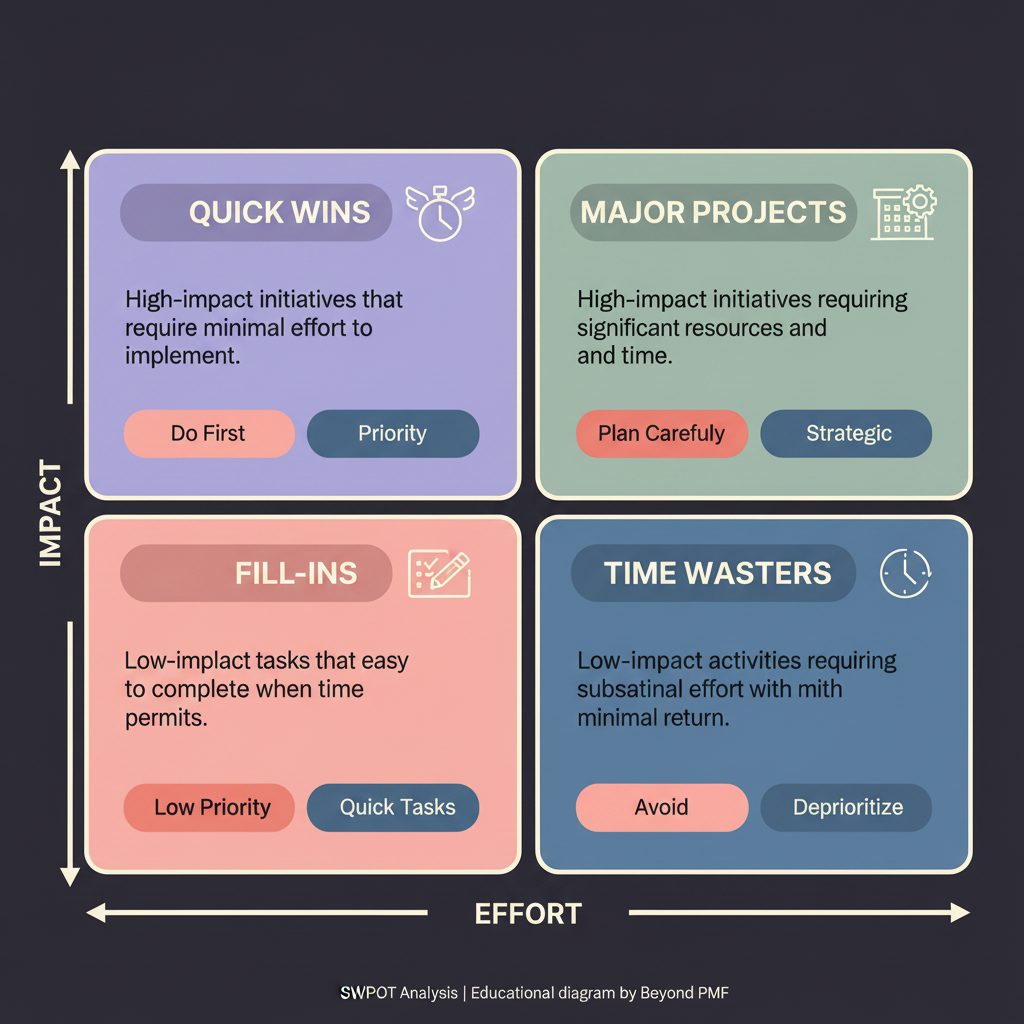
Impact/Effort Matrix

https://ik.imagekit.io/beyondpmf/frameworks/impact-effort-matrix.png
The Impact/Effort Matrix primarily addresses the friction of inefficient resource allocation and prioritization. It helps organizations streamline their processes and improve coordination by focusing on tasks that offer the highest impact for the least effort.

The Impact/Effort Matrix, also known as the Priority Matrix, helps teams prioritize tasks by categorizing them based on the estimated impact and the effort needed for implementation. This framework is widely used in project management and strategic planning to optimize resource allocation and increase efficiency. By evaluating tasks on these two dimensions, teams can focus on high-impact, low-effort initiatives that deliver the most value with the least resource expenditure.

Steps / Detailed Description

Identify and list all tasks or projects to be prioritized. | Rate each task on its potential impact to the organization or project goals. | Assess the effort required for each task, considering time, resources, and complexity. | Plot the tasks on a two-dimensional grid with impact on one axis and effort on the other. | Categorize the tasks into four quadrants: Quick Wins, Major Projects, Fill-Ins, and Thankless Tasks. | Prioritize tasks starting with Quick Wins and plan implementation accordingly.

Best Practices

Use objective criteria and data where possible to rate impact and effort | Regularly update the matrix as tasks and strategic priorities evolve | Combine with other decision-making tools for complex projects

Pros

Facilitates focused decision-making by categorizing tasks based on impact and effort | Helps in efficient allocation of resources and time management | Simple and easy to understand, making it accessible for all team members

Cons

Subjectivity in estimating impact and effort can lead to inaccuracies | Does not account for dependencies between tasks | May oversimplify complex decisions

When to Use

When prioritizing projects or tasks in project management | During strategic planning sessions to align efforts with business goals

When Not to Use

When tasks are interdependent and cannot be assessed in isolation | In situations where the effort and impact are difficult to estimate accurately

Related Frameworks

Categories

Scope

Scope not defined

Maturity Level

Maturity level not specified

Time to Implement

2–4 Weeks
3–6 Months
1–2 Weeks
3–6 Months
1–2 Months
3–6 Months
1–2 Weeks
Less Than 1 Day
1–2 Weeks
Longer Than 6 Months
1–2 Weeks
Longer Than 6 Months
1–2 Weeks
3–6 Months
1–2 Weeks
1–2 Weeks
1–2 Weeks
1–2 Weeks
1–2 Days
1–2 Weeks
1–2 Weeks
1–2 Weeks
1–2 Weeks
1–2 Weeks
1–2 Weeks
3–6 Months
1–2 Weeks
1–2 Weeks
1–2 Weeks
3–6 Months
1–2 Weeks
1–2 Weeks
2–4 Weeks
1–2 Weeks
1–2 Days
1–2 Weeks
Longer Than 6 Months
3–6 Months
Longer Than 6 Months
1–2 Weeks
Longer Than 6 Months
3–6 Months
Less Than 1 Day
3–6 Months
1–2 Months
3–6 Months
Longer Than 6 Months
3–6 Months
Less Than 1 Day
1–2 Weeks
3–6 Months
3–6 Months
1–2 Weeks
3–6 Months
1–2 Weeks
1–2 Weeks
1–2 Days
1–2 Weeks
1–2 Months
Longer Than 6 Months
1–2 Weeks
Longer Than 6 Months
1–2 Weeks
3–6 Months
1–2 Weeks
Less Than 1 Day
1–2 Weeks
3–6 Months
1–2 Weeks
3–6 Months
1–2 Weeks
1–2 Weeks
Longer Than 6 Months
Less Than 1 Day
3–6 Months
Longer Than 6 Months
1–2 Months
1–2 Weeks
Longer Than 6 Months
1–2 Weeks
3–6 Months
1–2 Weeks
1–2 Weeks
3–6 Months
Less Than 1 Day
1–2 Weeks
1–2 Weeks
3–6 Months
3–6 Months
Less Than 1 Day
1–2 Weeks
Longer Than 6 Months
1–2 Months
1–2 Weeks
1–2 Weeks
1–2 Weeks
Longer Than 6 Months

Copyright Information

Autor:
Public Domain
N/A
Publication:
Generic Business Tool