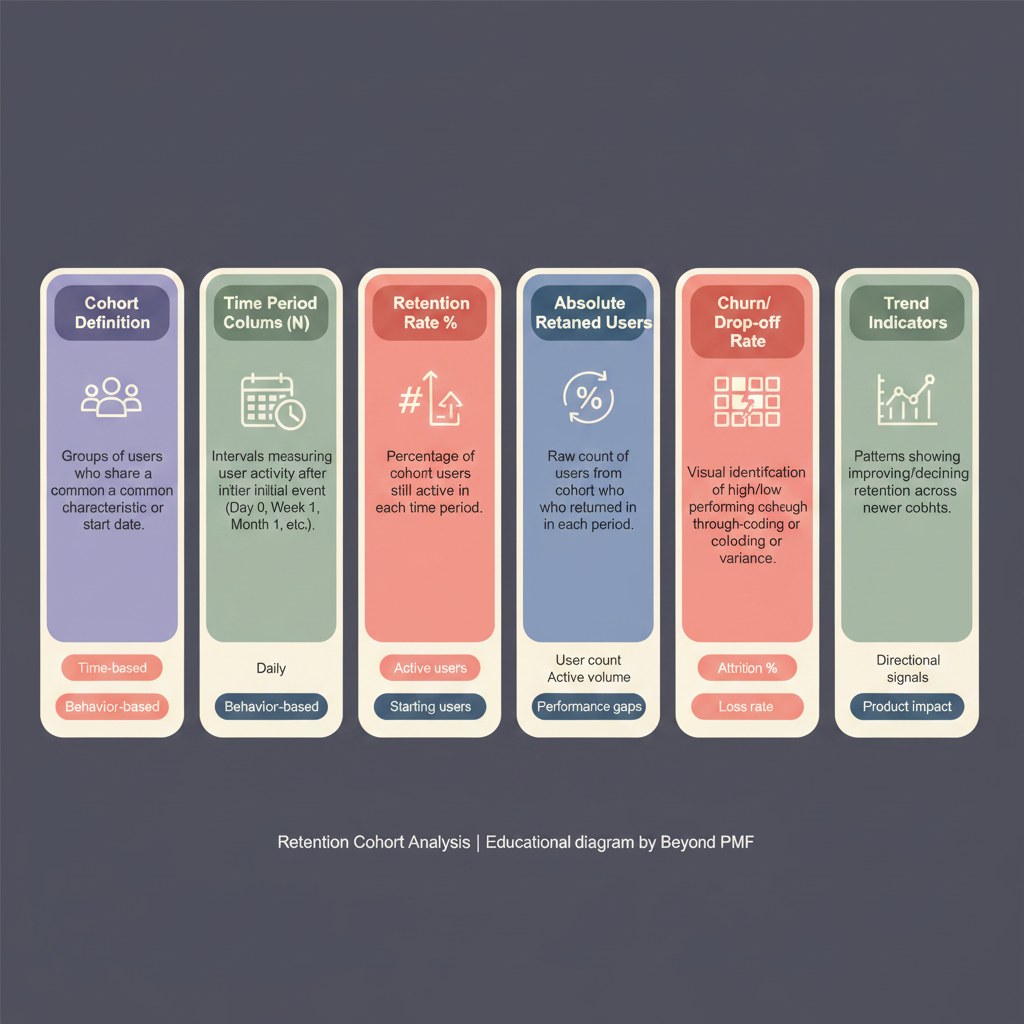
Retention Cohort Analysis

https://ik.imagekit.io/beyondpmf/frameworks/retention-cohort-analysis.png
Retention Cohort Analysis helps understand user behavior and identify drop-off points in the customer journey. This provides insights for improving customer experience and preventing churn, directly impacting the execution of product and service delivery.

Retention Cohort Analysis is a framework that groups users based on their acquisition date and tracks their activity or retention over time. This approach helps businesses understand how well they are retaining customers and identify patterns in customer behavior. The analysis can reveal insights into the effectiveness of product changes, marketing efforts, and customer service improvements.

Steps / Detailed Description

Define the cohort: Group users based on their start date or a specific event. | Set the time intervals: Determine the periods over which you will track user activity or retention. | Collect data: Gather data on user engagement or activity for each cohort over the specified time intervals. | Analyze the data: Calculate retention rates and observe trends and patterns across different cohorts. | Draw insights and make decisions: Use the analysis to inform business strategies and improve user retention.

Best Practices

Regularly update and review cohorts to keep data relevant. | Segment cohorts in a meaningful way that aligns with business goals. | Combine cohort analysis with qualitative data for deeper insights.

Pros

Provides clear insight into customer retention trends over time. | Helps identify which features or changes improve retention. | Allows for targeted interventions based on specific cohort behaviors.

Cons

Can be data-intensive, requiring robust data tracking and analysis capabilities. | May not account for external factors affecting user behavior. | Cohort analysis can be complex and time-consuming to set up correctly.

When to Use

When analyzing the impact of specific features or changes on user retention. | When trying to understand the lifecycle of different user segments.

When Not to Use

When immediate, real-time data is required for decision-making. | When the business lacks the resources to collect and analyze detailed user data.

Related Frameworks

Categories

Lifecycle

Not tied to a specific lifecycle stage

Scope

Scope not defined

Maturity Level

Maturity level not specified

Time to Implement

2–4 Weeks
3–6 Months
1–2 Weeks
3–6 Months
1–2 Months
3–6 Months
1–2 Weeks
Less Than 1 Day
1–2 Weeks
Longer Than 6 Months
1–2 Weeks
Longer Than 6 Months
1–2 Weeks
3–6 Months
1–2 Weeks
1–2 Weeks
1–2 Weeks
1–2 Weeks
1–2 Days
1–2 Weeks
1–2 Weeks
1–2 Weeks
1–2 Weeks
1–2 Weeks
1–2 Weeks
3–6 Months
1–2 Weeks
1–2 Weeks
1–2 Weeks
3–6 Months
1–2 Weeks
1–2 Weeks
2–4 Weeks
1–2 Weeks
1–2 Days
1–2 Weeks
Longer Than 6 Months
3–6 Months
Longer Than 6 Months
1–2 Weeks
Longer Than 6 Months
3–6 Months
Less Than 1 Day
3–6 Months
1–2 Months
3–6 Months
Longer Than 6 Months
3–6 Months
Less Than 1 Day
1–2 Weeks
3–6 Months
3–6 Months
1–2 Weeks
3–6 Months
1–2 Weeks
1–2 Weeks
1–2 Days
1–2 Weeks
1–2 Months
Longer Than 6 Months
1–2 Weeks
Longer Than 6 Months
1–2 Weeks
3–6 Months
1–2 Weeks
Less Than 1 Day
1–2 Weeks
3–6 Months
1–2 Weeks
3–6 Months
1–2 Weeks
1–2 Weeks
Longer Than 6 Months
Less Than 1 Day
3–6 Months
Longer Than 6 Months
1–2 Months
1–2 Weeks
Longer Than 6 Months
1–2 Weeks
3–6 Months
1–2 Weeks
1–2 Weeks
3–6 Months
Less Than 1 Day
1–2 Weeks
1–2 Weeks
3–6 Months
3–6 Months
Less Than 1 Day
1–2 Weeks
Longer Than 6 Months
1–2 Months
1–2 Weeks
1–2 Weeks
1–2 Weeks
Longer Than 6 Months

Copyright Information

Autor:
Public Domain
N/A
Publication:
Generic Business Tool