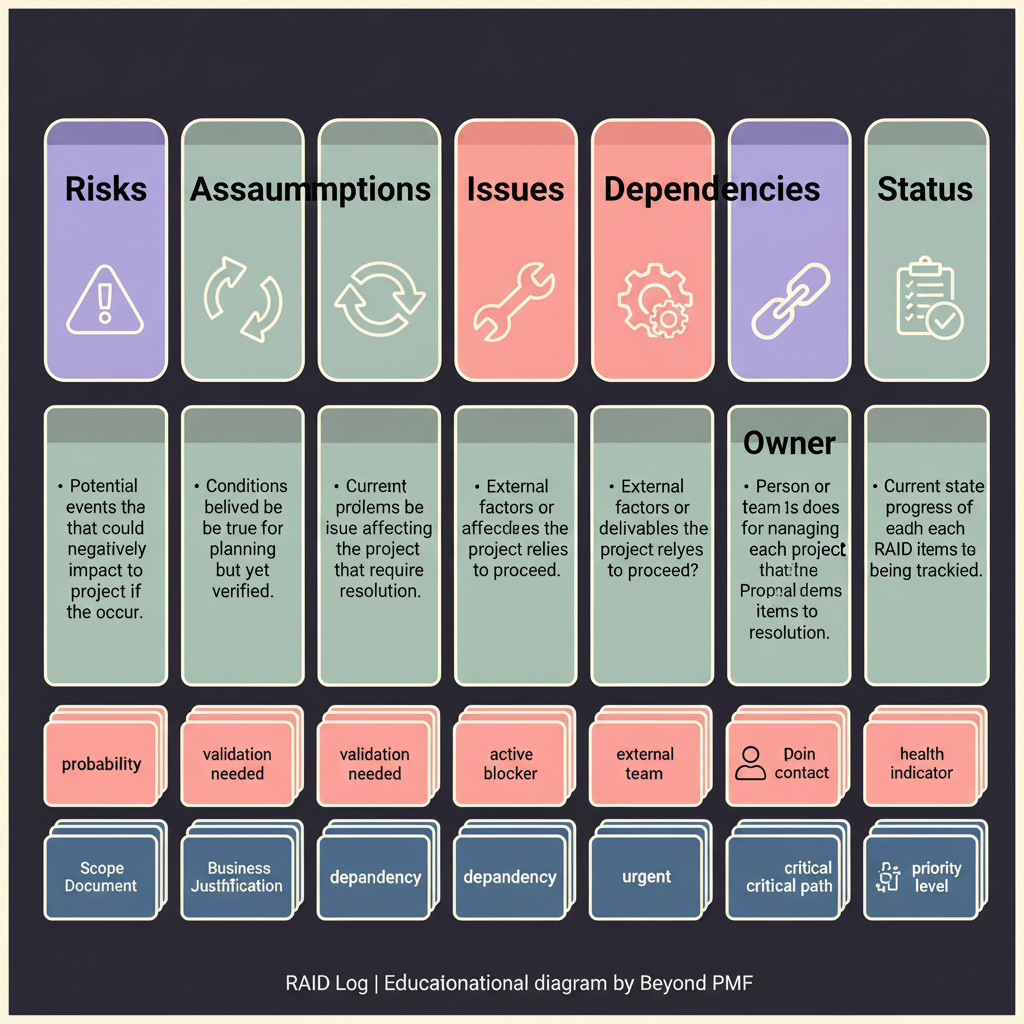
RAID Log

https://ik.imagekit.io/beyondpmf/frameworks/raid-log.png
The RAID Log primarily addresses operational friction by providing a structured method for managing issues, risks, assumptions, and dependencies within a project. It helps to improve coordination, workflows, and governance during project execution.

A RAID Log is a simple yet effective project management framework used to track Risks, Assumptions, Issues, and Dependencies. It serves as a centralized repository that allows project managers and teams to foresee potential problems and plan accordingly. By maintaining a RAID Log, teams can ensure that they are aware of and can proactively manage elements that could impact the project's success, thereby increasing transparency and improving communication among stakeholders.

Steps / Detailed Description

Identify all potential risks, assumptions, issues, and dependencies related to the project. | Assess each item based on its impact and likelihood to affect the project. | Assign ownership for each RAID item to ensure accountability. | Develop action plans for risks and issues and set review dates. | Regularly update the RAID log as the project progresses and re-assess items as necessary.

Best Practices

Integrate the RAID log updates into regular project meetings. | Ensure clear ownership and follow-up actions for each item. | Review and revise the RAID log regularly to keep it relevant.

Pros

Enhances risk management and proactive problem solving. | Improves communication and transparency among project stakeholders. | Helps in prioritizing project issues and risks effectively.

Cons

Can become cumbersome if not regularly updated. | May be overlooked if not integrated into regular project management activities. | Risk of becoming a tick-box exercise rather than a practical management tool.

When to Use

In complex projects with multiple stakeholders and dependencies. | When managing projects that are high in uncertainty and risks.

When Not to Use

For very small or straightforward projects where the setup might outweigh the benefits. | When project teams are not willing to actively maintain or use the log.

Related Frameworks

Categories

Lifecycle

Scope

Scope not defined

Maturity Level

Maturity level not specified

Time to Implement

2–4 Weeks
3–6 Months
1–2 Weeks
3–6 Months
1–2 Months
3–6 Months
1–2 Weeks
Less Than 1 Day
1–2 Weeks
Longer Than 6 Months
1–2 Weeks
Longer Than 6 Months
1–2 Weeks
3–6 Months
1–2 Weeks
1–2 Weeks
1–2 Weeks
1–2 Weeks
1–2 Days
1–2 Weeks
1–2 Weeks
1–2 Weeks
1–2 Weeks
1–2 Weeks
1–2 Weeks
3–6 Months
1–2 Weeks
1–2 Weeks
1–2 Weeks
3–6 Months
1–2 Weeks
1–2 Weeks
2–4 Weeks
1–2 Weeks
1–2 Days
1–2 Weeks
Longer Than 6 Months
3–6 Months
Longer Than 6 Months
1–2 Weeks
Longer Than 6 Months
3–6 Months
Less Than 1 Day
3–6 Months
1–2 Months
3–6 Months
Longer Than 6 Months
3–6 Months
Less Than 1 Day
1–2 Weeks
3–6 Months
3–6 Months
1–2 Weeks
3–6 Months
1–2 Weeks
1–2 Weeks
1–2 Days
1–2 Weeks
1–2 Months
Longer Than 6 Months
1–2 Weeks
Longer Than 6 Months
1–2 Weeks
3–6 Months
1–2 Weeks
Less Than 1 Day
1–2 Weeks
3–6 Months
1–2 Weeks
3–6 Months
1–2 Weeks
1–2 Weeks
Longer Than 6 Months
Less Than 1 Day
3–6 Months
Longer Than 6 Months
1–2 Months
1–2 Weeks
Longer Than 6 Months
1–2 Weeks
3–6 Months
1–2 Weeks
1–2 Weeks
3–6 Months
Less Than 1 Day
1–2 Weeks
1–2 Weeks
3–6 Months
3–6 Months
Less Than 1 Day
1–2 Weeks
Longer Than 6 Months
1–2 Months
1–2 Weeks
1–2 Weeks
1–2 Weeks
Longer Than 6 Months

Copyright Information

Autor:
Public Domain
N/A
Publication:
Generic Business Tool