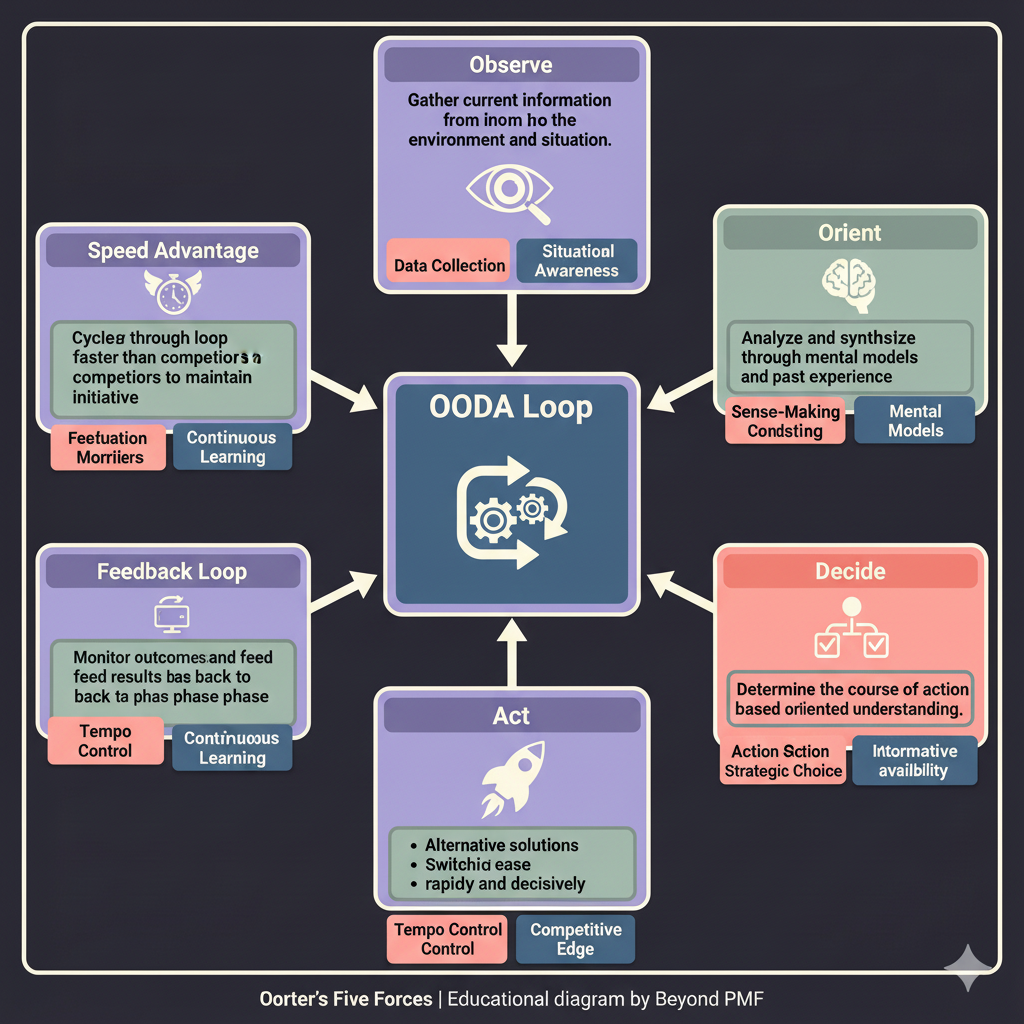
The OODA Loop, which stands for Observe, Orient, Decide, and Act, is a strategic framework developed by military strategist John Boyd. It is designed to help individuals and organizations operate faster than their competitors by continuously cycling through four stages: observing the situation, orienting oneself based on new information and analysis, deciding on the best course of action, and then acting on that decision. This iterative process enhances situational awareness and decision-making speed, making it highly effective in dynamic and competitive settings.
Observe: Gather data and information from the environment to understand the current situation. | Orient: Analyze the information and use it to update your current reality, considering new developments and unfolding dynamics. | Decide: Choose a course of action based on the observations and orientation that aligns best with your goals and strategies. | Act: Implement the decision and monitor the outcome, feeding back into the observation stage to begin the loop again.
Maintain a high level of situational awareness to improve the quality of observations. | Foster a culture of flexibility and rapid adaptation within the team or organization. | Continuously cycle through the loop, even after actions are taken, to refine strategies and responses.
Enhances adaptability to rapidly changing conditions | Improves decision-making speed and effectiveness | Facilitates continuous learning and situational awareness
Can be mentally demanding and stressful | Requires high-quality, real-time information which may not always be available | Potentially less effective in stable, predictable environments where quick decisions are less critical
In rapidly changing or competitive environments | When dealing with complex situations that require quick adaptation
In highly stable, predictable environments where decisions do not need to be made quickly | When there is a lack of sufficient real-time data to make informed decisions