
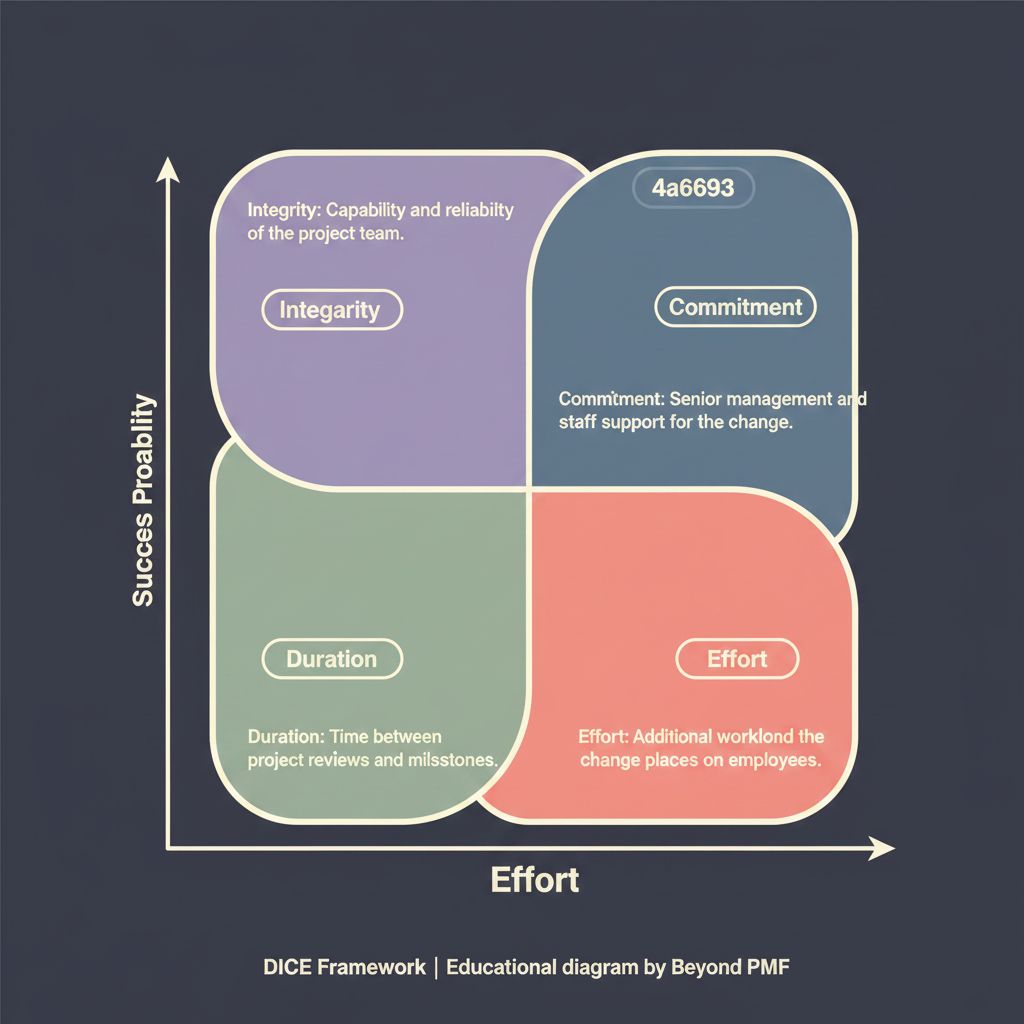
The DICE Framework, developed by the Boston Consulting Group, is a strategic tool used to assess the outcomes of projects, particularly in terms of change management. It helps organizations predict and enhance the success rate of their projects by evaluating four key elements: Duration, Integrity, Commitment, and Effort. This framework provides a systematic approach to identifying potential risks and readiness for change, ensuring that projects are aligned with organizational capabilities and resources.
Duration: Assess the time until project completion and the time between reviews. | Integrity: Evaluate the project team's skills and the project leader's capabilities. | Commitment: Measure the level of support from both senior executives and the staff affected by the change. | Effort: Estimate the additional effort required from employees beyond their usual workload.
Ensure thorough training on the framework for all evaluators | Regularly update the assessment as the project progresses | Use alongside other project management and change management tools
Provides a quick assessment of a project's likelihood of success | Helps in identifying potential risks and mitigation strategies | Facilitates alignment of projects with organizational strategy
May oversimplify complex change processes | Relies heavily on accurate and honest assessment of factors | Can be subjective, as much depends on the judgment of the assessors
In the planning phase of a project to assess readiness | When prioritizing multiple change initiatives
For very small or short-term projects where the setup might outweigh the benefits | When the organization lacks the data to accurately assess the four elements