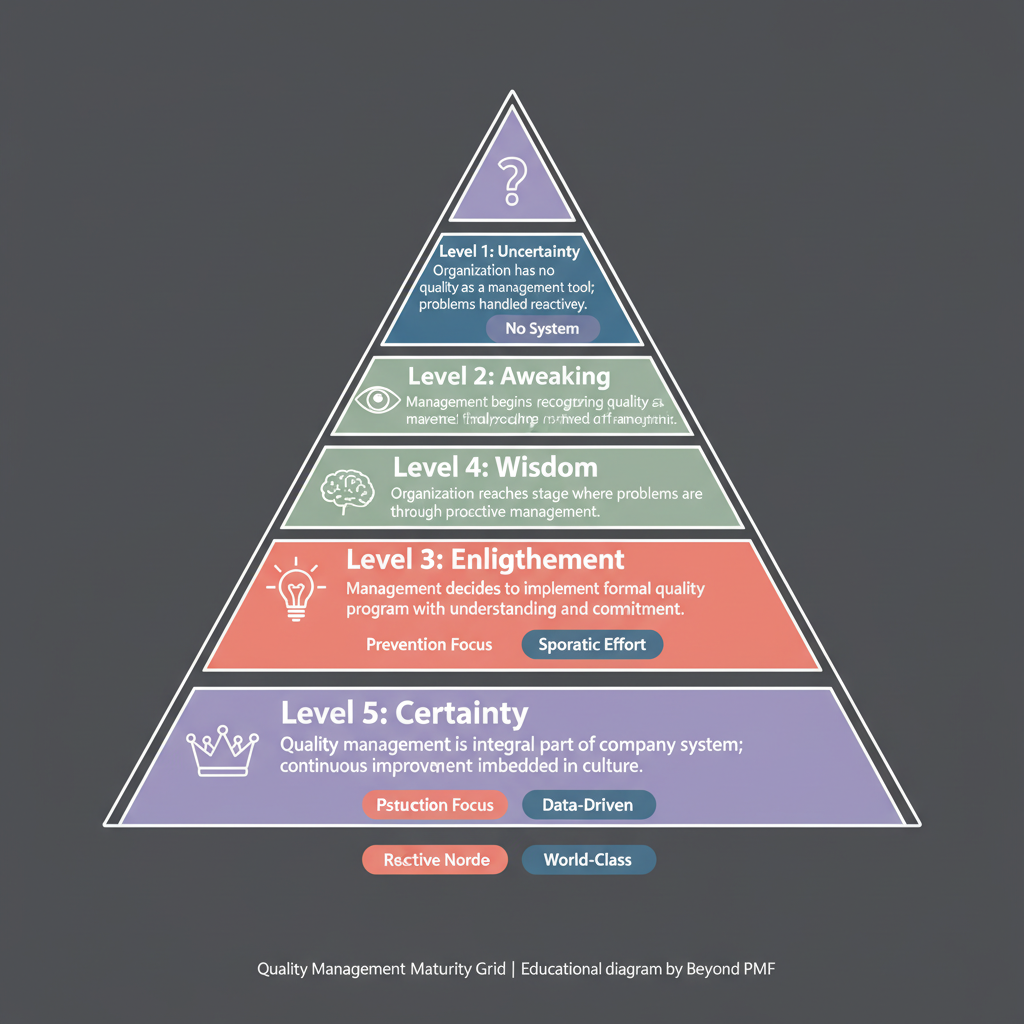
Quality Management Maturity Grid

https://ik.imagekit.io/beyondpmf/frameworks/quality-management-maturity-grid.png
The Quality Management Maturity Grid primarily addresses operational friction by focusing on the maturity of quality management processes. It aims to improve workflows, coordination, and governance related to quality.

The Quality Management Maturity Grid is a tool developed to help organizations evaluate the current effectiveness of their quality management systems and identify areas for improvement. By mapping out different levels of quality maturity, it guides organizations in progressing from initial, ad hoc practices to optimized, sustainable processes. This framework is beneficial for ensuring consistent quality improvements and aligning quality management practices with organizational goals.

Steps / Detailed Description

Assess Current Quality Practices: Evaluate existing quality management processes against the maturity grid. | Identify Maturity Level: Determine the current maturity level from initial to optimizing. | Develop Improvement Plan: Create a plan based on the gaps identified between current practices and the desired maturity level. | Implement Improvements: Execute the plan to enhance quality management practices. | Monitor and Review: Regularly assess the improvements and make adjustments as necessary.

Best Practices

Engage top management to ensure alignment and support | Regularly update the assessment as the organization evolves | Focus on actionable improvements rather than just assessment

Pros

Provides a clear roadmap for quality improvement | Helps in benchmarking against industry standards | Facilitates continuous improvement and optimization

Cons

Can be time-consuming to implement | Requires commitment from all levels of the organization | May not be suitable for very small organizations

When to Use

When seeking to improve quality management systems | When preparing for external quality audits

When Not to Use

In very small startups with limited resources | When immediate, short-term fixes are needed without regard for long-term strategy

Related Frameworks

Lifecycle

Not tied to a specific lifecycle stage

Scope

Scope not defined

Maturity Level

Maturity level not specified

Time to Implement

2–4 Weeks
3–6 Months
1–2 Weeks
3–6 Months
1–2 Months
3–6 Months
1–2 Weeks
Less Than 1 Day
1–2 Weeks
Longer Than 6 Months
1–2 Weeks
Longer Than 6 Months
1–2 Weeks
3–6 Months
1–2 Weeks
1–2 Weeks
1–2 Weeks
1–2 Weeks
1–2 Days
1–2 Weeks
1–2 Weeks
1–2 Weeks
1–2 Weeks
1–2 Weeks
1–2 Weeks
3–6 Months
1–2 Weeks
1–2 Weeks
1–2 Weeks
3–6 Months
1–2 Weeks
1–2 Weeks
2–4 Weeks
1–2 Weeks
1–2 Days
1–2 Weeks
Longer Than 6 Months
3–6 Months
Longer Than 6 Months
1–2 Weeks
Longer Than 6 Months
3–6 Months
Less Than 1 Day
3–6 Months
1–2 Months
3–6 Months
Longer Than 6 Months
3–6 Months
Less Than 1 Day
1–2 Weeks
3–6 Months
3–6 Months
1–2 Weeks
3–6 Months
1–2 Weeks
1–2 Weeks
1–2 Days
1–2 Weeks
1–2 Months
Longer Than 6 Months
1–2 Weeks
Longer Than 6 Months
1–2 Weeks
3–6 Months
1–2 Weeks
Less Than 1 Day
1–2 Weeks
3–6 Months
1–2 Weeks
3–6 Months
1–2 Weeks
1–2 Weeks
Longer Than 6 Months
Less Than 1 Day
3–6 Months
Longer Than 6 Months
1–2 Months
1–2 Weeks
Longer Than 6 Months
1–2 Weeks
3–6 Months
1–2 Weeks
1–2 Weeks
3–6 Months
Less Than 1 Day
1–2 Weeks
1–2 Weeks
3–6 Months
3–6 Months
Less Than 1 Day
1–2 Weeks
Longer Than 6 Months
1–2 Months
1–2 Weeks
1–2 Weeks
1–2 Weeks
Longer Than 6 Months

Copyright Information

Autor:
Unknown
N/A
Publication:
Unknown