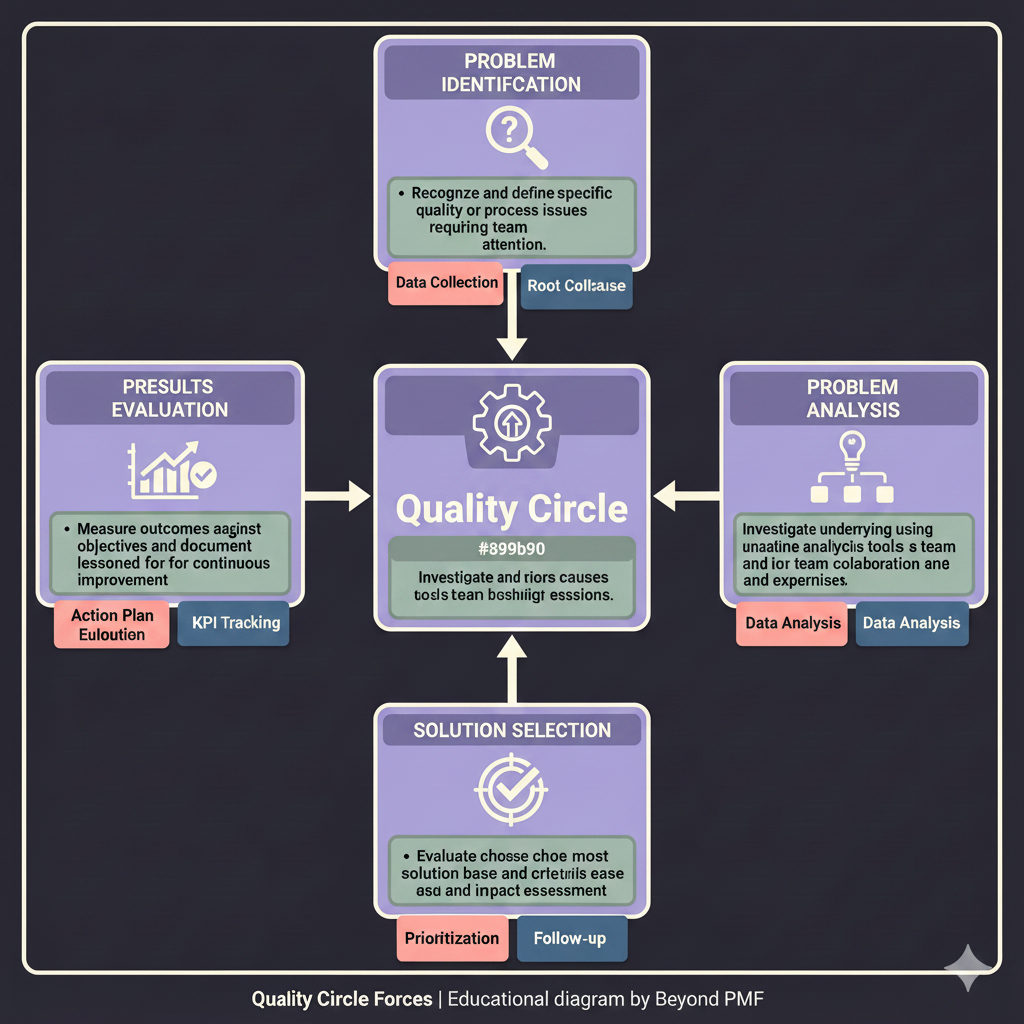
A Quality Circle is a group of workers who voluntarily meet to discuss and solve problems related to their work. Originating in Japan, this framework aims to harness the collective intelligence and insights of employees to identify, analyze, and solve work-related issues, particularly those affecting quality and productivity. The approach fosters a sense of ownership and collaboration among team members, leading to enhanced job satisfaction and organizational efficiency.
Formation of the circle: Employees from the same work area or doing similar work volunteer to form a circle. | Identify problems: Circle members regularly meet to identify issues affecting their work area. | Problem analysis: The group analyzes the problem to find its root cause using tools like cause-and-effect diagrams. | Develop solutions: Members brainstorm and propose solutions to the problems identified. | Implement solutions: With approval from management, the proposed solutions are implemented on a small scale to test their effectiveness. | Evaluate results: The effectiveness of the solutions is monitored and evaluated. | Standardize: Successful solutions are standardized and implemented across the organization.
Ensure management support and involvement | Provide training and resources needed for effective problem-solving | Regularly recognize and reward the contributions of circle members
Improves job satisfaction and employee morale | Enhances quality and productivity | Encourages teamwork and collaborative problem-solving
May require significant time commitment | Dependent on active and sustained management support | Can be less effective if not properly integrated into the company's culture
When aiming to improve product quality | When seeking to enhance employee engagement and collaboration
In highly bureaucratic organizations where changes are slow to implement | When there is a lack of commitment from top management