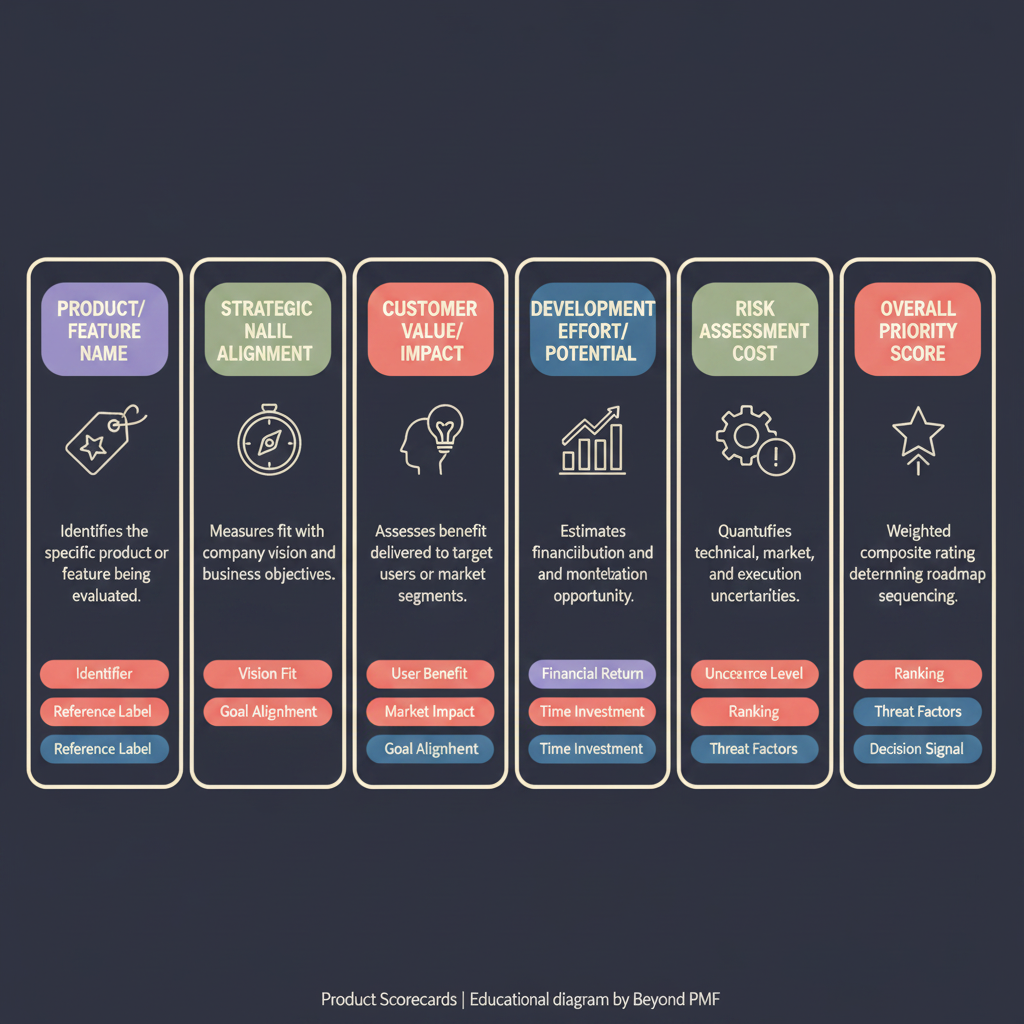
Product Scorecards

https://ik.imagekit.io/beyondpmf/frameworks/product-scorecards.png
Product Scorecards are used to assess performance based on specific criteria. This directly impacts the product's quality, features, and overall user experience, falling under the Execution category.

Product Scorecards are systematic frameworks used by businesses to evaluate the success of a product based on predefined metrics. These scorecards help in monitoring performance, identifying areas of improvement, and making informed decisions. The framework is beneficial for maintaining alignment with business goals, ensuring product quality, and enhancing customer satisfaction.

Steps / Detailed Description

Define clear, measurable objectives for the product. | Identify key performance indicators (KPIs) that align with the objectives. | Develop a scoring system for each KPI. | Collect data regularly and score the product according to the established KPIs. | Review and analyze the results to identify trends and areas for improvement. | Adjust strategies or processes based on the scorecard outcomes.

Best Practices

Regularly update the KPIs to reflect changing business goals and market conditions. | Ensure transparency and involvement of relevant stakeholders in the scoring process. | Use a balanced mix of qualitative and quantitative metrics to avoid skewed perspectives.

Pros

Provides a clear and quantifiable measure of product performance. | Helps in identifying areas for improvement and making data-driven decisions. | Facilitates alignment of product goals with overall business objectives.

Cons

Can be time-consuming to set up and maintain. | May focus too narrowly on quantifiable metrics, overlooking qualitative aspects. | Depends heavily on the accuracy and relevance of the chosen KPIs.

When to Use

When launching a new product to track its early-stage performance. | During product reviews to assess ongoing performance and strategic alignment.

When Not to Use

For products in conceptual or very early development stages where metrics are not yet definable. | When rapid market changes render established KPIs irrelevant or misleading.

Related Frameworks

Categories

Lifecycle

Not tied to a specific lifecycle stage

Scope

Scope not defined

Maturity Level

Maturity level not specified

Time to Implement

2–4 Weeks
3–6 Months
1–2 Weeks
3–6 Months
1–2 Months
3–6 Months
1–2 Weeks
Less Than 1 Day
1–2 Weeks
Longer Than 6 Months
1–2 Weeks
Longer Than 6 Months
1–2 Weeks
3–6 Months
1–2 Weeks
1–2 Weeks
1–2 Weeks
1–2 Weeks
1–2 Days
1–2 Weeks
1–2 Weeks
1–2 Weeks
1–2 Weeks
1–2 Weeks
1–2 Weeks
3–6 Months
1–2 Weeks
1–2 Weeks
1–2 Weeks
3–6 Months
1–2 Weeks
1–2 Weeks
2–4 Weeks
1–2 Weeks
1–2 Days
1–2 Weeks
Longer Than 6 Months
3–6 Months
Longer Than 6 Months
1–2 Weeks
Longer Than 6 Months
3–6 Months
Less Than 1 Day
3–6 Months
1–2 Months
3–6 Months
Longer Than 6 Months
3–6 Months
Less Than 1 Day
1–2 Weeks
3–6 Months
3–6 Months
1–2 Weeks
3–6 Months
1–2 Weeks
1–2 Weeks
1–2 Days
1–2 Weeks
1–2 Months
Longer Than 6 Months
1–2 Weeks
Longer Than 6 Months
1–2 Weeks
3–6 Months
1–2 Weeks
Less Than 1 Day
1–2 Weeks
3–6 Months
1–2 Weeks
3–6 Months
1–2 Weeks
1–2 Weeks
Longer Than 6 Months
Less Than 1 Day
3–6 Months
Longer Than 6 Months
1–2 Months
1–2 Weeks
Longer Than 6 Months
1–2 Weeks
3–6 Months
1–2 Weeks
1–2 Weeks
3–6 Months
Less Than 1 Day
1–2 Weeks
1–2 Weeks
3–6 Months
3–6 Months
Less Than 1 Day
1–2 Weeks
Longer Than 6 Months
1–2 Months
1–2 Weeks
1–2 Weeks
1–2 Weeks
Longer Than 6 Months

Copyright Information

Autor:
Unknown
N/A
Publication:
Generic Business Tool