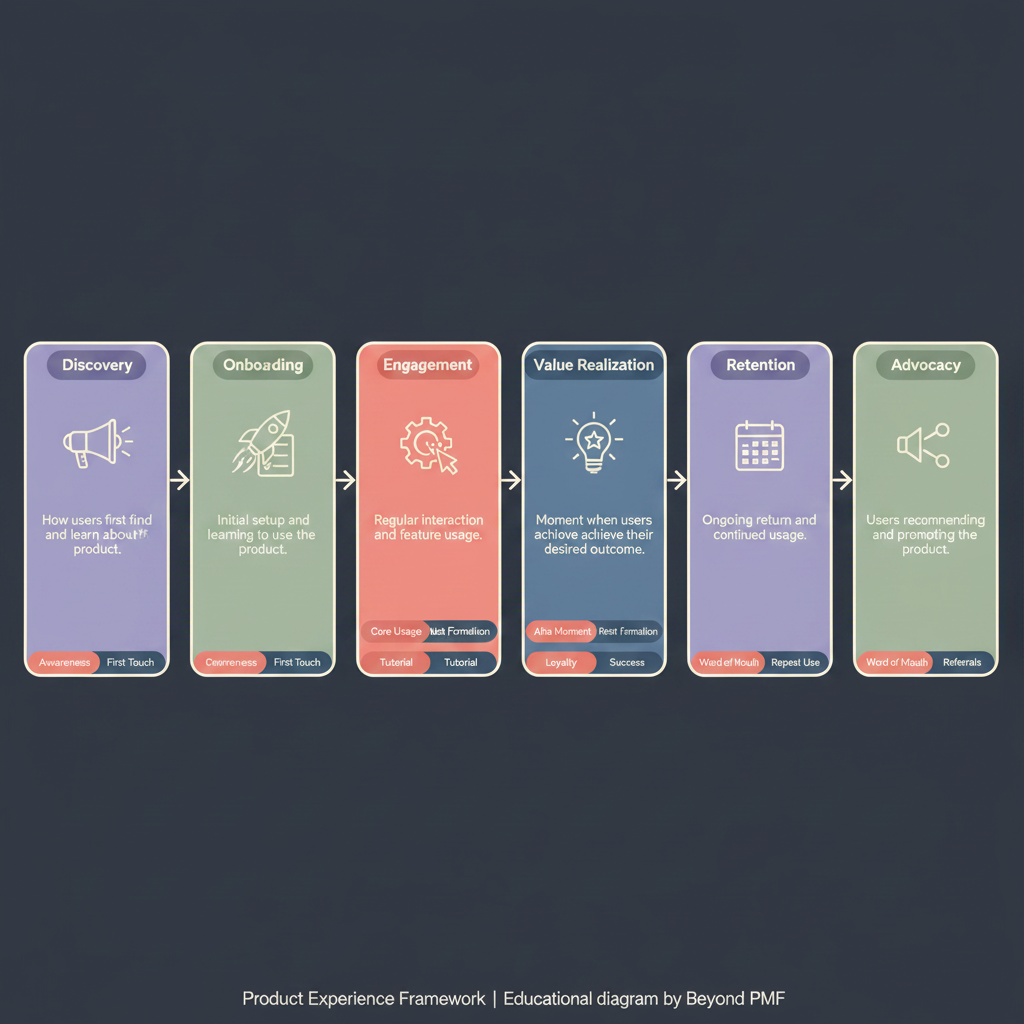
Product Experience Framework

https://ik.imagekit.io/beyondpmf/frameworks/product-experience-framework.png
The Product Experience Framework directly addresses issues related to the user's interaction with the product, focusing on satisfaction and usability. This encompasses customer-facing delivery and the quality of the user experience.

The Product Experience Framework is a comprehensive approach designed to systematically enhance the way users interact with a product. It focuses on understanding user needs, behaviors, and feedback to optimize the product's design, functionality, and overall usability. This framework is crucial for businesses aiming to improve customer satisfaction, increase user engagement, and drive product success in competitive markets.

Steps / Detailed Description

Identify user personas and their needs to tailor the product experience. | Map the user journey to understand all touchpoints and potential pain points. | Gather and analyze user feedback to identify areas for improvement. | Implement changes based on insights and iterate on the design. | Measure the impact of changes through user engagement and satisfaction metrics.

Best Practices

Regularly update user personas based on evolving user data | Use a variety of feedback tools to gather comprehensive user insights | Continuously measure the impact of changes and adapt strategies accordingly

Pros

Enhances user satisfaction and loyalty | Drives product improvements based on real user data | Increases overall usability and functionality of the product

Cons

Can be time-consuming to gather and analyze user feedback | Requires continuous updates and iterations | May necessitate significant resource investment

When to Use

When launching a new product to ensure it meets user expectations | When updating an existing product to enhance user experience

When Not to Use

For products with very limited user interaction | When immediate product changes are not feasible due to technical or budget constraints

Related Frameworks

Categories

Lifecycle

Not tied to a specific lifecycle stage

Scope

Scope not defined

Maturity Level

Maturity level not specified

Time to Implement

2–4 Weeks
3–6 Months
1–2 Weeks
3–6 Months
1–2 Months
3–6 Months
1–2 Weeks
Less Than 1 Day
1–2 Weeks
Longer Than 6 Months
1–2 Weeks
Longer Than 6 Months
1–2 Weeks
3–6 Months
1–2 Weeks
1–2 Weeks
1–2 Weeks
1–2 Weeks
1–2 Days
1–2 Weeks
1–2 Weeks
1–2 Weeks
1–2 Weeks
1–2 Weeks
1–2 Weeks
3–6 Months
1–2 Weeks
1–2 Weeks
1–2 Weeks
3–6 Months
1–2 Weeks
1–2 Weeks
2–4 Weeks
1–2 Weeks
1–2 Days
1–2 Weeks
Longer Than 6 Months
3–6 Months
Longer Than 6 Months
1–2 Weeks
Longer Than 6 Months
3–6 Months
Less Than 1 Day
3–6 Months
1–2 Months
3–6 Months
Longer Than 6 Months
3–6 Months
Less Than 1 Day
1–2 Weeks
3–6 Months
3–6 Months
1–2 Weeks
3–6 Months
1–2 Weeks
1–2 Weeks
1–2 Days
1–2 Weeks
1–2 Months
Longer Than 6 Months
1–2 Weeks
Longer Than 6 Months
1–2 Weeks
3–6 Months
1–2 Weeks
Less Than 1 Day
1–2 Weeks
3–6 Months
1–2 Weeks
3–6 Months
1–2 Weeks
1–2 Weeks
Longer Than 6 Months
Less Than 1 Day
3–6 Months
Longer Than 6 Months
1–2 Months
1–2 Weeks
Longer Than 6 Months
1–2 Weeks
3–6 Months
1–2 Weeks
1–2 Weeks
3–6 Months
Less Than 1 Day
1–2 Weeks
1–2 Weeks
3–6 Months
3–6 Months
Less Than 1 Day
1–2 Weeks
Longer Than 6 Months
1–2 Months
1–2 Weeks
1–2 Weeks
1–2 Weeks
Longer Than 6 Months

Copyright Information

Autor:
https://ik.imagekit.io/beyondpmf/tr:n-ik_ml_thumbnail/frameworks/product-experience-framework.png
https://ik.imagekit.io/beyondpmf/tr:n-diagram_full/frameworks/product-experience-framework.png
Publication: