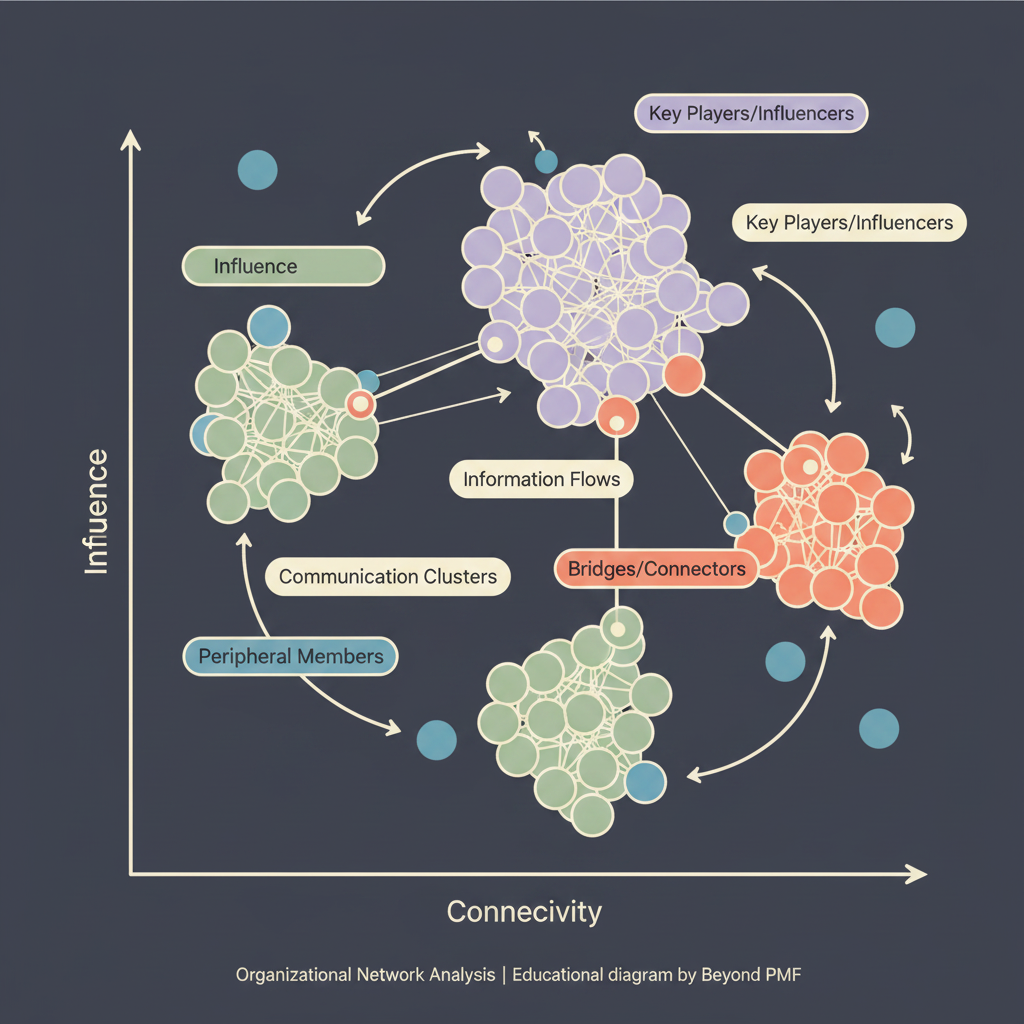
Organizational Network Analysis

https://ik.imagekit.io/beyondpmf/frameworks/organizational-network-analysis.png
Organizational Network Analysis primarily addresses friction related to organizational structure. It identifies communication patterns and information flow, which directly relates to how teams and individuals are connected and how effectively information moves within the organization. This reveals potential issues with roles, cross-functional collaboration, and overall organizational design.

Organizational Network Analysis (ONA) is a framework used to visualize and analyze relationships and flows between people, groups, and divisions within an organization. It helps in identifying informal networks, key influencers, information bottlenecks, and collaboration patterns. The insights gained from ONA can be used to improve decision-making, increase efficiency, and enhance organizational performance by optimizing the flow of information and collaboration.

Steps / Detailed Description

Define the objectives and scope of the analysis. | Collect data through surveys, digital tools, or observation. | Map the network using specialized software to visualize relationships. | Analyze the network to identify key players, clusters, and connectors. | Interpret the data to understand the impact on organizational goals. | Develop and implement strategies based on the analysis. | Monitor changes and adjust strategies as necessary.

Best Practices

Ensure clear objectives are set before starting the analysis | Use a mix of data collection methods for comprehensive insights | Communicate transparently with employees about the purpose and process

Pros

Improves understanding of communication dynamics | Identifies key influencers and information bottlenecks | Facilitates better strategic decision-making

Cons

Can be time-consuming and resource-intensive | Relies heavily on the accuracy of data collected | May raise privacy and trust concerns among employees

When to Use

To enhance collaboration and communication within the organization | During organizational restructuring or mergers

When Not to Use

When there is insufficient data | In highly sensitive environments where trust is low

Related Frameworks

Categories

Lifecycle

Not tied to a specific lifecycle stage

Scope

Scope not defined

Maturity Level

Maturity level not specified

Time to Implement

2–4 Weeks
3–6 Months
1–2 Weeks
3–6 Months
1–2 Months
3–6 Months
1–2 Weeks
Less Than 1 Day
1–2 Weeks
Longer Than 6 Months
1–2 Weeks
Longer Than 6 Months
1–2 Weeks
3–6 Months
1–2 Weeks
1–2 Weeks
1–2 Weeks
1–2 Weeks
1–2 Days
1–2 Weeks
1–2 Weeks
1–2 Weeks
1–2 Weeks
1–2 Weeks
1–2 Weeks
3–6 Months
1–2 Weeks
1–2 Weeks
1–2 Weeks
3–6 Months
1–2 Weeks
1–2 Weeks
2–4 Weeks
1–2 Weeks
1–2 Days
1–2 Weeks
Longer Than 6 Months
3–6 Months
Longer Than 6 Months
1–2 Weeks
Longer Than 6 Months
3–6 Months
Less Than 1 Day
3–6 Months
1–2 Months
3–6 Months
Longer Than 6 Months
3–6 Months
Less Than 1 Day
1–2 Weeks
3–6 Months
3–6 Months
1–2 Weeks
3–6 Months
1–2 Weeks
1–2 Weeks
1–2 Days
1–2 Weeks
1–2 Months
Longer Than 6 Months
1–2 Weeks
Longer Than 6 Months
1–2 Weeks
3–6 Months
1–2 Weeks
Less Than 1 Day
1–2 Weeks
3–6 Months
1–2 Weeks
3–6 Months
1–2 Weeks
1–2 Weeks
Longer Than 6 Months
Less Than 1 Day
3–6 Months
Longer Than 6 Months
1–2 Months
1–2 Weeks
Longer Than 6 Months
1–2 Weeks
3–6 Months
1–2 Weeks
1–2 Weeks
3–6 Months
Less Than 1 Day
1–2 Weeks
1–2 Weeks
3–6 Months
3–6 Months
Less Than 1 Day
1–2 Weeks
Longer Than 6 Months
1–2 Months
1–2 Weeks
1–2 Weeks
1–2 Weeks
Longer Than 6 Months

Copyright Information

Autor:
Unknown
N/A
Publication:
Generic Business Tool