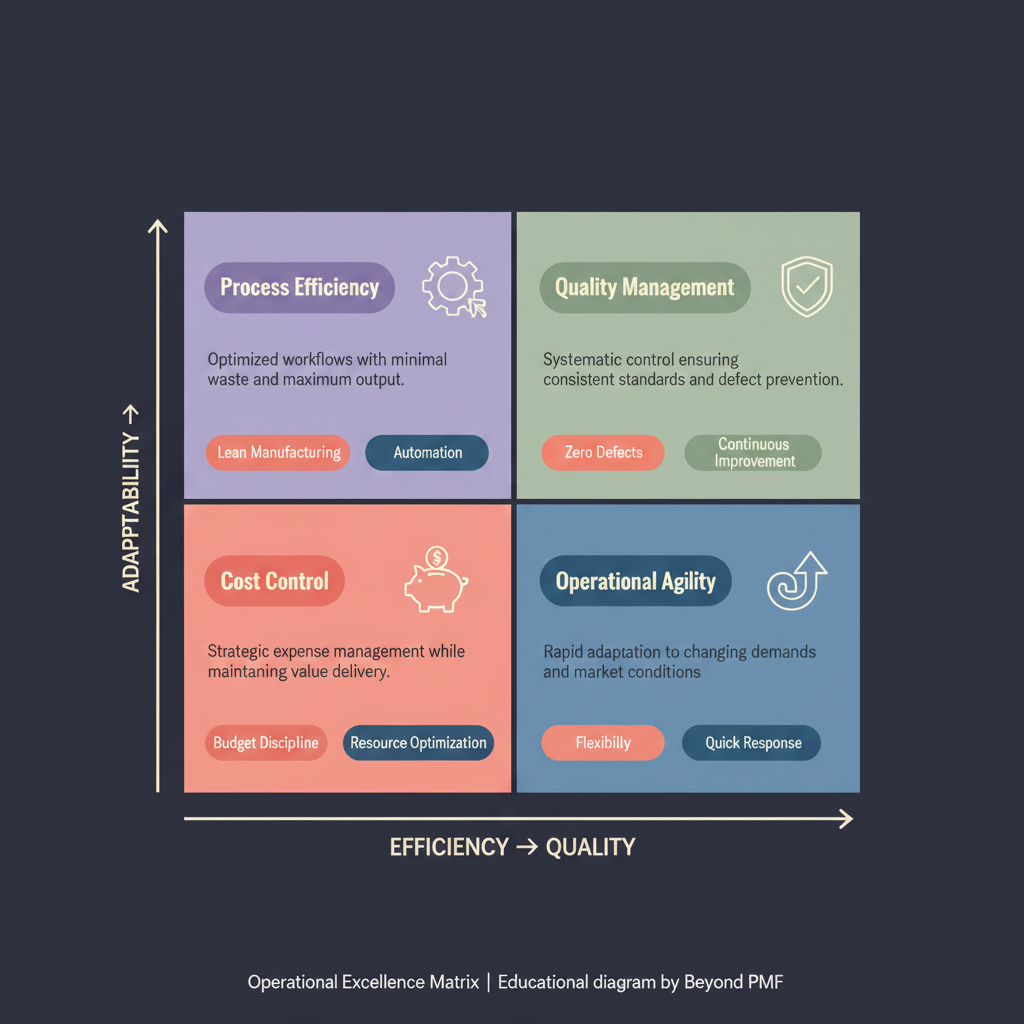
Operational Excellence Matrix

https://ik.imagekit.io/beyondpmf/frameworks/operational-excellence-matrix.png
The Operational Excellence Matrix focuses on improving how work is done within the organization. It addresses inefficiencies related to processes, workflows, and coordination to enhance overall operational performance.

The Operational Excellence Matrix is a framework designed to help organizations assess and improve their operational processes. It focuses on identifying areas of strength and weakness across various dimensions such as quality, speed, cost, and innovation. By evaluating these dimensions, companies can develop targeted strategies to optimize performance, reduce waste, and enhance overall productivity. The framework is widely used due to its structured approach in driving continuous improvement and operational excellence.

Steps / Detailed Description

Identify key operational areas to be assessed. | Define metrics for quality, speed, cost, and innovation. | Collect data and measure current performance against the metrics. | Analyze the data to identify gaps and areas of improvement. | Develop action plans based on the analysis to address the identified gaps. | Implement the action plans and monitor progress. | Continuously review and refine the operational strategies.

Best Practices

Regularly update the metrics to reflect changing business conditions. | Engage cross-functional teams to ensure comprehensive data collection and analysis. | Use the matrix as part of a broader strategic management process.

Pros

Provides a clear and structured approach to improving operations. | Helps in identifying specific areas of improvement. | Facilitates continuous improvement and competitive advantage.

Cons

Can be time-consuming to implement and maintain. | Requires accurate data collection, which can be resource-intensive. | May focus too narrowly on operational metrics, overlooking other important factors like employee satisfaction.

When to Use

When seeking to improve operational efficiency and effectiveness. | When an organization needs a systematic approach to process improvement.

When Not to Use

In very small organizations where formal frameworks may be too cumbersome. | When immediate, not structured long-term, improvements are required.

Related Frameworks

Lifecycle

Not tied to a specific lifecycle stage

Scope

Scope not defined

Maturity Level

Maturity level not specified

Time to Implement

2–4 Weeks
3–6 Months
1–2 Weeks
3–6 Months
1–2 Months
3–6 Months
1–2 Weeks
Less Than 1 Day
1–2 Weeks
Longer Than 6 Months
1–2 Weeks
Longer Than 6 Months
1–2 Weeks
3–6 Months
1–2 Weeks
1–2 Weeks
1–2 Weeks
1–2 Weeks
1–2 Days
1–2 Weeks
1–2 Weeks
1–2 Weeks
1–2 Weeks
1–2 Weeks
1–2 Weeks
3–6 Months
1–2 Weeks
1–2 Weeks
1–2 Weeks
3–6 Months
1–2 Weeks
1–2 Weeks
2–4 Weeks
1–2 Weeks
1–2 Days
1–2 Weeks
Longer Than 6 Months
3–6 Months
Longer Than 6 Months
1–2 Weeks
Longer Than 6 Months
3–6 Months
Less Than 1 Day
3–6 Months
1–2 Months
3–6 Months
Longer Than 6 Months
3–6 Months
Less Than 1 Day
1–2 Weeks
3–6 Months
3–6 Months
1–2 Weeks
3–6 Months
1–2 Weeks
1–2 Weeks
1–2 Days
1–2 Weeks
1–2 Months
Longer Than 6 Months
1–2 Weeks
Longer Than 6 Months
1–2 Weeks
3–6 Months
1–2 Weeks
Less Than 1 Day
1–2 Weeks
3–6 Months
1–2 Weeks
3–6 Months
1–2 Weeks
1–2 Weeks
Longer Than 6 Months
Less Than 1 Day
3–6 Months
Longer Than 6 Months
1–2 Months
1–2 Weeks
Longer Than 6 Months
1–2 Weeks
3–6 Months
1–2 Weeks
1–2 Weeks
3–6 Months
Less Than 1 Day
1–2 Weeks
1–2 Weeks
3–6 Months
3–6 Months
Less Than 1 Day
1–2 Weeks
Longer Than 6 Months
1–2 Months
1–2 Weeks
1–2 Weeks
1–2 Weeks
Longer Than 6 Months

Copyright Information

Autor:
Unknown
N/A
Publication:
Generic Business Tool