North Star Framework

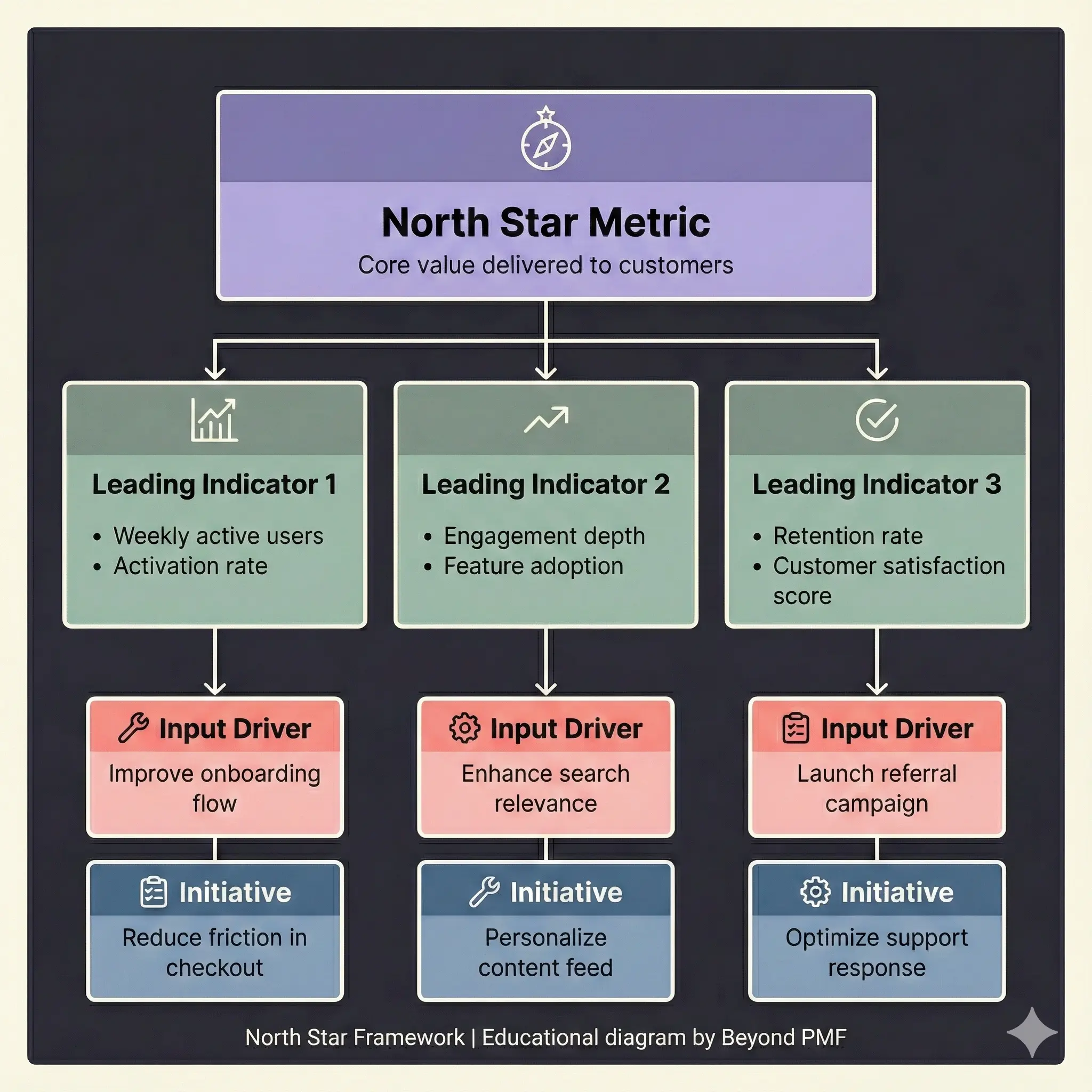
Diagram of the North Star Metric Framework showing the core value delivered to customers at the top, supported by three leading indicators such as active users, engagement depth, and retention rate. Each leading indicator connects to input drivers like improving onboarding, enhancing search relevance, and launching referral campaigns, followed by initiatives such as reducing checkout friction, personalizing content, and optimizing support response.
The North Star Framework directly addresses the strategic friction of unclear direction by identifying a key metric that represents the core value delivered to customers. This framework helps align the business around a common goal and provides a focus for decision-making.

The North Star Framework helps organizations define a single, crucial metric that reflects the core value they provide to their customers, known as the North Star Metric. This metric guides all strategic decisions and product development efforts, ensuring that every team within the organization aligns with the overall goal. The framework encourages consistent growth and alignment by focusing on what truly matters to customers, thereby driving sustainable long-term success.

Steps / Detailed Description

Identify the core value your product offers to customers. | Determine the metric that best captures this core value. | Align all teams and resources to focus on improving this metric. | Regularly track progress and refine strategies to enhance the North Star Metric. | Iterate and adapt the framework based on feedback and changing market conditions.

Best Practices

Regularly review and adjust the North Star Metric as needed | Ensure cross-departmental communication and collaboration | Use qualitative insights to complement quantitative metric tracking

Pros

Ensures company-wide alignment on key objectives | Focuses efforts on sustainable, value-driven growth | Facilitates clear and measurable strategic decision-making

Cons

Overemphasis on one metric can neglect other important areas | May not adapt quickly to market or product changes | Risk of oversimplifying complex business dynamics

When to Use

When needing to align multiple teams under a common goal | During strategic planning to focus on customer value

When Not to Use

In highly volatile markets where metrics may frequently change | When a business is in early stages and still exploring market fit

Related Frameworks

Categories

Lifecycle

Not tied to a specific lifecycle stage

Scope

Scope not defined

Maturity Level

Maturity level not specified

Time to Implement

2–4 Weeks
3–6 Months
1–2 Weeks
3–6 Months
1–2 Months
3–6 Months
1–2 Weeks
Less Than 1 Day
1–2 Weeks
Longer Than 6 Months
1–2 Weeks
Longer Than 6 Months
1–2 Weeks
3–6 Months
1–2 Weeks
1–2 Weeks
1–2 Weeks
1–2 Weeks
1–2 Days
1–2 Weeks
1–2 Weeks
1–2 Weeks
1–2 Weeks
1–2 Weeks
1–2 Weeks
3–6 Months
1–2 Weeks
1–2 Weeks
1–2 Weeks
3–6 Months
1–2 Weeks
1–2 Weeks
2–4 Weeks
1–2 Weeks
1–2 Days
1–2 Weeks
Longer Than 6 Months
3–6 Months
Longer Than 6 Months
1–2 Weeks
Longer Than 6 Months
3–6 Months
Less Than 1 Day
3–6 Months
1–2 Months
3–6 Months
Longer Than 6 Months
3–6 Months
Less Than 1 Day
1–2 Weeks
3–6 Months
3–6 Months
1–2 Weeks
3–6 Months
1–2 Weeks
1–2 Weeks
1–2 Days
1–2 Weeks
1–2 Months
Longer Than 6 Months
1–2 Weeks
Longer Than 6 Months
1–2 Weeks
3–6 Months
1–2 Weeks
Less Than 1 Day
1–2 Weeks
3–6 Months
1–2 Weeks
3–6 Months
1–2 Weeks
1–2 Weeks
Longer Than 6 Months
Less Than 1 Day
3–6 Months
Longer Than 6 Months
1–2 Months
1–2 Weeks
Longer Than 6 Months
1–2 Weeks
3–6 Months
1–2 Weeks
1–2 Weeks
3–6 Months
Less Than 1 Day
1–2 Weeks
1–2 Weeks
3–6 Months
3–6 Months
Less Than 1 Day
1–2 Weeks
Longer Than 6 Months
1–2 Months
1–2 Weeks
1–2 Weeks
1–2 Weeks
Longer Than 6 Months

Copyright Information

Autor:
Unknown
N/A
Publication:
Generic Business Tool