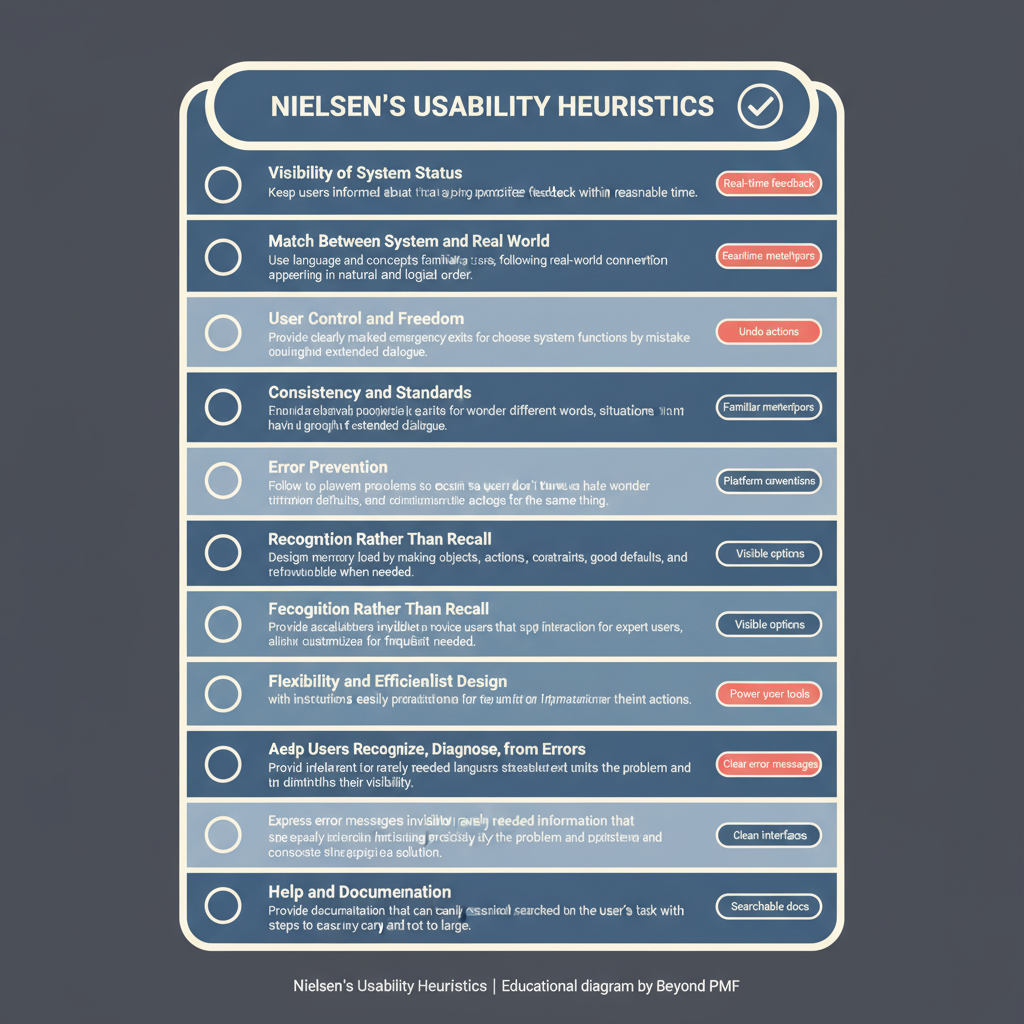
Nielsen's Usability Heuristics, developed by Jakob Nielsen, are a foundational set of guidelines used to evaluate and enhance user interface design. These principles focus on making software interfaces more intuitive, efficient, and user-friendly. The framework is widely adopted due to its simplicity and effectiveness in identifying common usability issues, making it an essential tool in user experience (UX) design.
Visibility of system status: Keep users informed about what is going on through appropriate feedback within a reasonable time. | Match between system and the real world: Speak the users' language with words, phrases, and concepts familiar to the user. | User control and freedom: Users often perform actions by mistake. Provide a clearly marked 'emergency exit' to leave the unwanted action without having to go through an extended process. | Consistency and standards: Users should not have to wonder whether different words, situations, or actions mean the same thing. Follow platform and industry conventions. | Error prevention: Design the system so that users cannot make serious errors, or at least confirm them before they commit to the action. | Recognition rather than recall: Minimize the user's memory load by making objects, actions, and options visible. | Flexibility and efficiency of use: Allow users to tailor frequent actions. | Aesthetic and minimalist design: Interfaces should not contain information which is irrelevant or rarely needed. | Help users recognize, diagnose, and recover from errors: Error messages should be expressed in plain language, precisely indicate the problem, and constructively suggest a solution. | Help and documentation: Even though it is better if the system can be used without documentation, it may be necessary to provide help and documentation.
Regularly refer to the heuristics during the design phase | Use the heuristics as a checklist in usability evaluations | Combine with other usability testing methods for comprehensive results
Improves user satisfaction | Increases usability and accessibility | Reduces development time by identifying issues early
May not cover all aspects of user experience | Can be subjective in interpretation | Might not address specific needs of complex applications
Early stages of product design | Usability testing and evaluation
In-depth user research | Detailed interface customization for expert users