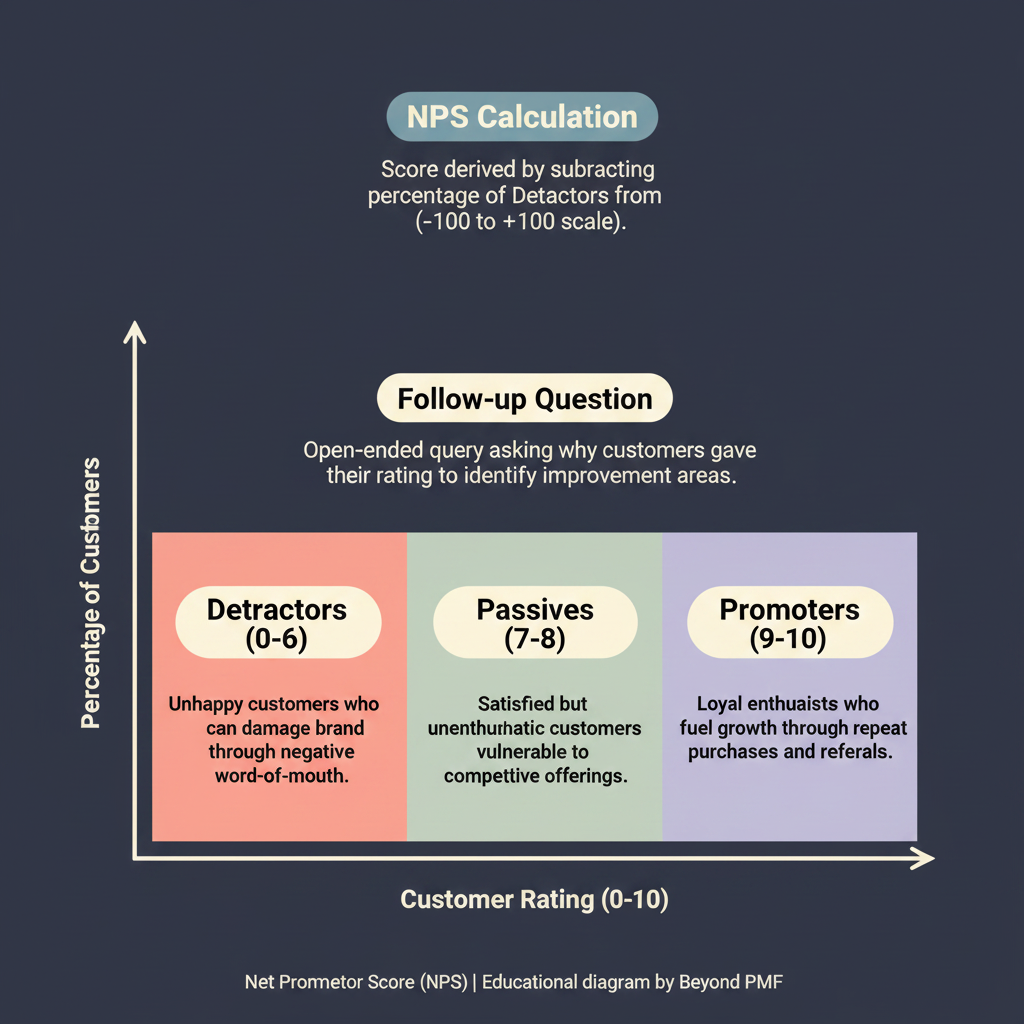
Net Promoter Score (NPS) is a widely used market research metric that measures the likelihood of customers to recommend a company's products or services to others. It is calculated based on responses to a single question: 'How likely are you to recommend our company/product/service to a friend or colleague?' The responses are used to classify customers into Promoters, Passives, and Detractors. NPS is a strong indicator of customer overall satisfaction and loyalty, and it provides actionable insights to improve service, product, or customer relationships.
Survey your customers asking them how likely they are to recommend your product or service on a scale of 0-10. | Categorize the responses into Promoters (9-10), Passives (7-8), and Detractors (0-6). | Calculate the NPS by subtracting the percentage of Detractors from the percentage of Promoters. | Analyze the feedback to understand the reasons behind the scores provided. | Implement improvements based on the insights gained to increase the number of Promoters and reduce the number of Detractors.
Regularly conduct NPS surveys to track changes over time | Combine NPS with other metrics for a comprehensive view | Act on the feedback to improve customer satisfaction
Simple to implement and understand | Facilitates comparison across different units or time periods | Directly correlates to growth and customer loyalty
Does not provide detailed insights on its own | Can be influenced by cultural factors in global surveys | May overlook the middle group (Passives) who can be potential Promoters
To measure customer loyalty and satisfaction | When evaluating the impact of a new product or service
If detailed, qualitative feedback is required | When immediate, actionable customer feedback is needed