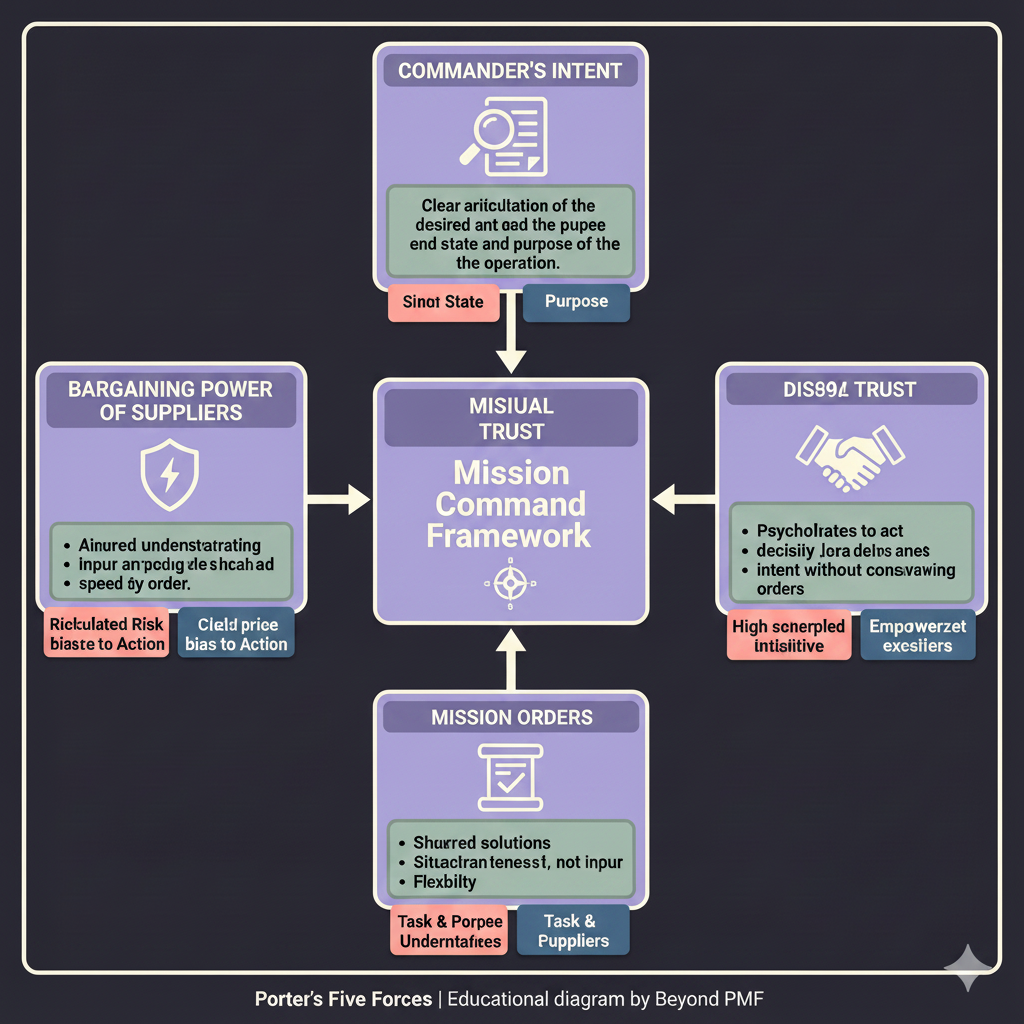
The Mission Command Framework is a leadership philosophy that empowers individuals and teams to make decisions in alignment with the organization's intent. It is used primarily in military and complex operations where rapid decision-making is critical under uncertain conditions. The framework fosters initiative, flexibility, and rapid adaptation, enhancing the organization's ability to respond to dynamic situations and achieve strategic goals effectively.
Understand the strategic intent: Clearly define the mission and the commanderβs intent to ensure all team members know the ultimate objective. | Develop mutual trust: Build a strong foundation of trust within the team, essential for effective decentralized decision-making. | Create shared understanding: Ensure all members understand the context and reasons behind missions and tasks. | Exercise disciplined initiative: Encourage team members to take decisive action within the bounds of the commanderβs intent. | Use mission orders: Issue orders that define the objective, not the details of how to achieve it. | Accept prudent risk: Empower leaders to make decisions that involve calculated risks to achieve strategic objectives.
Regularly train and educate team members on the framework | Establish clear communication channels and protocols | Continuously build and reinforce trust within the team
Enhances flexibility and adaptability in dynamic environments | Promotes faster decision-making and responsiveness | Empowers lower-level leaders and fosters leadership development
Risk of misinterpretation of the commanderβs intent | Potential for inconsistency in decision-making across units | Requires high levels of trust and communication, which can be challenging to establish
In environments where rapid response and adaptability are crucial | When the organization has competent leaders at all levels
In highly regulated or controlled environments where strict adherence to procedures is required | When there is insufficient training or trust among team members