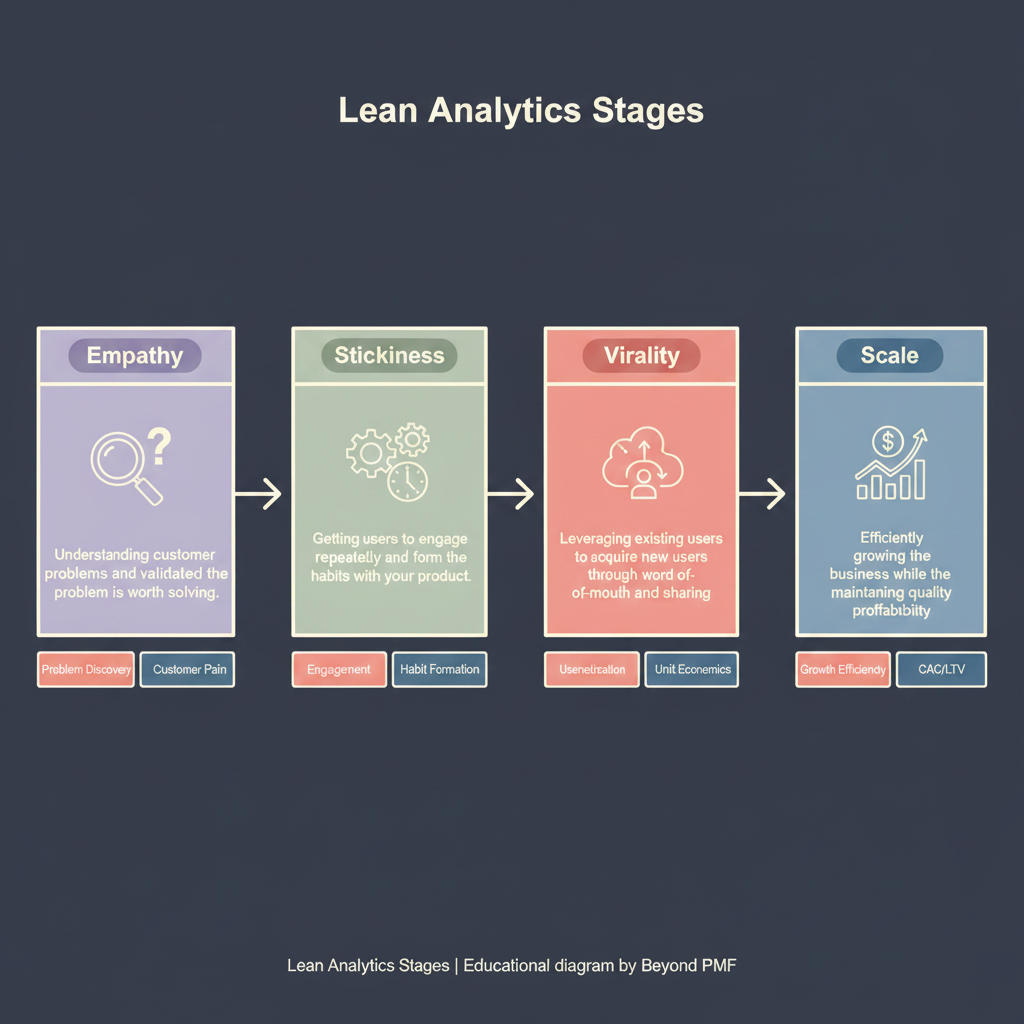
Lean Analytics Stages

https://ik.imagekit.io/beyondpmf/frameworks/lean-analytics-stages.png
Lean Analytics Stages helps startups focus on the most important metrics at each stage of their lifecycle, aligning measurement with the business's current strategic goals and direction. It addresses the friction of unclear direction by providing a framework to prioritize what to measure based on the stage of the business.

The Lean Analytics Stages framework is a methodology that helps startups and new ventures to focus on what is most important at each stage of their business development. By identifying and analyzing the right metrics, businesses can make informed decisions that drive growth and efficiency. This framework is particularly beneficial for rapidly iterating startups that need to constantly adapt and refine their strategies based on actionable data insights.

Steps / Detailed Description

Empathy Stage: Focus on understanding customer problems and needs. | Stickiness Stage: Measure user engagement and product value. | Virality Stage: Optimize marketing strategies to increase user acquisition. | Revenue Stage: Concentrate on monetization strategies and revenue growth. | Scale Stage: Expand the business sustainably with a focus on scaling operations and infrastructure.

Best Practices

Regularly review and adjust key metrics as business evolves | Integrate qualitative insights with quantitative data | Ensure all team members understand the importance of the metrics

Pros

Provides clear focus on key metrics at each stage | Facilitates data-driven decision making | Helps prioritize resources effectively

Cons

May overlook external factors affecting metrics | Can be overly rigid in metric selection | Requires accurate data collection and analysis capabilities

When to Use

In early-stage startups to determine product-market fit | During growth phases to optimize business operations

When Not to Use

In well-established companies with fixed performance metrics | When external factors are significantly impacting business metrics

Related Frameworks

Categories

Lifecycle

Not tied to a specific lifecycle stage

Scope

Scope not defined

Maturity Level

Maturity level not specified

Time to Implement

2–4 Weeks
3–6 Months
1–2 Weeks
3–6 Months
1–2 Months
3–6 Months
1–2 Weeks
Less Than 1 Day
1–2 Weeks
Longer Than 6 Months
1–2 Weeks
Longer Than 6 Months
1–2 Weeks
3–6 Months
1–2 Weeks
1–2 Weeks
1–2 Weeks
1–2 Weeks
1–2 Days
1–2 Weeks
1–2 Weeks
1–2 Weeks
1–2 Weeks
1–2 Weeks
1–2 Weeks
3–6 Months
1–2 Weeks
1–2 Weeks
1–2 Weeks
3–6 Months
1–2 Weeks
1–2 Weeks
2–4 Weeks
1–2 Weeks
1–2 Days
1–2 Weeks
Longer Than 6 Months
3–6 Months
Longer Than 6 Months
1–2 Weeks
Longer Than 6 Months
3–6 Months
Less Than 1 Day
3–6 Months
1–2 Months
3–6 Months
Longer Than 6 Months
3–6 Months
Less Than 1 Day
1–2 Weeks
3–6 Months
3–6 Months
1–2 Weeks
3–6 Months
1–2 Weeks
1–2 Weeks
1–2 Days
1–2 Weeks
1–2 Months
Longer Than 6 Months
1–2 Weeks
Longer Than 6 Months
1–2 Weeks
3–6 Months
1–2 Weeks
Less Than 1 Day
1–2 Weeks
3–6 Months
1–2 Weeks
3–6 Months
1–2 Weeks
1–2 Weeks
Longer Than 6 Months
Less Than 1 Day
3–6 Months
Longer Than 6 Months
1–2 Months
1–2 Weeks
Longer Than 6 Months
1–2 Weeks
3–6 Months
1–2 Weeks
1–2 Weeks
3–6 Months
Less Than 1 Day
1–2 Weeks
1–2 Weeks
3–6 Months
3–6 Months
Less Than 1 Day
1–2 Weeks
Longer Than 6 Months
1–2 Months
1–2 Weeks
1–2 Weeks
1–2 Weeks
Longer Than 6 Months

Copyright Information

Autor:
Alistair Croll and Benjamin Yoskovitz
2013
Publication:
Lean Analytics: Use Data to Build a Better Startup Faster