Knowledge-Centered Service (KCS)

https://ik.imagekit.io/beyondpmf/frameworks/knowledge-centered-service-kcs.png
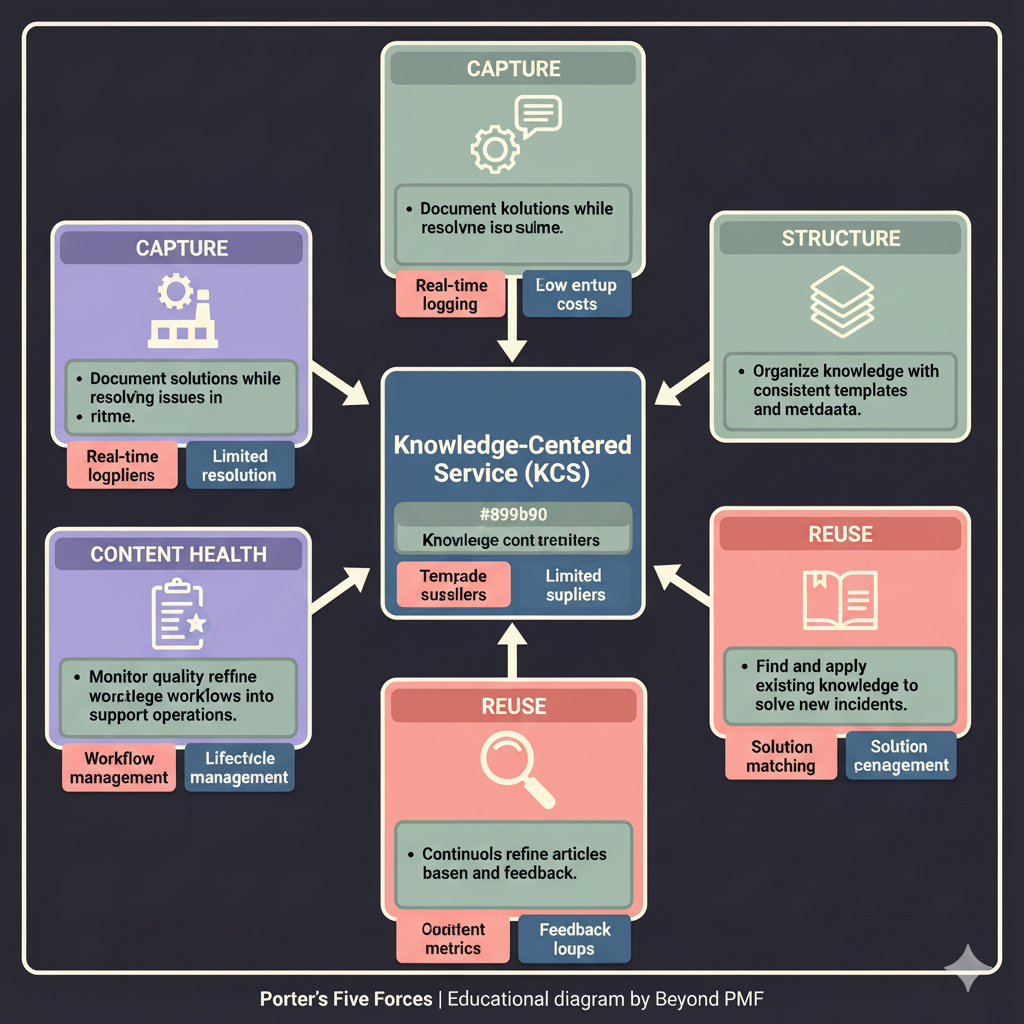
KCS focuses on improving service delivery by integrating knowledge management into daily tasks. This directly addresses the friction of slow delivery, poor quality, and ineffective problem-solving in a customer-facing environment.

Knowledge-Centered Service (KCS) is a service delivery methodology that focuses on knowledge as a key asset in the service process. It emphasizes creating, maintaining, and leveraging knowledge consistently across an organization to improve service efficiency, resolve problems faster, and enhance customer satisfaction. By integrating the creation and maintenance of knowledge into daily service tasks, KCS enables organizations to continuously improve and update their knowledge base.

Steps / Detailed Description

Capture knowledge as it is created during problem-solving. | Structure the knowledge for easy retrieval and reuse. | Review and improve the knowledge base continuously. | Integrate the use of the knowledge base into the workflow. | Measure the effectiveness and impact of knowledge on service delivery.

Best Practices

Encourage continuous input and feedback from all team members. | Regularly review and update the knowledge base to maintain accuracy. | Integrate KCS practices into performance metrics and incentives.

Pros

Improves resolution times by making solutions readily available. | Reduces operational costs by minimizing redundant work. | Enhances customer satisfaction through faster and more effective responses.

Cons

Requires significant initial and ongoing investment in training and tools. | Depends heavily on employee participation and adherence to processes. | Risk of outdated or incorrect information if not regularly maintained.

When to Use

In customer support centers to enhance service quality and response times. | In IT departments for efficient management of technical knowledge and issue resolution.

When Not to Use

In small teams where the cost and complexity of implementing KCS may not be justified. | Where rapid changes in information make it difficult to maintain an accurate knowledge base.

Related Frameworks

Lifecycle

Not tied to a specific lifecycle stage

Scope

Scope not defined

Maturity Level

Maturity level not specified

Time to Implement

2–4 Weeks
3–6 Months
1–2 Weeks
3–6 Months
1–2 Months
3–6 Months
1–2 Weeks
Less Than 1 Day
1–2 Weeks
Longer Than 6 Months
1–2 Weeks
Longer Than 6 Months
1–2 Weeks
3–6 Months
1–2 Weeks
1–2 Weeks
1–2 Weeks
1–2 Weeks
1–2 Days
1–2 Weeks
1–2 Weeks
1–2 Weeks
1–2 Weeks
1–2 Weeks
1–2 Weeks
3–6 Months
1–2 Weeks
1–2 Weeks
1–2 Weeks
3–6 Months
1–2 Weeks
1–2 Weeks
2–4 Weeks
1–2 Weeks
1–2 Days
1–2 Weeks
Longer Than 6 Months
3–6 Months
Longer Than 6 Months
1–2 Weeks
Longer Than 6 Months
3–6 Months
Less Than 1 Day
3–6 Months
1–2 Months
3–6 Months
Longer Than 6 Months
3–6 Months
Less Than 1 Day
1–2 Weeks
3–6 Months
3–6 Months
1–2 Weeks
3–6 Months
1–2 Weeks
1–2 Weeks
1–2 Days
1–2 Weeks
1–2 Months
Longer Than 6 Months
1–2 Weeks
Longer Than 6 Months
1–2 Weeks
3–6 Months
1–2 Weeks
Less Than 1 Day
1–2 Weeks
3–6 Months
1–2 Weeks
3–6 Months
1–2 Weeks
1–2 Weeks
Longer Than 6 Months
Less Than 1 Day
3–6 Months
Longer Than 6 Months
1–2 Months
1–2 Weeks
Longer Than 6 Months
1–2 Weeks
3–6 Months
1–2 Weeks
1–2 Weeks
3–6 Months
Less Than 1 Day
1–2 Weeks
1–2 Weeks
3–6 Months
3–6 Months
Less Than 1 Day
1–2 Weeks
Longer Than 6 Months
1–2 Months
1–2 Weeks
1–2 Weeks
1–2 Weeks
Longer Than 6 Months

Copyright Information

Autor:
The KCS Academy
1992
Publication:
The KCS Academy