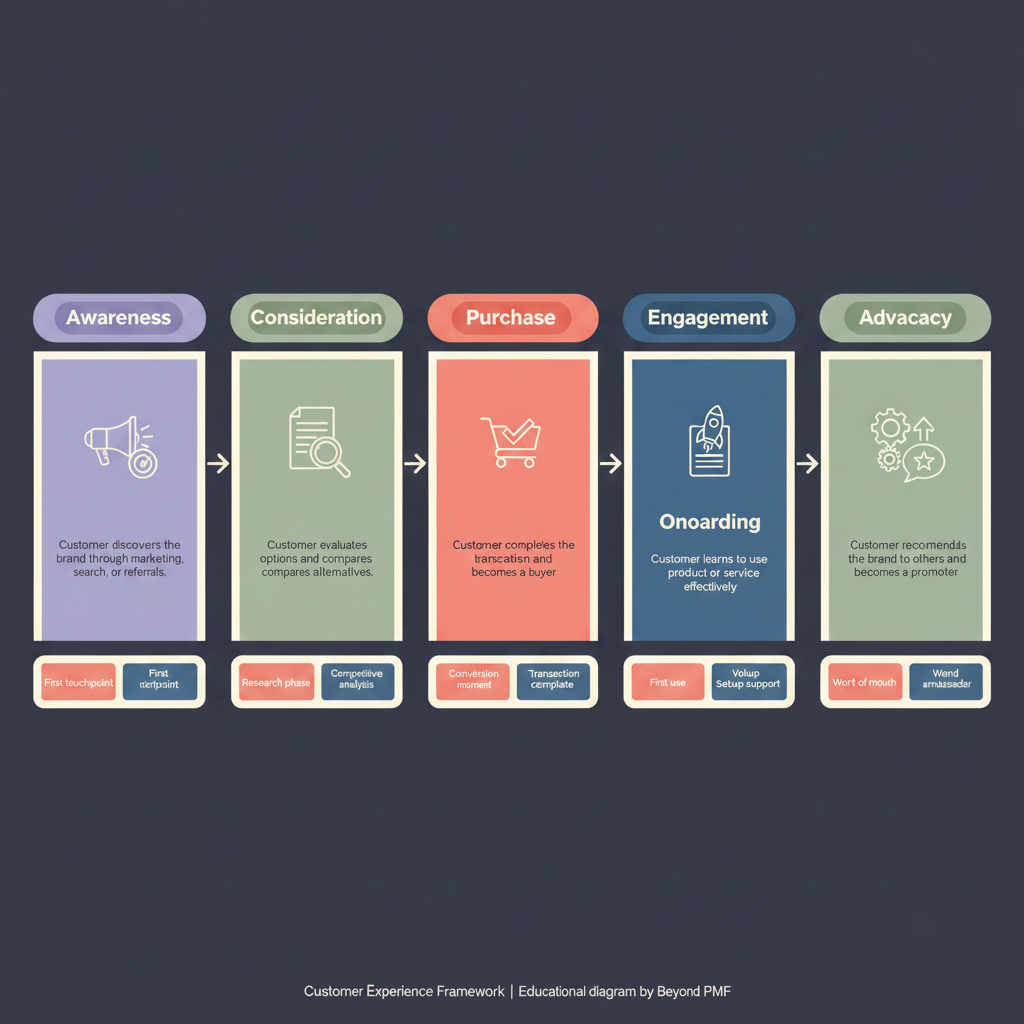
Customer Experience Framework

https://ik.imagekit.io/beyondpmf/frameworks/customer-experience-framework.png
The Customer Experience Framework directly addresses issues related to customer-facing delivery and the user experience. It aims to improve interactions at all touchpoints, which falls under the domain of execution and customer satisfaction.

The Customer Experience Framework is a comprehensive approach designed to systematically improve and manage the interactions between a company and its customers. It focuses on understanding customer needs, mapping customer journeys, and optimizing touchpoints to enhance satisfaction and loyalty. This framework helps businesses align their operations with customer expectations, leading to increased customer retention, higher customer satisfaction, and improved brand perception.

Steps / Detailed Description

Define customer personas to understand different customer segments. | Map the customer journey to identify all touchpoints. | Analyze customer feedback to identify areas for improvement. | Design and implement enhancements at each touchpoint. | Measure the impact of changes and iterate based on results.

Best Practices

Regularly update customer personas with new data | Ensure cross-departmental collaboration for holistic improvements | Leverage technology to gather and analyze customer feedback efficiently

Pros

Improves customer satisfaction and loyalty | Enhances brand reputation and value | Drives business growth through better customer retention

Cons

Can be resource-intensive to implement and maintain | Requires continuous data collection and analysis | May require significant organizational change

When to Use

When aiming to improve customer satisfaction and retention | When undergoing a brand refresh or repositioning

When Not to Use

In very early stages of a startup with limited resources | When the market or customer base is not well-defined

Related Frameworks

Lifecycle

Not tied to a specific lifecycle stage

Scope

Scope not defined

Maturity Level

Maturity level not specified

Time to Implement

2–4 Weeks
3–6 Months
1–2 Weeks
3–6 Months
1–2 Months
3–6 Months
1–2 Weeks
Less Than 1 Day
1–2 Weeks
Longer Than 6 Months
1–2 Weeks
Longer Than 6 Months
1–2 Weeks
3–6 Months
1–2 Weeks
1–2 Weeks
1–2 Weeks
1–2 Weeks
1–2 Days
1–2 Weeks
1–2 Weeks
1–2 Weeks
1–2 Weeks
1–2 Weeks
1–2 Weeks
3–6 Months
1–2 Weeks
1–2 Weeks
1–2 Weeks
3–6 Months
1–2 Weeks
1–2 Weeks
2–4 Weeks
1–2 Weeks
1–2 Days
1–2 Weeks
Longer Than 6 Months
3–6 Months
Longer Than 6 Months
1–2 Weeks
Longer Than 6 Months
3–6 Months
Less Than 1 Day
3–6 Months
1–2 Months
3–6 Months
Longer Than 6 Months
3–6 Months
Less Than 1 Day
1–2 Weeks
3–6 Months
3–6 Months
1–2 Weeks
3–6 Months
1–2 Weeks
1–2 Weeks
1–2 Days
1–2 Weeks
1–2 Months
Longer Than 6 Months
1–2 Weeks
Longer Than 6 Months
1–2 Weeks
3–6 Months
1–2 Weeks
Less Than 1 Day
1–2 Weeks
3–6 Months
1–2 Weeks
3–6 Months
1–2 Weeks
1–2 Weeks
Longer Than 6 Months
Less Than 1 Day
3–6 Months
Longer Than 6 Months
1–2 Months
1–2 Weeks
Longer Than 6 Months
1–2 Weeks
3–6 Months
1–2 Weeks
1–2 Weeks
3–6 Months
Less Than 1 Day
1–2 Weeks
1–2 Weeks
3–6 Months
3–6 Months
Less Than 1 Day
1–2 Weeks
Longer Than 6 Months
1–2 Months
1–2 Weeks
1–2 Weeks
1–2 Weeks
Longer Than 6 Months

Copyright Information

Autor:
Public Domain
N/A
Publication:
Generic Business Tool